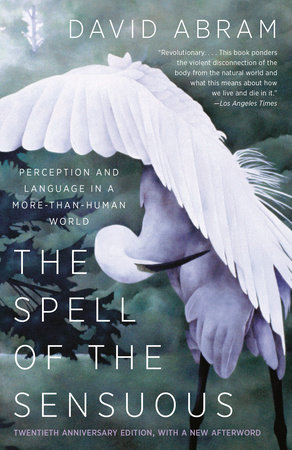
David Abram, The Spell of the Sensuous: Perception and Language in a More-Than-Human World

I’ve been meaning to read ecologist and philosopher David Abram’s book The Spell of the Sensuous: Perception and Language in a More-Than-Human World for quite a while, but when I learned that he is the originator of the term “more-than-human,” I decided to tackle his book sooner rather than later. The fact that Robin Wall Kimmerer mentions him in Braiding Sweetgrass also encouraged me to turn to this book. It’s become something of a classic, and if (as I suspect) it relies on phenomenology as a theoretical basis, it could turn out to be very useful for my research. And even if it doesn’t, because it’s a classic, I still should read it.

The book’s preface begins with relationships. “Humans are tuned for relationship,” Abram writes. “They eyes, the skin, the tongue, ears, and nostrils—all are gates where our body receives the nourishment of others. This landscape of shadowed voices, these feathered bodies and antlers and tumbling streams—these breathing shapes are our family, the beings with whom we are engaged, with whom we struggle and suffer and celebrate” (ix). Abram echoes what I understand to be Indigenous ways of thinking about kinship with other species here in poetic prose:

For the largest part of our species’ existence, humans have negotiated relationships with every aspect of the sensuous surroundings, exchanging possibilities with every flapping form, with each textured surface and shivering entity that we happened to focus upon. All could speak, articulating in gesture and whistle and sigh a shifting web of meanings that we felt on our skin or inhaled through our nostrils or focused with our listening ears, and to which we replied—whether with sounds, or through movements, or minute shifts of mood. (ix)

I’m surprised to find Abram echoing Jon Young’s book about bird language, or perhaps the reverse is true—or perhaps Young is studying one concrete aspect of Abram’s general point. “Every sound was a voice, every scrape or blunder was a meeting—with Thunder, with Oak, with Dragonfly,” he continues. “And from all of these relationships our collective sensibilities were nourished” (ix).

But things have changed. “Today we participate almost exclusively with other humans and with our human-made technologies,” Abram continues. “It is a precarious situation, given our age-old reciprocity with the many-voiced landscape. We still need that which is other than ourselves and our own creations” (ix). This book’s “simple premise” is “that we are human only in contact, and conviviality, with what is not human” (ix). That doesn’t mean we must renounce our technologies, but “it does imply that we must renew our acquaintance with the sensuous world in which our techniques and technologies are all rooted” (ix-x). We need forests and gravity and rivers to give us “distance from our technologies,” so that we can assess their limitations and “keep ourselves from turning into them” (x). “We need to know the textures, the rhythms and tastes of the bodily world, and to distinguish readily between such tastes and those of our own invention,” Abram writes. “Direct sensuous reality, in all its more-than-human mystery, remains the sold solid touchstone for an experiential world now inundated with electronically-generated vistas and engineered pleasures; only in regular contact with the tangible ground and sky can we learn how to orient and to navigate in the multiple dimensions that now claim us” (x).

Abram had two goals in writing the book. The first was “to provide a set of powerful conceptual tools for my colleagues in the broad world of environmental activism” who are “already struggling to make sense of, and to alleviate, our current estrangement from the animate earth” (x). But he also wants “to provoke some new thinking within the institutional realm of scholars, scientists, and educators—many of whom have been strangely silent in response to the rapid deterioration of wild nature, the steady vanishing of other species, and the consequent flattening of our human relationships” (x). Because of these two goals, he has “tried to maintain a high standard of theoretical and scholarly precision, without, however, masking the passion, the puzzlement, and the pleasure that flow from my own engagement with the living land” (x). So there are two introductions to the book, one personal and one technical (x). The technical chapter is about phenomenology—“the study of direct experience”—which suggests “that the human mind was thoroughly dependent upon (and thoroughly influenced by) our forgotten relation with the encompassing earth” (xi). Perhaps this book, among other things, will function as a kind of introduction to Maurice Merleau-Ponty’s work, some of which I think I’m obligated to read for this project.

The book’s first chapter, “The Ecology of Magic: A Personal Introduction to the Inquiry,” begins with Abram standing in the middle of rice paddies late at night in eastern Bali. The stars were reflected in the water: 

I was no longer simply beneath the night sky, but also above it—the immediate impression was one of weightlessness. I might have been able to reorient myself, to regain some sense of ground and gravity, were it not for a fact that confounded my senses entirely: between the constellations below and the constellations above drifted countless fireflies, their lights flickering like the stars, some drifting up to join the clusters of stars overhead, others, like graceful meteors, slipping down from above to join the constellations underfoot, and all these paths of light upward and downward were mirrored, as well, in the still surface of the paddies. I felt myself at times falling through space, at other moments floating and drifting. I simply could not dispel the profound vertigo and giddiness: the paths of the fireflies, and their reflections in the water’s surface, held me in a sustained trance. (4)

This experience was his introduction to the world of insects, and “the great influence that insects—such diminutive entities—could have on the human senses” (4). He was in Indonesia studying the relation between magic and medicine, and he was there not as an anthropologist or academic researcher, but as a magician in his own right; he had paid for college by performing as a magician throughout New England (4). He had studied the use of sleight-of-hand magic in psychotherapy, and had learned that magic might “lend itself well to the curative arts,” and for the first time had become interested in the relation between folk medicine and magic (4-5). 

But the focus of Abram’s research shifted “from questions regarding the application of magical techniques in medicine and ritual curing toward a deeper pondering of the relation between traditional magic and the animate natural world” (5). Villagers in Indonesia and Nepal believed that sorcerers could cause the very maladies they were curing, although Abram never say any evidence of that happening (5-6). Still, the magicians and healers did nothing to contradict those rumours, which enabled them to maintain a basic level of privacy: “the sorcerer ensured that only those who were in real and profound need of his skills would dare to approach him for help” (6). “This privacy, in turn, left the magician free to attend to what he acknowledged to be his primary craft and function,” Abram continues: “For the magician’s intelligence is not encompassed within the society; its place is at the edge of the community, mediating between the human community and the larger community of beings upon which the village depends for its nourishment and sustenance” (6). That community includes “the multiple nonhuman entities that constitute the local landscape, from the diverse plants and the myriad animals—birds, mammals fish, reptiles, insects—that inhabit or migrate through the region, to the particular winds that inform the local geography, as well as the various landforms—forests, rivers, caves, mountains—that lend their specific character to the surrounding earth” (6-7). 

Abram realizes that the shaman “acts as an intermediary between the human community and the larger ecological field, ensuring that there is an appropriate flow of nourishment, not just from the landscape to the human inhabitants, but from the human community back to the local earth” (7). Through ritual and ceremony, the shaman “ensures that the relation between human society and the larger society of beings is balanced and reciprocal, and that the village never takes more from the living land than it returns to it—not just materially but with prayers, propitiations, and praise” (7). To some extent this is the responsibility of every adult in the community, but “the shaman or sorcerer is the exemplary voyager in the intermediate realm between the human and the more-than-human worlds, the primary strategist and negotiator in any dealings with the Others” (7). It is through this engagement “with the animate powers that dwell beyond the human community” that the traditional magician can “alleviate many individual illnesses that arise within that community” (7). The ability to cure these ailments comes from this “more continuous practice of ‘healing’ or balancing the community’s relation to the surrounding land” (7). Disease in these cultures is usually thought of as an imbalance within the body of the sick person, but “such destructive influences within the human community are commonly traceable to a disequilibrium between that community and the larger field of forces in which it is embedded” (7). “Only those persons who, by their everyday practice, are involved in monitoring and maintaining the relations between the human village and the animate landscape are able to appropriately diagnose, treat, and ultimately relieve personal ailments and illnesses arising within the village,” Abrams writes (7-8). Thus the traditional magician or medicine person is primarily an intermediary between human and more-than-human worlds, and only secondarily a healer (8). “The medicine person’s primary allegiance, then, is not to the human community, but to the earthly web of relations in which that community is embedded—it is from this that his or her power to alleviate human illness derives—and this sets the local magician apart from other persons,” Abrams contends (8).

This point is often missed by Western anthropologists who assume that the natural world is determinate and mechanical, and who therefore see the sorcerer as dealing with supernatural entities (8). But, Abram argues, 

that which is regarded with the greatest awe and wonder by indigenous, oral cultures is . . . none other than what we view as nature itself. The deeply mysterious powers and entities with whom the shaman enters into a rapport are ultimately the same forces—the same plants, animals, forests, and winds—that to literate, “civilized” Europeans are just so much scenery, the pleasant backdrop of our more pressing human concerns. (9)

In such cultures, people “experience their own consciousness as simply one form of awareness among many others” (9). “Only by temporarily shedding the accepted perceptual logic of his culture can the sorcerer hope to enter into relation with other species on their own terms; only by altering the common organization of his senses will he be able to enter into a rapport with the multiple nonhuman sensibilities that animate the local landscape,” Abram continues (9). That ability defines the shaman’s powers: he or she must be able “to readily slip out of the perceptual boundaries that demarcate his or her particular culture” and “make contact with, and learn from, the other powers in the land. His magic is precisely this heightened receptivity to the meaningful solicitations—songs, cries, gestures—of the larger, more-than-human field” (9).

“Magic, then, in its perhaps most primordial sense, is the experience of existing in a world made up of multiple intelligences, the intuition that every form one perceives—from the swallow swooping overhead to the fly on a blade of grass, and indeed the blade of grass itself—is an experiencing form, an entity with its own predilections and sensations, albeit sensations that are very different from our own,” Abram writes (9-10). That ecological function isn’t always obvious, but we shouldn’t dismiss the dimensions into which the shaman sends his or her awareness as “supernatural” or “internal” to his or her psyche—“For it is likely that the ‘inner world’ of our Western psychological experience, like the supernatural heaven of Christian belief, originates in the loss of our ancestral reciprocity with the animate earth” (10). “When the animate powers that surround us are suddenly construed as having less significance than ourselves, when the generative earth is abruptly defined as a determinate object devoid of its own sensations and feelings,” Abram explains, “then the sense of a wild and multiplicitous otherness (in relation to which human existence has always oriented itself) must migrate, either into a supersensory heaven beyond the natural world, or else into the human skull itself—the only allowable refuge, in this world, for what is ineffable and unfathomable” (10). I wonder if that’s completely accurate—surely one can have individual psychology without losing a sense of the infinite complexity of the natural world. 

But perhaps Abram is going beyond infinite complexity: “in genuinely oral, indigenous cultures, the sensuous world itself remains the dwelling place of the gods, of the numinous powers that can either sustain or extinguish human life” (10). The shaman propels his awareness laterally, “outward into the depths of a landscape at once both sensuous and psychological, the living dream that we share with the soaring hawk, the spider, and the stone silently sprouting lichens on its coarse surface” (10). We need to pay attention the the shaman’s prayers and rituals, “the daily propitiations and praise that flow from her toward the land and its many voices” (11).

All of this came to Abram slowly during his stay in Bali. In one home, his hosts left food for the spirits of the family compound (11). The food was eaten by ants (12). Were these insects “the very ‘household spirits’ to whom the offerings were being made?” (12). He realized the logic of the practice: it kept the ants from infesting the rest of the compound, establishing “certain boundaries between the human and ant communities,” and “by honoring this boundary with gifts, the humans apparently hoped to persuade the insects to respect the boundary and not enter the buildings” (13). But Abram was puzzled by his hosts’ assertion that the offerings were for spirits: “my encounter with the ants was the first of many experiences suggesting to me that the ‘spirits’ of an indigenous culture are primarily those modes of intelligence or awareness that do not possess a human form,” rather than a Western, anthropomorphic or human version of spirit (13).

“As humans, we are well acquainted with the needs and capacities of the human body—we live in our own bodies and so know, from within, the possibilities of our form,” Abrams continues. “We cannot know, with the same familiarity and intimacy, the lived experience of a grass snake or a snapping turtle; we cannot readily experience the precise sensations of a hummingbird sipping nectar from a flower or a rubber tree soaking up sunlight” (13-14). While our experience may “be a variant of these other modes of sensitivity,” we cannot “precisely experience the living sensations of another form” (14). “We do not know, with full clarity, their desires or motivations; we cannot know, or can never be sure that we know, what they know,” he states (14). To us, other species “are purveyors of secrets, carries of intelligence that we ourselves often need: it is these Others who can inform us of unseasonable changes in the weather, or warn us of imminent eruptions and earthquakes, who show us, when foraging, where we might find the ripest berries or the best route to follow back home” (14). We learn from these other species, and we receive from them gifts of food, fuel, shelter, and clothing, and yet “they remain Other to us, inhabiting their own cultures and displaying their own rituals, never wholly fathomable” (14). In addition, in Indigenous cultures “it is not only those entities acknowledged by Western civilization as ‘alive,’” but also the rivers, the rains, the stones, the mountains (14). 

The worship of ancestors in oral cultures is related to more-than-human species and the “enveloping landscape” (15). Our bodies—“whether human or otherwise”—are not mechanical objects, but rather they are magical entities, “the mind’s own sensuous aspect,” and at death their “decomposition into soil, worms, and dust can only signify the gradual reintegration of one’s ancestors and elders into the living landscape, from which all, too, are born” (15). “Each indigenous culture elaborates this recognition of metamorphosis in its own fashion, taking its clues from the particular terrain in which it is situated,” Abram continues (15). “‘Ancestor worship,’ in its myriad forms, then, is ultimately another mode of attentiveness to nonhuman nature; it signifies not so much an awe or reverence of human powers, but rather a reverence for those forms that awareness takes when it is not in human form, when the familiar human embodiment dies and decays to become part of the encompassing cosmos,” he states (16). Thus other species or “forms of experience” are “never absolutely alien to ourselves. Despite the obvious differences in shape, and ability, and style of being, they remain at least distantly familiar, even familial. It is, paradoxically, this received kinship or consanguinity that renders the difference or otherness, so eerily potent” (16).

In a cave on Bali, Abram watches multiple spiders making webs, entranced by the “ever-complexifying expanse of living patterns upon patterns” (19). He writes that since then, he has never encountered a spider “without feeling a great strangeness and awe” (19). Those spiders were his introduction to the spirits, “the the magic afoot in the land” (19). “It was from them that I first learned of the intelligence that lurks in nonhuman nature, the ability that an alien form of sentience has to echo one’s own, to instill a reverberation in oneself that temporarily shatters habitual ways of seeing and feeling, leaving one open to a world all alive, awake, and aware,” he writes. “It was from such small beings that my senses first learned of the countless worlds within worlds that spin in the depths of this world that we commonly inhabit, and from them that I first learned that my body could, with practice, enter sensorially into these dimensions” (19). He notes that insects brought him the “long and cyclical trance that we call malaria” as well (20). 

“I had rarely before paid much attention to the natural world,” Abram writes. “But my exposure to traditional magicians and seers was shifting my senses; I became increasingly susceptible to the solicitations of nonhuman things” (20). He began seeing and hearing differently: “When a magician spoke of a power or ‘presence’ lingering in the corner of his house, I learned to notice the ray of sunlight that was then pouring through a chink in the roof, illuminating a column of drifting dust, and to realize that the column of light was indeed a power, influencing the air currents by its warmth, and indeed influencing the whole mood of the room” (20). He began to listen to bird song as a form of speech, “responding to and commenting on events in the surrounding earth” (20). He became a student of subtle differences: “Walking along the dirt paths, I learned to slow my pace in order to feel the difference between one nearby hill and the next, or to taste the presence of a particular field at a certain time of day when, as I had been told by a local dukun, the place had a special power and proffered unique gifts” (20). That power was communicated to his senses by shadows and smells and other things he “could only isolate after many days of stopping and listening” (20). He began encountering animals—monkeys and lizards—and his body seemed able to communicate with them, as if “motivated by a wisdom older than my thinking mind, as though it was held and moved by a logos, deeper than words, spoken by the Other’s body, the trees, and the stony ground on which we stood” (21). 

Abram suggests that our inability to discern the shaman’s allegiance to the more-than-human world is a fundamental misunderstanding (21). Our society, with its massive scale and economic centralization, “can hardly be seen in relation to any particular landscape or ecosystem; the more-than-human ecology with which it is directly engaged is the biosphere itself” (21-22). Our relationship with that biosphere is hardly reciprocal or balanced; we are destroying the biosphere (22). From an animistic perspective, that destruction is the cause of our culture’s physical and psychological distress (22). “Caught up in a mass of abstractions, our attention hypnotized by a host of human-made technologies that only reflect us back to ourselves, it is all too easy for us to forget our carnal inherence in a more-than-human matrix of sensations and sensibilities,” Abram writes. “Our bodies have formed themselves in delicate reciprocity with the manifold textures, sounds, and shapes of an animate earth—our eyes have evolved in subtle interaction with other eyes, as our ears are attuned by their very structure to the howling of wolves and the honking of geese” (22). Shutting ourselves off from these voices “is to rob our own sense of their integrity, and to rob our minds of their coherence. We are human only in contact, and conviviality, with what is not human” (22). 

In Nepal, Abram learned about birds. In the Himalayas, “those who dwell and soar in the sky are the primary powers. They alone move easily in such a zone, swooping downward to become a speck near the valley floor, or spiraling into the heights on invisible currents” (23). When he returned to the United States, he writes, “I was excited by the new sensibilities that had stirred in me—my newfound awareness of a more-than-human world, of the great potency of the land, and particularly of the keen intelligence of other animals, large and small, whose lives and cultures interpenetrate our own” (24). He surprised his neighbours by chattering with squirrels or watching herons fishing for hours (24-25). But gradually he began to lose his sense of the animals’ awareness, observing the animals from outside their worlds, not feeling the heron’s “tensed yet poised alertness” with his own muscles (25). “As the expressive and sentient landscape slowly faded behind my more exclusively human concerns, threatening to become little more than illusion or fantasy, I began to feel—particularly in my chest and abdomen—as though I were being cut off from vital sources of nourishment,” he writes. “I was indeed reacclimating to my own culture, becoming more attuned to its styles of discourse and interaction, yet my bodily senses seemed to be losing their acuteness, becoming less awake to subtle changes and patterns” (25-26). His senses were dimming, and “the air seemed thin and void of substance of influence. It was not, here, a sensuous medium—the felt matrix of our breath and the breath of the other animals and plants and soils—but was merely an absence, and indeed was constantly referred to in everyday discourse as mere empty space” (26). 

Abram started to find other ways “of tapping the very different sensations and perceptions” that he had grown used to in Asia (27). “Intermittently, I began to wonder if my culture’s assumptions regarding the lack of awareness in other animals and in the land itself was less a product of careful and judicious reasoning than of a strange inability to clearly perceive other animals—a real inability to clearly see, or focus upon, anything outside the realm of human technology, or to hear as meaningful anything other than human speech,” he writes:

The sad results of our interactions with the rest of nature were being reported in every newspaper—from the depletion of topsoil due to industrial farming techniques to the fouling of groundwater by industrial wastes, from the rapid destruction of ancient forests to, worst of all, the ever-accelerating extinction of our fellow species—and these remarkable and disturbing occurrences, all readily traceable to the ongoing activity of “civilized” humankind, did indeed suggest the possibility that there was a perceptual problem in my culture, that modern, “civilized” humanity simply did not perceive surrounding nature in a clear manner, if we have even been perceiving it at all. (27)

However, his experiences in Indonesia and Nepal had shown him “that nonhuman nature can be perceived and experienced with far more intensity and nuance than is generally acknowledged in the West” (27). “What was it that made possible the heightened sensitivity to extrahuman reality, the profound attentiveness to other species and to the Earth that is evidenced in so many of these cultures, and that had so altered my awareness that my senses now felt stifled and starved by the patterns of my own culture?” he asks (27). Why is the modern West so inattentive (27)? How had we “come to be so exempt from this sensory reciprocity,” “so deaf and blind to the vital existence of other species, and to the animate landscapes they inhabit, that we now so casually bring about their destruction?” (27-28).

For Abram, “our obliviousness to nonhuman nature is today held in place by ways of speaking that simply deny intelligence to other species and to nature in general” (28). “We consciously encounter nonhuman nature only as it has been circumscribed by our civilization and its technologies: through our domesticated pets, on the television, or at the zoo (or, at best, in carefully managed ‘nature preserves’),” he writes:

The plants and animals we consume are neither gathered nor hunted—they are bred and harvested in huge, mechanized farms. “Nature,” it would seem, has become simply a stock of “resources” for human civilization, and so we can hardly be surprised that our civilized eyes and ears are somewhat oblivious to the existence of perspectives that are not human at all, or that a person entering into or returning to the West from a nonindustrial culture would feel startled and confused by the felt absence of nonhuman powers. (28)

But the commodification doesn’t explain the perceptual shift that made it possible to reduce the more-than-human world to an object, “little of the power of the process whereby our senses first relinquished the power of the Other, the vision that for so long had motivated our most sacred rituals, our dances, and our prayers,” Abram continues (28). He asks how we might “catch a glimpse of this process, which has given rise to so many of the habits and linguistic prejudices that now structure our very thinking?” (28). Perhaps, if one were to stand on the edge of our civilization, “like a magician, or like a person who, having lived among another tribe, can no longer wholly return to his own,” it might be possible to become open “to the shifting voices and flapping forms that crawl and hover beyond the mirrored walls of the city,” and perhaps that person might “find the precise clues to the mystery of how those walls were erected, and how a simple boundary became a barrier, only if the moment is timely—only, that is, if the margin he frequents is a temporal as well as a spatial edge, and the temporal structure that it bounds is about to dissolve, or metamorphose, into something else” (29).

The second chapter, “Philosophy on the Way to Ecology,” is subtitled “A Technical Introduction to the Inquiry,” and it begins with a discussion of Edmund Husserl and phenomenology (31). Abrams says that it’s natural to turn to phenomenology “to understand the strange difference between the experienced world, or worlds, of indigenous, vernacular cultures and the world of modern European and North American civilization,” because “phenomenology is the Western philosophical tradition that has most forcefully called into question the modern assumption of a single, wholly determinable, objective reality” (31). That notion comes from René Descartes’s separation of the thinking mind, or subject, from the material world of things, or objects—although Galileo had already made a distinction between objective and subjective properties of matter (31-32). Still, it was only after Descartes “that material reality came to be commonly spoken of as a strictly mechanical realm, as a determinate structure whose laws of operation could be discerned only via mathematical analysis” (32). “By apparently purging material reality of subjective experience,” Descartes “laid the foundation for the construction of the objective or ‘disinterested’ sciences, which by their feverish and forceful investigations have yielded so much of the knowledge and many of the technologies that have today become commonplace in the West” (32). But the objective sciences “overlook our ordinary, everyday experience of the world around us,” which is “necessarily subjective, necessarily relative to our own position or place in the midst of things, to our particular desires, tastes, and concerns” (32). The world in which we find ourselves “is not an inert or mechanical object but a living field, an open and dynamic landscape subject to its own moods and metamorphoses” (32). 

“My life and the world’s life are deeply intertwined,” Abram argues (33). “The world and I reciprocate each other,” he continues (33). That world “is hardly a determinate object; it is an ambiguous realm that responds to my emotions and calls forth feelings from me in turn. Even the most detached scientist must begin and end her study in this indeterminate field of experience” (33). Indeed, that scientist is “drawn to a particular field by a complex of subjective experiences and encounters, many of which unfold far from the laboratory and its rarefied atmosphere,” and he or she “never completely succeeds in making himself into a pure spectator of the world, for he cannot cease to live in the world as a human among other humans, or as a creature among other creatures, and his scientific concepts and theories necessarily borrow aspects of their character and texture from his untheorized, spontaneously lived experience” (33). The results of science’s “value-free” investigations “come to display themselves in the open and uncertain field of everyday life, whether embedded in social policies with which we must come to terms or embodied in new technologies with which we must grapple” (33-34). Our spontaneous, emotional, subjective experience of the world “remains the vital and dark ground of all our objectivity” (34).

That ground is not acknowledged by scientific culture, however, and “[t]he fluid realm of direct experience has come to be seen as a secondary, derivative dimension, a mere consequence of events unfolding in the ‘realer’ world of quantifiable and measurable scientific ‘facts,’” as merely subjective, rather than objective (34). For Abram, “[t]he living, feeling, and thinking organism is assumed to derive, somehow, from the mechanical body whose reflexes and ‘systems’ have been measured and mapped, the living person now an epiphenomenon of the anatomized corpse” (34). “That it takes living, sensing subjects, complete with their enigmatic emotions and unpredictable passions, to conceive of those subatomic fields, or to dissect and anatomize the body, is readily overlooked, or brushed aside as inconsequential,” he states (34). This argument is a thorough debunking of positivism, of scientism, but I wonder if science is really that bloodless. Maybe it is—I’m not a scientist and have no first-hand knowledge.

“Nevertheless, the ambiguity of experience is already a part of any phenomenon that draws our attention,” Abram continues. “For whatever we perceive is necessarily entwined with our own subjectivity, already blended with the dynamism of life and experience” (34). That’s particularly true of psychology, he argues, even though that discipline models itself on the positivism of the “hard” sciences (34-35). “Here as elsewhere,” he states, “the everyday world—the world of our direct, spontaneous experience—is still assumed to derive from an impersonal, objective dimension of pure ‘facts’ that we glimpse only through our instruments and equations” (35).

Edmund Husserl inaugurated the philosophical discipline of phenomenology because he was frustrated with such assumptions, particularly in the early discipline of psychology (35). Phenomenology “would turn toward ‘the things themselves,’ toward the world as it is experienced in its felt immediacy” (35). It would “describe as closely as possible the way the world makes itself evident to awareness, the way things first arise in our direct, sensorial experience,” and by doing so, it “would articulate the ground of the other sciences” and establish them at last “upon a firm footing—not, perhaps, as solid as the fixed and finished ‘object’ upon which those sciences pretend to stand, but the only basis possible for a knowledge that necessarily emerges from our lived experience of the things around us” (35-36). Abram gives us a long quotation from Maurice Merleau-Ponty’s Phenomenology of Perception here: it runs, in part, “To return to things themselves is to return to that world which precedes knowledge, of which knowledge always speaks, and in relation to which every scientific schematization is an abstract and derivative sign-language, as is geography in relation to the countryside in which we have learnt beforehand what a forest, a prairie or a river is” (qtd. 36).

For Husserl, the world of experience, or the “phenomenal” world, is “a thoroughly subjective realm,” a “wholly mental dimension, an immaterial field of appearances” which is experienced by a self or subject that is “a pure consciousness, a ‘transcendental’ mind or ego” (36). That characterization led critics to attack his method as being solipsistic, locking philosophers inside their own solitary experiences, their own minds (37). Husserl struggled to answer this criticism: “How does our subjective experience enable us to recognize the reality of other selves, other experiencing beings?” (37). According to Abram, the solution implicated the body—both one’s own and that of others—“as a singularly important structure within the phenomenal field” (37). One’s own body is experienced from within, but those of others are experienced from the outside; nevertheless, “[t]he gestures and expressions of these other bodies, viewed from without, echo and resonate one’s own bodily movements and gestures, experienced from within. By an associative ‘empathy,’ the embodied subject comes to recognize these other bodies as other centers of experience, other subjects” (37). In this way, “[t]he field of appearances, while still a thoroughly subjective realm, was now seen to be inhabited by multiple subjectivities; the phenomenal field was no longer the isolate haunt of a solitary ego, but a collective landscape, constituted by other experiencing subjects as well as by oneself” (37). There are two regions of the experiential or phenomenal field: images that arise within the body—dreams and fantasies—but also phenomena that are “responded to and experienced by other embodied subjects as well as by myself” (38). Those phenomena are still subjective, since they appear through experience—but they cannot be altered or dissipated at will (like dreams or fantasies), “for they seem to be buttressed by many involvements besides my own” (38). In this way, “they are intersubjective phenomena—phenomena experienced by a multitude of sensing subjects” (38).

“Husserl’s notion of intersubjectivity suggested a remarkable new interpretation of the so-called ‘objective world,’” Abram writes. “For the conventional contrast between ‘subjective’ and ‘objective’ realities could now be framed as a contrast between the subjective field of experience itself—as the felt contrast between subjective and intersubjective phenomena” (38). For Husserl, the scientific method was about intersubjectivity, not objectivity—about reaching a consensus among a group of subjects, rather than avoiding subjectivity altogether (38). Objectivity was merely a theoretical construction, “an unwarranted idealization of intersubjective experience” (38). The world is “an intertwined matrix of sensations and perceptions, a collective field of experience lived through from many different angles” (39). We might experience the phenomenal world as stable and solid, but that “experienced solidity is precisely sustained by the continual encounter with others, with other embodied subjects, other centers of experience” (39). We intuit that things are more than what we directly see of them, that they existed before we looked at them and will not disappear when we stop looking at them, “since it remains an experience for others—not just for other persons, but . . . for other sentient organisms,” for the birds that nest in a tree’s branches and the insects that climb its bark and even the tissues of the tree itself (39). “It is this informing of my perceptions by the evident perceptions and sensations of other bodily entities that establishes, for me, the relative solidity and stability of the world,” Abram writes (39).

Husserl’s “growing recognition of intersubjective experience, and of the body’s importance for such experience, ultimately led him to recognize a more primary, corporeal dimension midway between the transcendental ‘consciousness’ of his earlier analyses and the utterly subjective ‘matter’ assumed by the natural sciences,” Abram continues. “This was the intersubjective world of life, the Lebenswelt, or ‘life-world’” (40). According to Abram, the life-world “is the world of our immediately lived experience as we live it, prior to all our thoughts about it” (40). It is not private, but collective—“the common field of our lives and the other lives with which we are entwined”—but it is also “profoundly ambiguous and indeterminate, since our experience of this field is always relative to our situation within it” (40). “The life-world is thus the world as we organically experience it in its enigmatic multiplicity and open-endedness, prior to conceptually freezing it into a static space of ‘facts’”—or even prior to any kind of complete conceptualizing (40). The life-world is “peripherally present in any thought or activity we undertake,” but when we attempt to explain that world conceptually, “we seem to forget our active participation within it” (40). “Striving to represent the world, we inevitably forfeit its direct presence,” Abram writes. “It was Husserl’s genius to realize that the assumption of objectivity had led to an almost total eclipse of the life-world in the modern era, to a nearly complete forgetting of this living dimension in which all our endeavors are rooted” (40-41). This separation between science and technical discourses and “the sensuous world of our ordinary engagements” led, for Husserl, “to a clear crisis in European civilization,” because science and technical discourses “were beginning to blindly overrun the experiential world—even, in their errancy, threatening to obliterate the world-of-life entirely” (41). 

Abram believes that it ought to be evident that the life-world may be different for different cultures—that it is deeply influenced by the way members of other cultures live and engage the life-world (41). “Even the scientifically disclosed ‘objective universe’ of contemporary Western civilization cannot genuinely be separated from the particular institutions, technologies, and ways of life endemic to this society since the seventeenth century,” he writes (41). If human life-worlds are diverse, how much more diverse must be the life-worlds of wolves, or owls, or bees in a hive, he suggests, although he acknowledges that “there are basic structures of the life-world that are shared, elements that are common to different cultures and even, we may suggest, to different species” (41). Husserl suggests that “underneath the layer of the diverse cultural life-worlds there reposes a deeper, more unitary life-world,” which “supports and sustains all our diverse and discontinuous worldviews” (41-42). The earth, which for Husserl is space itself, or at least our perception of space, is that unitary life-world (42). He even suggests that the Copernican revolution was incorrect, because we perceive the earth as stable and the sun as rotating around it (42-43). Husserl also contends that the earth is at the heart of our notions of time and space (43). The earth is thus “the secret depth of the life-world,” “the most unfathomable region of experience, and enigma that exceeds the structurations of any particular culture or language,” the “art of the world,” “the common ‘root basis’ of all relative life-worlds” (43). According to Abram, these insights “into the importance of the earth for all human cognition” had “profound implications for the subsequent unfolding of phenomenological philosophy” (43). Husserl wasn’t rejecting science; instead, he was asking science to “acknowledge that it is rooted in the same world that we all engage in our everyday lives and with our unaided senses,” and that “quantitative science remains an expression of, and hence must be guided by, the qualitative world of our common experience” (43). Phenomenology’s task is to demonstrate how “every theoretical and scientific practice grows out of and remains supported by the forgotten ground of our directly felt and lived experience, and has value and meaning only in reference to this primordial and open realm” (43). 

Here, Abram says that the work of Maurice Merleau-Ponty shows “how Husserl’s legacy was taken up and transformed in a manner that endowed this philosophy with a particular power and relevance for the ecological questions that now confront us” (44). Merleau-Ponty “set out to radicalize Husserl’s phenomenology” by clarifying its inconsistencies and “by disclosing a more eloquent way of speaking” that “might itself draw us into the sensuous depths of the life-world” (44). First, while the body was central to Husserl’s attempt at avoiding solipsism, and our insertion into “the common, or intersubjective, field of experience,” it remained a mere appearance in Husserl’s thinking (44-45). It was still “a transcendental ego, ultimately separable for the phenomena (including the body) that it posits and ponders,” Abram writes. “It is precisely this lingering assumption of a self-subsistent, disembodied, transcendental ego that Merleau-Ponty rejects” (45). Instead, the subject, for Merleau-Ponty, the “experiencing ‘self,’” is “the bodily organism” (45). This, Abram says, is “a radical move,” since most of us are used to thinking about the self, “our innermost essence,” as something incorporeal (45). But our selves are situated in, and dependent on, our bodies, our sense organs (45). “The living body is thus the very possibility of contact, not just with others but with oneself—the very possibility of reflection, of thought, of knowledge,” Abram contends. “The common notion of the experiencing self, or mind, as an immaterial phantom ultimately independent of the body can only be a mirage:  Merleau-Ponty invites us to recognize, at the heart of even our most abstract cogitations, the sensuous and sentient life of the body itself” (45). The living, animate, attentive body, which Merleau-Ponty called the “bodily subject,” is the power we have to look at something, or to turn and look at something else, to walk on the ground and breathe in the air (46). 

“Yet ‘I’ do not deploy these powers like a commander piloting a ship, for I am, in my depths, indistinguishable from them,” Abram writes (46). Acknowledging that I am a body doesn’t “reduce the mystery of my yearnings and fluid thoughts to a set of mechanisms, or my ‘self’ to a determinate robot,” but rather “it is to affirm the uncanniness of this physical form” (46). Nor does it lock our awareness within a closed and bounded object, because the boundaries of a living body “are open and indeterminate; more like membranes than barriers, they define a surface of metamorphosis and exchange” (46). It is difficult to define where our bodies begin and where they end; considered phenomenologically—“that is, as we actually experience and live it—the body is a creative, shape-shifting entity” (46-47). Our “finite bodily presence” is our “very means of entering into relation with all things” (47). Because the body is “the very subject of awareness,” Merleau-Ponty suggests that philosophy can’t provide a complete picture of reality (which would require a perspective outside of existence, which is impossible), but this move does open “the possibility of a truly authentic phenomenology, a philosophy which would strive, not to explain the world as if from outside, but to give voice to the world from our experienced situation within it, recalling us to our participation in the here-and-now, rejuvenating our sense of wonder at the fathomless things, events and powers that surround us on every hand” (47). 

“Ultimately, to acknowledge the life of the body, and to affirm our solidarity with this physical form, is to acknowledge our existence as one of the earth’s animals, and so to remember and rejuvenate the organic basis of our thoughts and our intelligence,” Abram writes (47). This runs against the central current of the Western philosophical tradition, which separates mind from body (47). Descartes even denied other organisms the ability to feel pleasure or pain (48). These arguments for human uniqueness “have regularly been utilized by human groups to justify the exploitation not just of other organisms, but of other humans as well (other nations, other races, or simply the ‘other’ sex); armed with such arguments, one had only to demonstrate that these others were not fully human, or were ‘closer to the animals,’ in order to establish one’s right of dominion” (48). But those hierarchies are undone “by any phenomenology that takes seriously our immediate sensory experience. For our senses disclose to use a wild-flowering proliferation of entities and elements, in which humans are thoroughly immersed,” since “we find ourselves in the midst of, rather than on top of, this order” (48-49). “Does the human intellect, or ‘reason,’ really spring us free from our inherence in the depths of this wild proliferation of forms?” Abram asks. “Or on the contrary, is the human intellect rooted in, and secretly borne by, our forgotten contact with the multiple nonhuman shapes that surround us?” (49).

“For Merleau-Ponty, all of the creativity and free-ranging mobility that we have come to associate with the human intellect is, in truth, an elaboration, or recapitulation, of a profound creativity already underway at the most immediate level of sensory perception,” Abram continues. “The sensing body is not a programmed machine but an active and open form, continually improvising its relation to things and to the world. The body’s actions and engagements are never wholly determinate, since they must ceaselessly adjust themselves to a world and a terrain that is itself continually shifting” (49). One sign of the body’s indeterminacy is our ability to be surprised or startled—they show that not everything has been anticipated by our programming (49). Even our experiences, or perception, is “the constant thwarting of such closure” (49). A spider’s ability to make a web might be genetically programmed, but those instructions “can hardly predict the specifics of the microterrain within which the spider may find itself at any particular moment” (50). For that reason, “the genome could not explicitly have commanded the order of every flexion and extension of her various limbs as she weaves this web into its place” (50). Her genetic programming still needs to “be woven into the present, an activity that necessarily involves both a receptivity to the specific shapes and textures of that present and a spontaneous creativity in adjusting oneself (and one’s inheritance) to those contours” (50). For Abram, and Merleau-Ponty, “this open activity, this dynamic blend of receptivity and creativity by which every animate organism necessarily orients itself to the world (and orients the world around itself) is what is meant by “perception” (50).

Like the spider, we have bodies, with a genetic inheritance and an evolutionary history, but the human body “is also our insertion in a world that exceeds our grasp in every direction, our means of contact with things and lives that are still unfolding, open and indeterminate, all around us” (50). Nothing we perceive is determinate, because “each entity that my body sees, presents some face or facet of itself to my gaze while withholding other aspects from view” (50). Abram’s example is a clay bowl: we can only see one side at a time, and if we look at the outside, we will miss the inside, but we still know that these other dimensions exist, even if they are not immediately accessible (51). In addition, “the bowl is a temporal being, an entity shifting and changing in time, although the rhythm of its changes may be far slower than my own,” and as temporal entities, we change every time we return to that bowl (51). Every other object is the same (52). And all of those objects reciprocate our attention: 

When my body thus responds to the mute solicitation of another being, that being responds in turn, disclosing to my senses some new aspect or dimension that in turn invites further exploration. By this process my sensing body gradually attunes itself to the style of this other presence—to the way of this stone, or tree, or table—as the other seems to adjust itself to my own style and sensitivity. In this manner the simplest thing may become a world for me, as, conversely, the thing or being comes to take its place more deeply in my world. (52)

“Perception, in Merleau-Ponty’s work, is precisely this reciprocity, the ongoing interchange between my body and the entities that surround it,” a “silent conversation” that we carry on with things, “a continuous dialogue that unfolds far below my verbal awareness” and indeed independent of that awareness, as when “my legs, hiking, continually attune and adjust themselves to the varying steepness of the mountain slopes . . . without my verbal consciousness needing to direct those adjustments” (52-53). “Whenever I quiet the persistent chatter of words within my head, I find this silent or wordless dance always already going on,” Abram continues—“this improvised duet between my animal body and the fluid, breathing landscape that it inhabits” (53).

“Where does perception originate?” Abram asks (53). Not in the thing perceived, which will be perceived differently by other beings (a bee sees a flower differently than a human does), or in our own heads, since “without the actual existence of this other entity,” of a flower, for instance, there would be nothing to perceive (53). For Merleau-Ponty, neither the perceiver nor the perceived “is wholly passive in the event of perception” (53). The sensible solicits our bodies, and our bodies question the sensible, “a reciprocal encroachment” (54). In the act of perception, Abram explains, 

I enter into a sympathetic relation with the perceived, which is possible only because neither my body nor the sensible exists outside the flux of time, and so each has its own dynamism, its own pulsation and style. Perception, in this sense, is an attunement or synchronization between my own rhythms and the rhythms of the things themselves, their own tones and textures. (54)

Merleau-Ponty consistently writes of “the sensible thing, commonly considered by our philosophical tradition to be passive and inert,” in “the active voice,” giving it, grammatically, agency and action, treating it as an animate thing, “and, in some curious manner, alive” (55). “Are such animistic turns of phrase to be attributed simply to some sort of poetic license that Merleau-Ponty has introduced into his philosophy?” Abram asks (55-56). No, he replies: 

Merleau-Ponty writes of the perceived things as entities, of sensible qualities as powers, and of the sensible itself as a field of animate presences, in order to acknowledge and underscore their active, dynamic contribution to perceptual experience. To describe the animate life of particular things is simply the most precise and parsimonious way to articulate the things as we spontaneously experience them, prior to our conceptualizations and definitions. (56)

For Merleau-Ponty, or “most immediate experience of things” is “necessarily an experience of reciprocal encounter—of tension, communication, and commingling” (56). In the depths of that encounter, we experience the sensible thing as an interlocutor, “as a dynamic presence that confronts us and draws us into relation” (56). “To define the other being as an inert or passive object is to deny its ability to actively engage us and to provoke our senses; we thus block our perceptual reciprocity with that being,” Abram writes, and “we cut our conscious, speaking selves off from the spontaneous life of our sensing bodies” (56). We cannot “avoid speaking of the phenomenon as an active, animate entity with which we find ourselves engaged” if “we wish to describe a particular phenomenon without repressing our direct experience” (56). That’s why Merleau-Ponty uses the active voice: “To the sensing body, no thing presents itself as utterly passive or inert. Only by affirming the animateness of perceived things do we allow our words to emerge directly from the depths of our ongoing reciprocity with the world” (56). 

Abram borrows the term “participation” from the French anthropologist Lucien Lévy-Bruhl “to characterize the event of perception” (57). Lévy-Bruhl used participation to characterize the way Indigenous peoples thought stones or mountains were alive, and the way that “particular places and persons and powers may all be felt to participate in one another’s existence, influencing each other and being influenced in turn” (57). For Merleau-Ponty, “participation is a defining attribute of perception itself”: “perception always involves, at its most intimate level, the experience of an active interplay, or coupling, between the perceiving body and that which it perceives” (57). Abram contends that “at the level of our spontaneous, sensorial engagement with the world around us, we are all animists” (57). 

Abram uses the analogy of sleight-of-hand magic to explain this claim. The magician “uses his sleights to enhance the animation of the object,” creating “ambiguous gaps and lacunae” in its visible trajectory, which are filled by spectators with impossible events, “and it is this spontaneous involvement of the spectators’ own senses” that allows the object to appear and reappear or pass through the magician’s hand (57-58). The spectators’ imagination “is not a separate mental faculty,” but instead is “the way the senses themselves have of throwing themselves beyond what is immediately given, in order to make tentative contact with the other sides of things that we do not sense directly, with the hidden or invisible aspects of the sensible” (58). “In truth, since the act of perception is always open-ended and unfinished, we are never wholly locked into any particular instance of participation,” Abram continues (59). We can turn our attention elsewhere, for instance, but we are only substituting one participation for another, rather than suspending “the flux of participation itself” (59).

Perception is “the concerted activity of all the body’s senses as they function and flourish together” (59). For Abram, the various senses are blended together in the act of participation: Merleau-Ponty argues that “our primordial, preconceptual experience . . . is inherently synaesthetic,” and that only seems surprising because “we have become estranged from our direct experience (and hence from our primordial contact with the entities and elements that surround us” (60). That doesn’t mean that the senses are not “distinct modalities,” but rather “[i]t is to assert that they are divergent modalities of a single and unitary living body, that they are complementary powers evolved in complex interdependence with one another. Each sense is a unique modality of this body’s existence, yet in the activity of perception these divergent modalities necessarily intercommunicate and overlap” (61). Our senses, “diverging as they do from a single, coherent body, coherently converge . . . in the perceived thing,” in the same way that our eyes converge upon the object they perceive “and convene there into a single focus” (62). “My senses connect up with each other in the things I perceive, or rather each perceived thing gathers my senses together in a coherent way, and it is this that enables me to experience the thing itself as a center of forces, as another nexus of experience, as an Other,” Abram suggests (62). Thus the act of perception involves “a participation between the various sensory systems of the body itself,” which are not separable, “for the intertwining of my body with the things it perceives is effected only through the interweaving of my senses, and vice versa” (62). Our bodies are open circuits that complete themselves “only in things, in others, in the encompassing earth” (62).

Abram suggests that “[w]hen we begin to consciously frequent the wordless dimension of our sensory participations,” human artifacts “begin to exhibit a common style, and so to lose some of their distinctiveness,” while “organic entities” start “to display a new vitality, each coaxing the breathing body into a unique dance” (63). Rocks themselves “seem to speak their own uncanny languages of gesture and shadow, inviting the body and its bones into silent communication” (63). “In contact with the native forms of the earth, one’s senses are slowly energized and awakened, combining and recombining in ever-shifting patterns,” Abram continues (63). Those organic forms are defined by variation, whereas mass-produced artifacts of our industrial civilization reiterate themselves without variation, without surprise (64). However, “our human-made artifacts inevitably retain an element of more-than-human otherness,” an unknowability from the materials of which they are made, even though that “dynamism is stifled within mass-produced structures closed off from the rest of the earth, imprisoned within technologies that plunder the living land,” and without that dynamism, “our animal senses wither even as they support the abstract intellect” (64). “Whenever we assume the position and poise of the human animal—Merleau-Ponty’s body-subject—then the entire material world itself seems to come awake and to speak, yet organic, earth-born entities speak far more eloquently than the rest,” and “we find ourselves alive in a living field of powers far more expressive and diverse than the strictly human sphere to which we are accustomed” (65). I’m not sure I agree with Abram here: I’ve been surprised by things made by humans.

“So the recuperation of the incarnate, sensorial dimension of experience brings with it a recuperation of the living landscape in which we are corporeally embedded,” Abram continues. “As we return to our senses, we gradually discover our sensory perceptions to be simply our part in a vast, interpenetrating webwork of perceptions and sensations born by countless other bodies” (65). This is the biosphere “as it is experienced and lived from within by the intelligent body,” rather than the biosphere as a “complex assemblage of planetary mechanisms” (65). It is the biosphere as experienced by “the attentive human animal who is entirely a part of the world that he, or she, experiences” (65). 

In his last, unfinished book, The Visible and the Invisible, Merleau-Ponty writes of the collective “Flesh,” meaning “both our flesh and ‘the flesh of the world’” (66). “The Flesh is the mysterious tissue or matrix that underlies and gives rise to both the perceiver and the perceived as interdependent aspects of its own spontaneous activity,” Abram explains. “It is the reciprocal presence of the sentient in the sensible and of the sensible in the sentient, a mystery of which we have always, at least tacitly, been aware, since we have never been able to affirm one of these phenomena, the perceivable world or the perceiving self, without implicitly affirming the existence of the other” (66). Abram distinguishes this notion from conventional scientific discourse, which “commonly maintains that subjective experience is ‘caused’ by an objectifiable set of processes in the mechanically determined field of the sensible,” and from New Age spiritualism, which “privileges pure sentience, or subjectivity, in abstraction from sensible matter, and often maintains that material reality is itself an illusory effect caused by an immaterial mind or spirit” (66). By prioritizing either the sentient or the sensed, these views “perpetuated the distinction between human ‘subjects’ and natural ‘objects,’” and so “neither threatens the common conception of sensible nature as a purely passive dimension suitable for human manipulation and use” (66-67). Both views avoid considering “the possibility that both the perceiving being and the perceived being are of the same stuff, that the perceiver and the perceived are interdependent and in some sense even reversible aspects of a common animate element, or Flesh, that is at once both sensible and sensitive” (67). “Once I acknowledge that my own sentience, or subjectivity, does not preclude my visible, tactile, objective existence for others, I find myself forced to acknowledge that any visible, tangible form that meets my gaze may also be an experiencing subject, sensitive and responsive to the beings around it, and to me,” Abram states (67).

Our hands, according to Merleau-Ponty, can only touch things because they are touchable: “we are ourselves included in the sensible field, and have our own textures, sounds, and tastes. We can perceive things at all only because we ourselves are entirely a part of the sensible world that we perceive” (68). Abram goes as far as to say that “the world is perceiving itself through us” (68). That idea comes from Merleau-Ponty’s claim that “the presence of the world is precisely the presence of its flesh to my flesh” (qtd. 69). All of this brings Merleau-Ponty’s ideas “into startling consonance with the worldviews of many indigenous, oral cultures” (69). For Abram, a new “environmental ethic” may come into being “through a renewed attentiveness to this perceptual dimension that underlies all our logics, through a rejuvenation of our carnal, sensorial empathy with the living land that sustains us” (69). 

Abram suggests that in Indigenous, oral cultures, “language seems to encourage and augment the participatory life of the senses, while in Western civilization language seems to deny or deaden that life, promoting a massive distrust of sensorial experience while valorizing an abstract realm of ideas hidden behind or beyond the sensory appearances” (71-72). For that reason, the next chapter, “The Flesh of Language,” examines what is meant by the word “language.” He intends to pay attention to the mystery of language in order to “develop a conscious familiarity with it, a sense of its texture, its habits, its sources of sustenance” (73). While the exchange of perception is open and indeterminate, it is nevertheless “highly articulate”: it has a coherent structure, embodying “an open-ended logos that we enact from within rather than the abstract logic we deploy from without” (73-74). Merleau-Ponty saw language as “a profoundly carnal phenomenon, rooted in our sensorial experience of each other and of the world” (74). He believed language came out of gesture, and that rather than embodying an arbitrary sign for an emotion or feeling, gesture “is the bodying-forth of that emotion into the world, it is that feeling of delight or of anguish in its tangible, visible aspect” (74). Gestures speak directly to our bodies, are are understood “without any interior reflection,” according to Merleau-Ponty, and speech is “a vocal gesticulation wherein the meaning is inseparable from the sound, the shape, and the rhythm of the worlds” (74). We acquire our first language through mimicry and by making sounds—through our bodies, according to Abram, not our minds—and so language “cannot be genuinely studied or understood in isolation from the sensuous reverberation and resonance of active speech” (75). Linguistic meaning, for Merleau-Ponty, “is rooted in the felt experience induced by specific sounds and sound-shapes as they echo and contrast with one another, each language a kind of song, a particular way of ‘singing the world’” (76).

This view of language is a stark contrast to the prevalent view, which “considers any language to be a set of arbitrary but conventionally agreed upon words, or ‘signs,’ linked by a purely formal system of syntactic and grammatical rules,” which make language something like a code that represents things in the world without any “internal, nonarbitrary connections to the world, and hence is readily separable from it” (77). That’s what I was taught, years ago, and it makes sense, given the very different ways different languages represent the same objects. “If we agree with Merleau-Ponty’s assertion that active speech is the generative core of all language, how can we possibly account for the overwhelming prevalence of a view that considers language to be an ideal or formal system readily detachable from the material act of speaking?” Abram asks. “Merleau-Ponty suggests that such a view of language could arise only at a time when the fresh creation of meaning has become a rare occurrence, a time when people commonly speak in conventional, ready-made ways” (77). Of course, languages change and evolve continuously, so I’m not sure this argument holds water. Abram suggests another reason for the dominance of the notion that language is an arbitrary “or strictly conventional” sign system: the philosophical occupation with ideas of human uniqueness (77). Even after Darwin’s theory of evolution became widely accepted, most scientists “were reluctant to relinquish the assumption of human specialness,” and language became a marker of that specialness, considered as “an exclusively human property, that is most often used to demonstrate the excellence of humankind relative to all other species,” something humans alone possess (78). Other animals communicate with each other, but their sounds, gestures, dances, and chemical cues “may be said to remain within the sphere of felt, bodily expression,” their meanings “tied to the expressive nature of the gestures themselves, and to the direct sensations induced by these movements—to the immediacy of instinct and bodily urge” (79). 

“In everyday human discourse, on the other hand, we readily locate a dimension of significance beyond the merely expressive power of the words, a layer of abstract meanings fixed solely, it would seem, by convention,” Abram writes (79). That secondary layer of abstract or conventional meanings, isolated “from the felt significance carried by the tone, rhythm, and resonance of spoken expressions,” is what is understood as a code, “a determinate and mappable structure composed of arbitrary signs linked by purely formal rules” (79). “And only thus, by conceiving language as a purely abstract phenomenon, can we claim it as an exclusively human attribute,” Abram continues. “Only by overlooking the sensuous, evocative dimension of human discourse, and attending solely to the denotative and conventional aspect of verbal communication, can we hold ourselves apart from, and outside of, the rest of animate nature” (79). But, if Merleau-Ponty is right, “then the denotative, conventional dimension of language can never be truly severed from the sensorial dimension of direct, affective meaning,” since it’s “the sensuous, gestural significance of spoken sounds—their direct bodily resonances—that makes verbal communication possible at all” (79). That “expressive potency” lies beneath “all the more abstract and conventional meanings that we assign to those words” (79-80). The “gestural, somatic dimension of language” is still “subtly operative in all our speaking and writing—if, that is, our words have any significance whatsoever” (80). Meaning “remains rooted in the sensory life of the body—it cannot be completely cut off from the soil of direct, perceptual experience without withering and dying” (80).

This argument renounces the idea that language is exclusively a human property: “If language is always, in its depths, physically and sensorially resonant, then it can never be definitively separated from the evident expressiveness of birdsong, or the evocative howl of a wolf late at night” (80). Animal calls “reverberate with affective, gestural significance, the same significance that vibrates through our own conversations and soliloquies, moving us at times to tears, or to anger or to intellectual insights we could never have anticipated” (80). For Abram, “[l]anguage as a bodily phenomenon accrues to all expressive bodies, not just to the human,” and our own speech “does not set us outside of the animate landscape but—whether or now we are aware of it—inscribes us more fully in its chattering, whispering, soundful depths” (80). Perhaps this argument is true, but aren’t human languages, more complex? Is there a difference in degree, perhaps, rather than kind? And doesn’t this argument skip over the differences between spoken and written language? I’ve heard that most spoken communication is actually nonverbal, though, which would support Abram’s argument, and Jon Young’s work shows that the calls and songs of birds are definitely communicative. As Abram notes, “two birds singing to each other across the field” are “attentive, conscious beings, earnestly engaged in the same world that we ourselves engage, yet from an astonishingly different angle and perspective” (81).

“Moreover, if we allow that spoken meaning remains rooted in gestural and bodily expressiveness, we will be unable to restrict our renewed experience of language solely to animals,” Abram continues (81). Since phenomena are not passive or inert—since “[t]hings disclose themselves to our immediate perception as vectors, as styles of unfolding—not as finished chunks of matter given once and for all, but as dynamic ways of engaging the senses and modulating the body”—then each phenomenon “has the power to reach us and influence us,” meaning that all phenomena are “potentially expressive” (81). “Thus, at the most primordial level of sensuous, bodily experience, we find ourselves in an expressive, gesturing landscape, in a world that speaks,” Abram contends (81). Fine, but isn’t he confusing a more general argument with a quite specific one about language here?

For Abram, phrases like “howling winds” aren’t just metaphors: “Our own languages are continually nourished by these other voices—by the roar of waterfalls and the thrumming of crickets” (82). Words like “splash” or “wash” reflect the sound of water, for instance (82). “If language is not a purely mental phenomenon but a sensuous, bodily activity born of carnal reciprocity and participation, then our discourse has surely been influenced by many gestures, sounds, and rhythms besides those of our single species,” he writes. “Indeed, if human language arises from the perceptual interplay between the body and the world, then this language ‘belongs’ to the animate landscape as much as it ‘belongs’ to ourselves” (82).

Abram tells us that Merleau-Ponty was fascinated by Ferdinand de Saussure’s distinction between langue and parole; he found the relationship between the two “enigmatic” (82). “By describing any particular language as a system of differences, Saussure indicated that meaning is not found in the words themselves but in the intervals, the contrasts, the participations between the terms,” Abram writes (83). “[T]he weblike nature of language ensures that the whole of the system is implicitly present in every sentence, in every phrase,” and language is “constituted as much by silence as by sounds”; rather than being “an inert or static structure,” it is “an evolving bodily field” (83). “It is like a vast, living fabric continually being woven by those who speak,” Abram suggests (83). Language changes as it is spoken: speech that merely repeats established formulas is barely speech at all, because “it does not really carry meaning in the weave of its words but relies solely upon the memory of meanings that once lived there,” treating the language “as a finished institution” (83-84). “Indeed, all truly meaningful speech is inherently creative, using established words in ways they have never quite been used before, and thus altering, ever so slightly, the whole webwork of the language,” Abram continues. “Wild, living speech takes up, from within, the interconnected matrix of the language and gestures with it, subjecting the whole structure to a ‘coherent deformation’” (84). “At the heart of any language, then, is the poetic productivity of expressive speech,” Abram writes. “A living language is continually being made and remade, woven out of the silence by those who speak” (84). That silence consists of our “wordless participations, of our perceptual immersion in the depths of an animate, expressive world” (84). 

According to Abram, “Saussure’s distinction between the structure of language and the activity of speech is ultimately undermined by Merleau-Ponty,” who blends the two dimensions back together “into a single, ever-evolving matrix” (84). “Language is not a fixed or ideal form, but an evolving medium we collectively inhabit, a vast topological matrix in which the speaking bodies are generative sites, vortices where the matrix itself is continually being spun out of the silence of sensorial experience,” he writes (84). However, Merleau-Ponty retains Saussure’s notion of language “as an interdependent, weblike system of relations,” but he “comes in his final writings to affirm that it is first the sensuous, perceptual world that is relational and weblike in character, and hence that the organic, interconnected structure of any language is an extension or echo of the deeply interconnected matrix of sensorial reality itself” (84). The life-world is primary, not language; that life-world’s “wild, participatory logic ramifies and elaborates itself in language” (84).

Science has come to see nature “as a realm of complexly interwoven relationships” (85). This “biospheric web” idea is now commonplace, “and it converges neatly with Merleau-Ponty’s late description of sensuous reality, ‘the Flesh,’ as an intertwined, and actively intertwining, lattice of mutually dependent phenomena, both sensorial and sentient, of which our own sensing bodies are a part” (85). For Abram, “[i]t is this dynamic, interconnected reality that provokes and sustains all our speaking, lending something of its structure to all our various languages” (85). Thus, “it is not the human body alone but rather the whole of the sensuous world that provides the deep structure of language. As we ourselves dwell and move within language, so, ultimately, do the other animals and animate things of the world; if we do not notice them there, it is only because language has forgotten its expressive depths” (85). The animate world speaks within us (85-86). For Abram, this notion suggests “that the complexity of human language is related to the complexity of the earthly ecology—not to any complexity of our species considered apart from that matrix” (86). As our technological civilization “diminishes the biotic diversity of the earth, language itself is diminished”—as the numbers of songbirds decline, “human speech loses more and more of its evocative power,” because it can no longer be “nourished by their cadences” (86). Our languages “become increasingly impoverished and weightless, progressively emptied of their earthly resonance” (86). That’s an interesting notion, but I wish Abram had provided some evidence to support it.

For Abram, Merleau-Ponty’s fragmentary work on language “provides the most extensive investigation we have, as yet, into the living experience of language” (86). “When we attend to our experience not as intangible minds but as sounding, speaking bodies, we begin to sense that we are heard, even listened to, but the numerous other bodies that surround us,” he writes. “Our sensing bodies respond to the eloquence of certain buildings and boulders, to the articulate motions of dragonflies. We find ourselves alive in a listening, speaking world” (86). “Listening” and “speaking” seem to have become metaphors here, since the three examples in that sentence are all mute. But for Abram, Merleau-Ponty’s work leads back to the spoken beliefs of Indigenous, oral cultures (87). Many cultures believe that animals and humans once shared language, and although now their languages are different, they still all speak: “all have the power of language” (87-88). In addition, humans can understand the gestures of a deer, or the guttural utterances of a raven, and those other creatures can hear and sometimes understand our talking (88). “Merleau-Ponty’s view of language as a thoroughly incarnate medium, of speech as rhythm and expressive gesture, and hence of spoken words and phrases as active sensuous presences afoot in the material landscape,” Abram writes, “goes a long way toward helping us understand the primacy of language and word magic in native rituals of transformation, metamorphosis, and healing. Only if words are felt, bodily presences, like echoes or waterfalls, can we understand the power of spoken language to influence, alter, and transform the perceptual world” (89). Overlooking the power of words to influence the body “and hence to modulate our sensory experience of the world around us” renders language incomprehensible (89).

Here Abram summarizes Merleau-Ponty’s investigation of language. Perception is participatory and interactive; perceived things are encountered by the perceiving body “as animate, living powers that actively draw us into relation,” and rather than distinguish between animate and inanimate phenomena, we ought to distinguish “between diverse forms of animateness”; the complex interchange of language is rooted in that non-verbal exchange that is always going on “between our flesh and the flesh of the world”; and therefore human languages are informed by “the evocative shapes and patterns of the more than human terrain,” and they are not special properties of our species—they are rather “an expression of the animate earth that enfolds us” (89-90). 

At this point, though, Abram suggests that this philosophy meets an impasse that threatens to invalidate its conclusions (90). If sensory participation is participatory and the inescapable source of all experience, “how can we possibly account for the apparent absence of participation in the modern world?” (90). How could we have forgotten the loss of our sense of the world as animate (90)? “We may suspect, at first, that the apparent loss of participation has something to do with language,” since it “has a profound capacity to turn back upon, and influence, our sensorial experience” (90-91). For Abram, the vulnerability of perception “to the decisive influence of language” explains Edward Sapir’s hypothesis of linguistic determination, which suggests “that one’s perception is largely determined by the language that one speaks” (91). But Abram doesn’t think language alone is responsible for “the shift from a participatory to a nonparticipatory world” (91). Still, how has language become separated from the “vaster life” around us (91)? “If participation, in its depths, is truly participatory, why do we not experience the rest of the world as animate and alive?” Abram asks. “If our own language is truly dependent upon the existence of other, nonhuman voices, why do we now experience language as an exclusively human property or possession?” (91). “Nonhuman nature seems to have withdrawn from both our speaking and our senses,” he continues. “What event could have precipitated this double withdrawal, constricting our ways of speaking even as it muffled our ears and set a veil before our eyes?” (92).

The next chapter, “Animism and the Alphabet,” might be expected to tackle these questions, and it starts by considering the origins of the ecological crisis, “modern civilization’s evident disregard for the needs of the natural world,” as discussed by philosophers (93). Some have concluded that all human activities are extractive, but others have noted that Indigenous cultures “display a remarkable solidarity with the lands that they inhabit” (93). “European civilization’s neglect of the natural world and its needs has clearly been encouraged by a style of awareness that disparages sensorial reality, denigrating the visible and tangible order of things on behalf of some absolute source assumed to exist entirely beyond, or outside of, the bodily world,” Abram writes (94). Some philosophers see this rooted in the Bible and its command that humans rule over other creatures; others have seen its beginnings in the Greek philosophers, particularly Plato’s claim that the forms of the world are “mere simulacra” of eternal and pure ideas existing in a nonsensorial realm, which have “contributed profoundly to civilization’s distrust of bodily and sensorial experience, and to our congruent estrangement from the earthly world around us” (94). Both the ancient Hebrews and the ancient Greeks, then, “are variously taken to task for providing the mental context that would foster civilization’s mistreatment of nonhuman nature” (94-95). However, even though those two traditions are very different, “they were both, from the start, profoundly informed by writing,” and both used the alphabet (hence the chapter’s title) (95).

Writing “is engendered not only within the human community but between the human community and the animate landscape, born of the interplay and contact between the human and more-than-human world,” Abram contends, suggesting that that the latter “is shot through with suggestive scrawls and traces,” both in landforms and in the markings of animals (95). “Our first writing . . . was our own tracks, our footprints, our handprints in mud or ash pressed upon the rock,” he suggests (96). Later, perhaps, we imitated the marks left by animals as a way of placing ourselves “in distant contact with the Other, whether to invoke its influence or to exert one’s own” (96). He cites Indigenous petroglyphs in North America as an example (96-97). Another example is Egyptian hieroglyphics, a more conventionalized pictographic system, like Chinese and Mesoamerican writing systems (97). “The efficacy of these pictorially derived systems necessarily entails a shift of sensory participation away from the voices and gestures of the surrounding landscape toward our own human-made images,” he continues (97). But how could one represent an abstract concept, like the English word belief, without resorting to a visual pun (bee-leaf) (97-98). Such rebuses were used in pictographic languages, invoking the sound of a human voice rather than its referent (98). 

The rebus “inaugurated the distant possibility of a phonetic script,” he suggests, “one that would directly transcribe the sound of the speaking voice rather than its outward intent or meaning” (98). But pictographs can be used by people who speak different linguistic dialects, and the elite status of scribes kept such written languages from widespread use (98-99). Nevertheless, in the ancient Middle East syllabaries appeared, “wherein every basic sound-syllable of the language had its own conventional notation or written character” (99). Then the alphabet was invented by Semitic scribes, based on an innovation—a recognition “that almost every syllable of their language was composed of one or more silent consonantal elements plus an element of sounded breath—that which we would today call a vowel. The silent consonants provided, as it were, the bodily framework or shape through which the sounded breath must flow” (99). The original Semitic alphabet “established a character, or letter, for each of the consonants of the language,” to which the vowels would be added “in order to make them come alive and to speak” (99-100). These innovations reduced the number of characters required for a written script to just 22—“a simple set of signs that could be readily practiced and learned in a brief period by anyone who had the chance, even by a young child,” a simplicity that made widespread literacy possible (100). Other languages developed their own alphabets (100).

With the invention of the alphabet, “a new distance opens between human culture and the rest of nature,” because “the written character no longer refers us to any sensible phenomenon out in the world, or even to the name of such a phenomenon (as with the rebus), but solely to a gesture to be made by the human mouth” (100). “A direct association is established between the pictorial sign and the vocal gesture, for the first time completely bypassing the thing pictured,” Abram emphasizes, and now “the larger, more-than-human life-world is no longer part of the semiotic, no longer a necessary part of the system” (100-01). Or is that correct? he asks (101). The ancient Hebrew alphabet retains some elements of the pictographic system, although those connections are more tenuous than in earlier, nonphonetic scripts (101). “The other animals, the plants, and the natural elements—sun, moon, stars, waves—are beginning to lose their own voices,” Abram suggests. “In the Hebrew Genesis, the animals do not speak their own names to Adam; rather, they are given their names by this first man. Language, for the Hebrews, was becoming a purely human gift, a human power” (101).

But it was only with the invention of the Greek alphabet “that the progressive abstraction of linguistic meaning from the enveloping life-world reached a type of completion,” since the Greek scribes adapted the Semitic letters and their names, which had no grammatological meanings for them (101-02). “That is, while the Semitic name for the letter was also the name of the sensorial entity commonly imaged by or associated with the letter, the Greek name had no sensorial reference at all,” serving “only to designate the human-made letter itself,” and the pictorial or iconic significance of the Semitic letters was lost (102). “The indebtedness of human language to the more-than-human perceptual field, an indebtedness preserved in the names and shapes of the Semitic letters, could now be entirely forgotten,” Abram states (102).

Abram notes that Socrates, in the Phaedrus, says he has nothing to learn from trees or open country, only from other men, and suggests that statement is hard to reconcile with the Greece we know through Homer’s poetry, where “the natural landscape itself bears the omens and signs that instruct human beings in their endeavors,” and where the gods speak through clouds, waves, and the flight of birds (102-03). “This participatory and animate earth contrasts vividly with the dismissive view of nature espoused by Socrates in the Phaedrus,” he states (103). Abram argues that the difference can be explained by the difference between Homer’s oral literature and Plato’s written texts—by the invention of the Greek alphabet—and suggests that what we see in Plato are “many of the mental patterns or thought styles that today we of literate culture take for granted” (104). He describes the differences between oral and written texts—Homer’s use of repeated verbal formulae and stock epithets as mnemonic devices, for instance (105)—and suggests that when those poems were recorded in writing, “the art of the rhapsodes began to lose its preservative and instructive function” as the knowledge the poems and other myths contained “was now captured for the first time in a visible and fixed form, which could be returned to, examined, and even questioned” (107). It was only now that language became “a ponderable presence in its own right,” as scribes or authors began “to dialogue” with their own “visible inscriptions, viewing and responding to” their words as they wrote them down (107). “A new power of reflexivity was thus coming into existence, borne by the relation between the scribe and his scripted text,” Abram emphasizes (107). Plato was writing at the time that alphabetic literacy was becoming widespread and collective, when the gods were being expelled from the natural world, and he “may be recognized as the hinge on which the sensuous, mimetic, profoundly embodied style of consciousness proper to orality gave way to the more detached, abstract mode of thinking engendered by alphabetic literacy. Indeed, it was Plato who carefully developed and brought to term the collective thought-structures appropriate to the new technology” (108-09). 

The Socratic dialectic, Abram continues, “was primarily a method for disrupting the mimetic thought patterns of oral culture,” because it forced speakers to separate themselves from their own words, “from the phrases and formulas that had become habitual through the constant repetition of traditional teaching stories” (109). “Prior to this moment, spoken discourse was inseparable from the endlessly repeated stories, legends, and myths that provided many of the spoken phrases one needed in one’s daily actions and interactions,” Abram writes. “To speak was to live within a storied universe, and thus to feel one’s closeness to those protagonists and ancestral heroes whose words often seemed to speak through one’s own mouth. Such, as we have said, is the way culture preserves itself in the absence of written records” (109). But by interrupting his interlocutors and asking them to explain themselves in other words, Socrates interrupted this process, “by getting them thus to listen to and ponder their own speaking” (109). “Socrates stunned his listeners out of the mnemonic trance demanded by orality, and hence out of the sensuous, storied realm to which they were accustomed,” he states (109-10). 

Before the spread of writing, positive ethical qualities “were thoroughly entwined with the specific situations in which those qualities were exhibited,” and “they had no apparent existence independent of those situations” (110). So justice or temperance were “experienced as living occurrences, as events,” “inseparable from the particular persons or actions that momentarily embodied them” (110). However, “as soon as such utterances were recorded in writing, they acquired an autonomy and a permanence hitherto unknown,” becoming something unchanging and independent of the speaker and “the corporeal situations and individuals that exhibited” those virtues (110). “Socrates clearly aligned his method with this shift in the perceptual field,” Abram writes (110). He is “clearly convinced that there is a fixed, unchanging essence of ‘justice’ that unites all the just instances, as there is an eternal essence of ‘virtue,’ of ‘beauty,’ of ‘goodness,’ ‘courage,’ and all the rest,” a conviction that would only be possible with the alphabet: “For only when a qualitative term is written down does it become ponderable as a fixed form independent of both the speakers and of situations” (111). “Not all writing systems foster this thorough abstraction of spoken quality from its embeddedness in corporeal situations”—Chinese ideographic script juxtaposes ideographs to the world of sensory experience, for example—and so it was not writing alone, but phonetic writing, “and the Greek alphabet in particular, that enabled the abstraction of previously ephemeral qualities like ‘goodness’ and ‘justice’ from their inherence in situations, promoting them to a new realm independent from the flux of ordinary experience” (111). That’s because “the Greek alphabet had effectively severed all ties between the written letters and the sensible world from which they were derived; it was the first writing system able to render almost any human utterance in a fixed and lasting form” (111). So, along with specific, individual rivers, there was now the singular notion, “river,” which could be considered apart from those specific examples (112). No wonder Plato believed that “genuine knowledge must be of what is unchanging and eternal” (112). 

For the letters of the alphabet, like the Platonic Ideas, do not exist in the world of ordinary vision,” Abram contends. “The letters, and the written words that the present, are not subject to the lux of growth and decay, to the perturbations and cyclical changes common to other visible things; they seem to hover, as it were, in another, strangely timeless dimension” (112). They also deflect “our attention from its visible aspect, effectively vanishing behind the current of human speech that it provokes” (112). In addition, being able to view and even dialogue with one’s own words after writing them down “enables a new sense of autonomy and independence from others, and even from the sensuous surroundings that had earlier been one’s constant interlocutor” (112). That reflective self gains from writing “a timeless quality,” “a sense of the relative independence of one’s verbal, speaking self from the breathing body with its shifting needs” (112). “The literate self cannot help but feel its own transcendence and timelessness relative to the fleeting world of corporeal experience,” Abram suggests (112). Socrates calls this “new, seemingly autonomous, reflective awareness” psychê, and it is separated from the body, becoming “that aspect of oneself that is refined and strengthened by turning away from the ordinary sensory world in order to contemplate the intelligible Ideas, the pure and eternal forms that, alone, truly exist” (112-13). The psychê, then, “is none other than the literate intellect, that part of the self that is born and strengthened in relation to the written letters” (113).

In the Phaedrus, Plato critiques the influence of writing, by having Socrates tell a story about an Egyptian king, Thamus, rejecting writing because “spoken teachings, once written down, easily find their way into the hands of those who will misunderstand those teachings while nevertheless thinking that they understand them,” and because writing erodes the memory (113). “It is remarkable that Plato held to such criticisms despite the fact that he was an inveterate participant in the alphabetic universe,” Abram suggests (114). Nevertheless, despite his cautions, Plato “did not recognize the extent to which the very content of his teaching—with its dependence upon the twin notions of a purely rational psychê and a realm of eternal, unchanging Ideas—was already deeply under the influence of alphabetic writing” (114). At the time, while an observer might see the effects of writing on the memory, “it was hardly possible to discern the pervasive influence of letters upon patterns of perception and contemplation in general” (115). In a similar way, “we are simply unable to discern with any clarity the manner in which our own perceptions and thoughts are being shifted by our sensory involvement with electronic technologies, since any thinking that seeks to discern such a shift in itself is subject to the very effect that it strives to thematize” (115). In any case, in retrospect, we can see “how the distinctive shape of Western philosophy was born of the meeting between the human senses and the alphabet in ancient Greece” (115).

At this point, Abram digs more deeply into the critique of writing in the Phaedrus, particularly the notion that the trees and open country have nothing to teach—a statement that would be nonsense in a hunter-gatherer society, where “nature itself is articulate; it speaks” (116). Socrates’s words are “a vivid indication of the extent to which the human senses in Athens had already withdrawn from direct participation in the natural landscape,” of the way that the relationship between people and the land had diminished (117). Nevertheless, that dialogue in the Phaedrus suggests ambivalence rather than outright rejection, since it takes place within the open country and under the trees (117). Plato takes philosophy outside of the city “to confront and come to terms with the older, oral ways of knowing” (117). In the dialogue, trees and animals have magical powers (118). He tells a story about how the cicadas were transformed into their present form, a “functional myth” that “serves to explain certain observed characteristics of the cicadas, like their endless humming and buzzing, and their apparent lack of any need for nourishment” (119). Such stories have a practical function: “Without a versatile writing system, there is simply no way to preserve, in any fixed, external medium, the accumulated knowledge regarding particular plants . . . and regarding specific animals . . . or even regarding the land itself. . . . Such practical knowledge must be preserved, then, in spoken formulations that can be easily remembered, modified when new facts are learned, and retold from generation to generation” (119-20). Stories are necessary to make evident the characteristics of plants and animals through narrated events (120). If the living, sensuous body cannot appropriate inert facts, it can “easily assimilate other dynamic or eventful processes, like the unfolding of a story, appropriating each episode or event as a variation of its own unfolding” (120). The more lively the story, the more readily it can be incorporated (120).

In this way, “that which we literates misconstrue as a naïve attempt at causal explanation may be recognized as a sophisticated mnemonic method whereby precise knowledge is preserved and passed along from generation to generation” (121). In addition, by evoking a distant time when humans and plants or animals spoke together, “these stories affirm human kinship with the multiple forms of the surrounding terrain” (121). “They thus indicate the respectful, mutual relations that must be maintained with natural phenomena, the reciprocity that must be practiced in relation to other animals, plants, and the land itself, in order to ensure one’s own health and to preserve the well-being of the human community,” Abram writes (121). 

So, in the Phaedrus, “Plato accords much more consideration to the oral-poetic universe, with its surplus of irrational, sensuous, and animistic powers, than he does in other dialogues” (121). That text, then, “seems to attempt a reconciliation of the transcendent, bodiless world of eternal Ideas proposed in this and other dialogues with the passionate, feeling-toned world of natural magic that still lingered in the common language of his day” (121). However, “this conciliatory affirmation of the animistic, sensuous universe is effected only within the context of a more subtle devaluation,” particularly in Socrates’s account of love as divine madness, in which the lover is reminded, “however faintly,” of “the more pure, genuine beauty of the eternal, bodiless Ideas which it once knew” (121-22). Thus “the bodily desire for sensuous contact and communion with other bodies and with the bodily earth” is really only “an incitement or spur toward the more genuine union of the reasoning soul with the eternal forms” which “lie beyond the sensory world entirely” (122). “The erotic, participatory world of the sensing body is conjured forth only to be subordinated to the incorporeal world toward which, according to Plato, it points,” Abram writes. “The literate intellect here certifies its dominion by claiming the sensuous life of the body-in-nature as its subordinate ally” (122). In the Phaedrus, then, “we may still discern the seeds of nature’s eventual eclipse behind a world of letters, numbers, and texts” (123).

According to Abram, “none of the major twentieth-century scholars who have directed their attention to the changes wrought by literacy have seriously considered the impact of writing—and, in particular, phonetic writing—upon the human experience of the wider natural world” (123). Instead, research has focused on “the alphabet’s impact on processes either internal to human society or presumably ‘internal’ to the human mind” (123). This limitation demonstrates “an anthropocentric bias wholly endemic to alphabetic culture” (123). In oral cultures, “neither society, nor language, nor even the experience of ‘thought’ or consciousness, can be pondered in isolation from the multiple nonhuman shapes and powers that lend their influence to all our activities” and “human communities come to know themselves primarily as they are reflected back by the animals and the animate landscapes with which they are directly engaged” (123). “This epistemological dependence is readily evidenced, on every continent, by the diverse modes of identification commonly categorized under the single term ‘totemism,’” Abram writes (123). Literate people are simply unable to approach “the vividness and intensity with which surrounding nature spontaneously presents itself to the members of an indigenous, oral community,” but in Merleau-Ponty’s phenomenology, we begin to see “a deeply participatory relation to things and to the earth, a felt reciprocity curiously analogous to the animistic awareness of indigenous, oral persons” (124). So, to understand the impacts of phonetic literacy, we need to return “to the intimate analysis of sensory perception inaugurated by Merleau-Ponty” (124).

Merleau-Ponty’s sense of the importance of synaesthesia “resulted in a number of experiential analyses directly pertinent to the phenomenon of reading” (124). Reading is “a profoundly synaesthetic encounter”: 

Our eyes converge upon a visible mark, or a series of marks, yet what they find there is a sequence not of images but of sounds, something heard; the visible letters . . . trade our eyes for our ears. Or, rather, the eye and the ear are brought together at the surface of the text—a new linkage has been forged between seeing and hearing which ensures that a phenomenon apprehended by one sense is instantly transposed into the other. (124) 

This sensory transposition is mediated by our mouths and tongues, since vocal sounds are created there (124). Reading only became silent in the Middle Ages (124). “Alphabetic reading, then, proceeds by way of a new synaesthetic collaboration between the eye and the ear, between seeing and hearing,” and Abram is interested in the consequences of this development (125). He begins by considering “the centrality of synaesthesia in our perception of others and the earth” (125). He notes that the experiencing body is “not a self-enclosed object, but an open, incomplete entity” with “multiple ways of encountering and exploring the world,” all of which “continually open outward from the perceiving body, like different paths diverging from a forest” (125). But our “divergent senses meet up with each other in the surrounding world, converging and commingling in the things I perceive. We may think of the sensing boy as a kind of open circuit that completes itself only in things, and in the world” (125). It is through engagements with things in the world that one integrates one’s senses and thereby experiences one’s own “unity and coherence” (125). 

Vision itself is a form of synaesthesia, since it blends the two perspectives of our eyes (125). Vision “often prompts the added collaboration of the other senses”: if we see a blackbird eating berries, we may notice “a slightly acidic taste” in our mouths, or if we see someone fall from a bicycle, we may feel the impact (126). The sound of the crash may obscure other ambient sounds (127). “The diversity of my sensory systems, and their spontaneous convergence in the things that I encounter, ensures this interpenetration or interweaving between my body and other bodies—this magical participation that permits me, at times, to feel what others feel,” Abram contends. “The gestures of another being, the rhythm of its voice, and the stiffness or bounce in its spine all gradually draw my senses into a unique relation with one another, into a coherent, if shifting, organization” (127). However, “the dynamic conjunction of the eyes has a particularly ubiquitous magic, opening a quivering depth in whatever we focus on, ceaselessly inviting the other senses into a concentrated exchange with stones, squirrels, parked cars, persons, snow-capped peaks, clouds, and termite-ridden logs” (127). That power is important for understanding the perceptual effects of literacy (127).

Here Abram turns to what he sees as the most important chapter in Merleau-Ponty’s last, unfinished book, “The Intertwining—The Chiasm” (127). He notes that “chiasm” means “criss-cross” or crossover (127). There is a chiasm between our two eyes (which creates depth perception), and there is a chiasm between “the various sense modalities, such that they continually couple and collaborate with one another” (128). “Finally, this interplay of the different senses is what enables the chiasm between the body and the earth, the reciprocal participation—between one’s own flesh and the encompassing flesh of the world—that we commonly call perception,” he writes (128). Phonetic reading uses the conjunction between sight and hearing, both of which are distance senses, and which create most vividly the sense of being “confronted by another power like myself, another life” (128-29). When hearing and sight converge, “we may suddenly feel ourselves in relation with another expressive power, another center of experience,” the way trees may seem to speak when their leaves rustle in the wind (129). For Abram, “the animistic discourse of indigenous, oral peoples is an inevitable counterpart of their immediate, synaesthetic engagement with the land they inhabit,” since “the creative interplay of the senses in the things they encounter” is “our sole way of linking ourselves to those things and letting the things weave themselves into our experience” (130). But today, most of us seem far from such experiences—phenomena in the world “no longer address us, no longer compel our involvement or reciprocate our attention” (130). Abram wonders why that is—what could have frozen that “ongoing animation” or blocked “the wild exchange between the senses and the things that engage them,” since doing so “would be tantamount to freezing the body itself, stopping it short in its tracks” (131). 

He suggests that “the animating interplay of the senses has been transferred to another medium, another locus of participation”: the written text (131). “For to read is to enter into a profound participation, or chiasm, with the inked marks upon the page,” he writes. “In learning to read we must break the spontaneous participation of our eyes and our ears in the surrounding terrain (where they had ceaselessly converged in the synaesthetic encounter with animals, plants, and streams) in order to recouple those senses on the flat surface of the page” (131). Reading, then, “is a form of animism that we take for granted, but it animism nonetheless—as mysterious as a talking stone” (131). Only when “a culture shifts its participation to these printed letters” do “the stones fall silent” (131). However, to be more precise, it was only “when the written characters lost all explicit reference to visible, natural phenomena” that we moved “into a new order of participation,” and only then that “speech or language” came “to be experienced as an exclusively human power” (132). Only then “did civilization enter into the wholly self-reflexive mode of animism, or magic, that still holds us in its spell” (132). That argument falls down in the face of environmental devastation in China, however. It can’t just be the phonetic alphabet that’s at the root of our separation from the life-world.

“That alphabetic reading and writing was itself experienced as a form of magic is evident from the reactions of cultures suddenly coming into contact with phonetic writing,” Abram writes (132). He cites Tzvetan Todorov’s suggestion that Cortez was able to defeat the Aztecs because of the way that phonetic writing allowed the Spanish to see themselves as only in communication with each other, rather than with “the sensuous forms of the world,” whereas the Aztecs had to answer “in their actions as in their speech, to the whole sensuous, natural world that surrounds them; the Spanish need answer only to themselves” (134). “In contact with this potent new magic, with these men who participate solely with their own self-generated signs, whose speech thus seems to float free form the surrounding landscape, and who could therefore be duplicitous and lie even in the presence of the sun, the moon, and the forest, the Indians felt their own rapport with those sensuous powers, or gods, beginning to falter,” Abram writes (134). In other words, in the face of “aggression from this new, entirely self-reflexive form of magic,” Indigenous peoples in the Americas and elsewhere “felt their own magics wither and become useless, unable to protect them” (135).

The following chapter, “In the Landscape of Language,” seems to inaugurate a new section in the book. Abram suggests that in the book’s first part, the question of how Western civilization became so estranged from nature, leading to widespread ecological destruction, was discussed. “Or, more specifically, how did civilized humankind lose all sense of reciprocity and relationship with the animate natural world, that rapport that so influences (and limits) the activities of most indigenous, tribal peoples?” he asks. “How did civilization break out of, and leave behind, the animistic or participatory mode of experience known to all native, place-based cultures?” (137). Animism didn’t disappear, though, Abram reiterates—it transferred from the life-world to the alphabet, to reading (137-38). “Only by concentrating the synaesthetic magic of the senses upon the written letters could these letters become to come alive and to speak,” he states (138). As the letters came alive and spoke, nature lost its voice (138). 

“The highly anthropocentric (human-centred) mode of experience endemic to alphabetic culture spread throughout Europe in the course of two millennia, receiving a great boost from the calligraphic innovations introduced in the monastic scriptoria” and by the invention of moveable type in the 15th century (138). Today “alphabetic awareness” has infiltrated “even those cultures that had retained iconic, ideographic writing systems”—which perhaps explains China’s environmental catastrophe, then (139). “Nevertheless, there remain, on the edges and even in the middle of this ever-expanding monoculture, small-scale local cultures or communities where the traditional oral, indigenous modes of experience still prevail—cultures that have never fully transferred their sensory participation to the written word,” Abram writes: 

They have not yet closed themselves within an exclusively human field of meanings, and so still dwell within a landscape that is alive, aware, and expressive. To such peoples, that which we term “language” remains as much a property of the animate landscape as of the humans who dwell and speak within that terrain. Indeed, the linguistic discourse of such cultures is commonly bound, in specific and palpable ways, to the expressive earth. (139)

This chapter will look at a few of the ways “in which the common discourse of an oral culture may open, directly, onto the evocative sounds, shapes, and gestures of the surrounding ecology” (139).

Abram warns that whenever people from literate cultures “seek to engage and understand the discourse of oral cultures, we must strive to free ourselves from our habitual impulse to visualize any language as a static structure that could be diagrammed, or a set of rules that could be ordered and listed” (139). That’s because without writing, “the language of an oral culture cannot be objectified as a separable entity by those who speak it, and this lack of objectification influences not only the way in which oral cultures experience the field of discursive meanings, but also the very character and structure of that field” (139). “In the absence of any written analogue to speech, the sensible, natural environment remains the primary visual counterpart of spoken utterance, the visible accompaniment of all spoken meaning,” Abram states. “The land, in other words, is the sensible site or matrix wherein meaning occurs and proliferates. In the absence of writing, we find ourselves situated in the field of discourse as we are embedded in the natural landscape; indeed, the two matrices are not separable. We can no more stabilize the language and render its meanings determinate than we can freeze all the motion and metamorphosis within the land” (139-40).

Abram suggests that the sounds of an oral language “are attuned, in multiple and subtle ways, to the contour and scale of the local landscape,” and that the humans who speak that language are also attuned “to the various nonhuman calls and cries that animate the local terrain” (140). “Such attunement is simply imperative for any culture still dependent upon foraging for its subsistence,” he suggests, since that way of living requires a sensitivity to the subtleties of the land (140). Hunters need to get close to the animals, not just physically but emotionally, “empathetically entering into proximity with the other animal’s ways of sensing and experiencing” (140). In effect, the Indigenous hunter enters into an apprenticeship with the animals, gradually developing “an instinctive knowledge of the habits of his prey, of its fears and pleasures, its preferred foods and favored haunts,” and especially “the communicative signs, gestures, and cries of the local animals” (140). “A familiarity with animal calls and cries provides the hunter, as well, with an expanded set of senses, an awareness of events happening beyond his field of vision, hidden by the forest leaves or obscured by the dark of night,” Abram continues (141). In addition, a skilled hunter will be able to mimic those calls and cries (141). This is precisely Jon Young’s argument about becoming aware and attuned to birds, particularly their alarm calls.

Abram provides accounts from the Peruvian rainforest and from northwestern Alaska to support this argument (141-53), which explain the ways that different Indigenous peoples see human and animal language as being intertwined. These accounts provide “some evidence for the thesis that language, in indigenous oral cultures, is experienced not as the exclusive property of humankind, but as a property of the sensuous life-world” (154). He cites anthropologist Keith Basso’s discussion of the importance of place names in the Apache language and culture (154-56) and the way that the land can “ensure mindful and respectful behavior in the community,” a power that is “mediated by a whole class of brief stories that are regularly recounted within the village (156). Stories that are intended as corrections can make the offender feel ill or weak, and the place where the story occurred can become “the guarantor of corrected behavior, the visible presence that reminds one of past foibles and ensures one’s subsequent attentiveness” (158-59). Those stories establish “an almost familial bond between the persons at whom the stories are aimed and particular sites or features of the natural landscape” (159). The stories inhere in the land, and to lose contact with sites invoked by place-names is to lose touch with the stories that reside in those places (160). “To members of a non-writing culture, places are never just passive settings,” Abram contends:

Remember that in oral cultures the human eyes and ears have not yet shifted their synaesthetic participation from the animate surroundings to the written word. Particular mountains, canyons, streams, boulder-strewn fields, or groves of trees have not yet lost the expressive potency and dynamism with which they spontaneously present themselves to the senses. A particular place in the land is never, for an oral culture, just a passive or inert setting for the human events that occur there. It is an active participant in those occurrences. Indeed, by virtue of its underlying and enveloping presence, the place may even be felt to be the source, the primary power that expresses itself through the various events that unfold there. (161-62)

For that reason, stories are not told “without identifying the earthly sites where the events in those stories occur”—at least, that’s the case for the Western Apache (162). Human events “simply cannot be isolated from the places that engender them,” because places are themselves active elements in the genesis of the events (162). To an oral culture, “experienced events remain rooted in the particular soils, the particular ecologies, the particular places that gave rise to them” (162).

“Yet there remains another reason for the profound association between storytelling and the more-than-human terrain,” Abram writes. “It resides in the encompassing, enveloping wholeness of a story in relation to the characters that act and move within it. A story envelops its protagonists much as we ourselves are enveloped by the terrain. In other words, we are situated in the land in much the same way that characters are situated in a story” (163). This is more than an analogy: “along with the other animals, the stones, the trees, and the clouds, we ourselves are characters within a huge story that is unfolding all around us” (163).

Here, Abram turns to the Dreamtime beliefs common to Aboriginal peoples of Australia (163-72). He praises the success of those peoples in surviving in a harsh environment for tens of thousands of years and suggests that their reliance on the land, rather than on technology, is the reason for their “astonishing endurance” (164). He tries to explain those beliefs, but I have no idea whether his explanation is accurate or not—perhaps not, since it relies on Bruce Chatwin’s Songlines, but I don’t know. It’s a fascinating explanation, though. Abram notes that there is an intimate connection between stories and topographical features on the land, and that the Dreaming songs of the land “provide an auditory mnemonic (or memory tool)—an oral means of recalling viable routes through an often harsh terrain” (175). At the same time, “[t]he landscape itself . . . provides a visual mnemonic, a set of visual cues for remembering the Dreamtime stories” (175). Thus, “the songs and stories carry much more than a set of instructions for moving through the terrain”; they also “suggest, through multiple examples, how to act, or how not to act, in particular situations” by offering “a ready set of guidelines for proper behavior on the part of those who sing or hear those stories today” (175). “Social taboos, customs, interspecies etiquette—the right way to hunt particular animals or gather particular foods and medicines—all are contained in the Dreamtime songs and stories,” Abram writes. “And it is the land itself that is the most potent reminder of these teachings, since each feature in the landscape activates the memory of a particular story or cluster of stories” (175-76).

“One of the strong claims of this book is that the synaesthetic association of visible topology with auditory recall—the intertwining of earthly place with linguistic memory—is common to almost all indigenous, oral cultures,” Abram continues. “It is, we may suspect, a spontaneous propensity of the human organism—one that is radically transformed, yet not eradicated, by alphabetic writing” (176). Even in European culture, he notes, the memory palace technique has been used since the ancient Greeks to help orators remember long speeches (176). Unlike those orators, though, who constructed imaginary “topological matrices,” “the native peoples of Australia found themselves corporeally immersed in just such a linguistic-topological field, walking through a material landscape whose every feature was already resonant with speech and song!” (176-77). Thus, “we can discern two basic mnemonic relationships between the Dreamtime stories and the earthly landscape,” Abram writes. “First, the spoken or sung Dreamings provide a way of recalling viable routes through an often difficult terrain. Second, the continual encounter with various features of the surrounding landscape stirs the memory of the spoken Dreamings that pertain to those sites” (177). Those stories and songs are thus “reciprocally mnemonic, experientially couples in a process of mutual invocation. The land and the language—insofar as the language is primarily embodied in the ancestral Dreamings—are inseparable” (177).”The narratives respond directly to the land, as the land responds directly to the spoken or sung stories,” in other words (177).

In the chapter’s concluding pages, Abram notes that “the linguistic patterns of an oral culture remain uniquely responsive, and responsible, to the more-than-human life-world, or bioregion, in which that culture is embedded” (178). So when Indigenous people are forcibly displaced from their territories, they are destitute: “The local earth is, for them, the very matrix of discursive meaning; to force them from their native ecology (for whatever political or economic purpose) is to render them speechless—or to render their speech meaningless—to dislodge them from the very ground of coherence. It is, quite simply, for force them out of their mind” (178). Forced displacement projects are thus a form of cultural genocide, Abram states (178)—genocide proper, I think. “Yet while such civilizational ‘progress’ rumbles forward, a mounting resistance is beginning to emerge within technological civilization itself, fired in part by a new respect for oral modes of sensibility and awareness,” Abram continues (178). The work of the anthropologists he has cited has been used to stop development on Indigenous lands (178). 

But, more importantly, I think, for his book is Abram’s recognition that for Indigenous, oral cultures, “the coherence of human language is inseparable from the coherence of the surrounding ecology, from the expressive vitality of the more-than-human terrain. It is the animate earth that speaks; human speech is but a part of that vaster discourse” (179). This chapter leaves me wondering about Cree place names, and why I’ve learned so few, and what it might mean when colonization disrupts the process of intergenerational transmission of those names, along with the names of species of plants, animals, and birds. Perhaps, in the courses I’ve taken, we’ve been trying to learn the basics first—perhaps place names, in the pedagogy of the language, are considered something you learn after that. Or perhaps they’ve been lost, either because of residential schools or forced displacement and confinement on reserves. Or Abram could be wrong about all of this, I suppose, although I find his argument quite convincing. I would love to be able to discuss this book with someone who would be able to explain whether what he’s saying holds water or not.

The next chapter, “Time, Space, and the Eclipse of the Earth,” begins with the way that stories—hearing them, and then telling them—“actively preserve the coherence of one’s culture,” its “practical knowledge,” “moral patterns and social taboos,” and “indeed the very language or manner of speech of any non writing culture maintain themselves primarily through narrative chants, myths, legends, and trickster tales—that is, through the telling of stories” (181). Those stories are often “deeply bound to the earthly landscape inhabited by that culture” (182). That is, “earthly locales may speak through the human persons that inhabit them” through stories (182). Such stories demonstrate “the unique power of particular bioregions, the unique ways in which different ecologies call upon the human community”; they also give evidence “about specific sites within those larger regions” (182). Not rooting a story in a specific location can “render the telling powerless or ineffective” (182). “The singular magic of a place is evident from what happens there, from what befalls oneself or others when in its vicinity,” Abram writes. “To tell of such events is implicitly to tell of the particular power of that site, and indeed to participate in its expressive potency” (182). “Each place has its own dynamism, its own patterns of movement, and these patterns engage the senses and relate them in particular ways, instilling particular moods and modes of awareness, so that unlettered, oral people will rightly say that each place has its own mind, its own personality, its own intelligence,” he continues (182).

However, as writing spreads through a previously oral culture, “the felt power and personality of particular places begins to fade,” because the stories that embody that power get written down, rendering them separable from the places where those stories took place, making it possible to carry them anywhere, and as a result, the stories “come to seem independent of any specific locale” (183). Instead of the “instructive value and moral efficacy” of those stories resting on their contact with the actual places where they took place, “the visible text becomes the primary mnemonic activator of the spoken stories—the inked traces left by the pen as it traverses the page replacing the earthly traces left by the animals, and by one’s ancestors, in their interactions with the local land” (183). “The places themselves are no longer necessary to the remembrance of the stories, and often come to seem wholly incidental to the tales, the arbitrary backdrops for human events that might just as easily have happened elsewhere,” Abram writes. “The transhuman, ecological determinants of the originally oral stories are no longer emphasized, and often are written out of the tales entirely. In this manner the stories and myths, as they lose their oral, performative character, forfeit as well their intimate links to the more-than-human earth” (183-84). And the earth, stripped of its “particularizing stories,” “begins to lose its multiplicitous power. The human senses, intercepted by the written word, are no longer gripped and fascinated by the expressive shapes and sounds of particular places. The spirits fall silent. Gradually, the felt primacy of place is forgotten, superseded by a new, abstract notion of ‘space’ as a homogenous and placeless void” (184). I wonder if that shift makes destructive and extractive practices easier to carry out.

As writing developed in the Middle East, China, and Mesoamerica, it was accompanied by “a large increase in the scale of human settlements, as well as by a concomitant growth in the human ability, or willingness, to manipulate and cultivate the earth” (184). The spread of agriculture led to “new, sedentary economies” (184). “The ability to precisely measure and inventory agricultural surpluses, itself made possible by numerical and linguistic notation, enabled the new, highly centralized cities to survive and perpetuate themselves,” and eventually “enabled the commercial trading of surpluses , and the rise of nation-states” (184). The growing number of people living in towns and cities “could only intensify the growing estrangement of the human senses from the wild, animate diversity in which those senses had evolved” (184). However, Abram points out that he’s not primarily interested in agriculture or urbanization, but with writing itself—“with the influence of writing upon the human senses and upon our direct sensorial experience of the earth around us” (184). He reiterates the “double retreat” writing occasions, of “both the senses and of spoken stories, from the diverse places that had once gripped them,” and posits that these twin retreats “cleared the way for the notion of a pure and featureless ‘space’—an abstraction conception that has nevertheless come to seem, today, more primordial and real than the earthly places in which we remain corporeally embedded” (185).

Alphabetic writing was also central “to the emergence of abstract, linear ‘time’” (185). For Indigenous cultures, time is cyclical, inseparable from “the circular life of the sun and the moon, from the cycling of the seasons, the death and rebirth of the animals—from the eternal return of the greening earth” (185). In a literate, technological civilization, however, we “conceive and even feel, behind all the seasonal recurrences in the sensuous terrain, the inexorable thrust of a linear and irreversible time” (185). But cultures without writing have “no separate vantage point from which to view and take note of the subtle mutations and variations in the endless cycles of nature. Those changes that are notices are often assumed to be part of other, larger cycles” (185). “The trajectory of our visible, tangible world—the world disclosed to humankind by our unaided senses—is circular,” Abram contends (185-86). “The curvature of time in oral cultures is very difficult to articulate on the page, for it defies the linearity of the printed line,” he continues. “Yet to fully engage, sensorially, with one’s earthly surroundings is to find oneself in a world of cycles within cycles within cycles. The ancestral stories of an oral culture are recounted again and again—only thus can they be preserved—and this regular, often periodic repetition serves to bind the human community to the ceaseless round dance of the cosmos” (186). Telling those stories means “actively participating in a creative process that is felt to be happening right now,” rather than at some point in the distant past (186). Events are assumed to have archetypes enacted in the mythic times, even highly extraordinary events, such as the arrival of Cortés in Mexico, which was interpreted by the Aztecs as the return of Quetzalcoatl to his kingdom (186-87). In oral cultures, “human events take on meaning only to the extent that they can be located within a stories universe that continually retells itself; unprecedented events, singular encounters that have no place among the cycling stories, can have no place, either, among the turning seasons of the cycles of earth and sky” (187). “The multiple ritual enactments, the initiatory ceremonies, the annual songs and dances of the hunt and the harvest—all are ways whereby indigenous peoples-of-place actively engage the rhythms of the more-than-human cosmos, and thus embed their own rhythms within those of the vaster round,” Abram states (187). So, to take a personal example, my sense of my aging body as existing in a linear process, beginning in childhood and ending, eventually, perhaps, in decrepit old age, would be experienced in an oral culture as part of a cycle of life, something experienced by many others before me. I wonder if it’s possible that sometimes people would consider aging as both cyclical and linear—if Abram’s account ignores the possibility that linear time would still have existed, although it would have been secondary to cyclical time, the way that cyclical time still exists in a literate culture, even if linear time is predominant—or perhaps linear time is an new invention, which seems to be Abram’s argument?

In any case, Abrams argues that the alphabet changes cyclical time, because “[i]n order to read phonetically, we must disengage the synaesthetic participation between our senses and the encompassing earth,” and the letters of the alphabet themselves “begin to function as mirrors reflecting us back upon ourselves,” establishing “a new reflexivity between the human organism and its own signs, short-circuiting the sensory reciprocity between that organism and the end,” creating what Abram calls a “reflective intellect,” which is that reflexive loop between ourselves and our written signs (187-88). “Human encounters and events begin to become interesting in their own right, independent of their relation to natural cycles,” he states (188). When mythic events are written down, they “are no longer able to shift their form to fit current situations,” and so current events lose “their mythic, storied resonance,” acquiring “a naked specificity and uniqueness hitherto unknown” (188). Writing fixes events in their particularity, taking on “their singular place within the slowly accreting sequence of recorded events” (188). In this way oral story gives way to written history: “They cyclical shape of earthly time gradually fades behind the new awareness of an irreversible and rectilinear progression of itemizable events. And historical, linear time becomes apparent” (188). 

Moreover, “a time that is cyclical, or circular, is just as much spatial as it is temporal” (188). This idea, for Abram, is “one of the most intransigent barriers preventing genuine understanding between the modern, alphabetized West and indigenous, oral cultures” (188). “Unlike linear time, time conceived as cyclical cannot be readily abstracted from the spatial phenomena that exemplify it—from, for instance, the circular trajectories of the sun, the moon, and the stars,” he explains. “Unlike a straight line, moreover, a circle demarcates and encloses a spatial field. Indeed, the visible space in which we commonly find ourselves when we step outdoors is itself encompassed by the circular enigma that we have come to call ‘the horizon’” (188-89). Abram suggests that medicine wheels “enabled a person to orient herself within a dimension that was neither purely spatial nor purely temporal—the large stone that is precisely aligned with the place of the sun’s northernmost emergence, marks a place that is as much in time (the summer solstice) as in space” (189). Thus, “a cyclical mode of time does not readily distinguish itself from the spatial field in which oral persons find themselves experientially immersed,” although that spatial field is experienced as place, or places—“as a differentiated realm containing diverse sites, each of which has its own power, its own way of organizing our senses and influencing our awareness” (190). Each place is “a qualitative matrix, a pulsing or potentized field of experience, able to move us even in its stillness,” and for that reason, we shouldn’t be surprised “that oral peoples speak of what to us are purely spatial phenomena as animate, emerging processes, and of space itself as a kind of dynamism, a continual unfolding” (190). 

And, to address my earlier question about the potential existence of linear time in oral cultures, Abram points out that linguist Benjamin Lee Whorf found no evidence of linear time in the Hopi language during his analyses in the 1930s and 1940s, and no was to refer to space that excludes time (190-91). Whorf’s work has been misunderstood and “taken simplistically” by other researchers, according to Abram, and “he did discern, in the Hopi language, a distinction between two basic modalities of existence, which he terms the ‘manifested’ and the ‘manifesting’” (191). Here, “manifested” roughly equates to our notion of “objective” existence, but with no attempt to distinguish between the present and the past (but excluding the future), while “manifesting” includes both what we consider to be the future but also everything that exists or appears in the mind” (191-92). “The ‘manifested,’ in other words, is that aspect of phenomena already evident to our senses, while the ‘manifesting’ is that which is not yet explicit, not yet present to the senses, but which is assumed to be psychologically gathering itself toward manifestation within the depths of all sensible phenomena,” Abram explains. “One’s own feeling, thinking, and desiring are a part of, and hence participant with, this collective desiring and preparing implicit in all things” (192). In fact, human intention “contributes directly to the becoming-manifested” of phenomena like the ripening of corn or “the bestowal of rain” (192).

Abram contends that a distinction similar to the one between “manifested” and “manifesting” exists in Navajo as well (a language from a very different linguistic group than Hopi) (192). In both languages, there is “a sense of space as a continual emergence from implicit to explicit existence, and of human intention as participant with this encompassing emergence” (193). “The indistinction of space and time” is also evident in the Aboriginal Australian notions of Dreamtime (103). There are many other examples, according to Abram, and they 

demonstrate that separable “time” and “space” are not absolute givens in all human experience. It is likely that without a formal system of numerical and linguistic notation it is not possible to entirely abstract a uniform sense of progressive ‘time’ from the direct experience of the animate, emergent environment—or, what amounts to the same thing, to freeze the dynamic experience of earthly place into the intuition of a static, homogenous “space.” If this is the case, then writing must be recognized as a necessary condition for the belief in an entirely distinct space and time. (193)

He suggests that it was the ancient Hebrews who discovered “a linear, nonrepeating mode of time,” and of course they were one of the pioneers of alphabetic writing (194). “[T]he new recognition of a nonmythological, nonrepeating time by the Hebrew scribes can only be comprehended with reference to alphabetic writing itself,” Abram contends, because writing fixes events in their particularity, making them permanent “while inscribing them in a steadily accreting sequence of similarly unique occurrences” (195). 

“While the visible landscape provides an oral, tribal culture with a necessary mnemonic, or memory trigger, for remembering its ancestral stories, alphabetic writing enabled the Hebrew tribes to preserve their cultural stories intact even when the people were cut off, for many generations, from the actual lands where those stories had taken place,” Abram continues. “By carrying on its lettered surface the vital stories earlier carried by the terrain itself, the written text became a kind of portable homeland for the Hebrew people” (195). The Hebrew Bible is structured by the motif of exile, from the very beginning, with the exile from Eden, and so “[t]he Jewish sense of exile was never merely a state of separation from a specific locale, from a particular ground,” but rather “it was (and is) also a sense of separation from the very possibility of being placed, from the very possibility of being entirely at home” (196). For Abram, “this sense of always already being in exile” cannot be separated “from alphabetic literacy, this great and difficult magic of which the Hebrews were the first real caretakers”:

Alphabetic writing can engage the human senses only to the extent that those senses sever, at least provisionally, their spontaneous participation with the animate earth. To begin to read, alphabetically, is thus already to be dis-placed, cut off from the sensory nourishment of a more-than-human field of forms. It is also, however, to feel the still-lingering savor of that nourishment, and so to yearn, to hope, that such contact and conviviality may someday return. (196)

All of this reminds me of Robert Graves’s wonderful poem “The Cool Web,” although that poem is about acquiring language in childhood, rather than literacy (Graves). 

“The pain, the sadness of this exile, is precisely the trace of what has been lost, the intimation of a forgotten animacy,” Abram continues (196). Stories in Genesis are “deeply attuned to the animistic power of places” (196). Moreover, for the ancient Hebrews time was not entirely linear: “The holy days described in the Bible are closely bound to the intertwined cycles of the sun and the moon” (196). In this way, “[t]ime and space are still profoundly influenced by one another in the Hebrew Bible. They are never entirely distinguishable, for they are still informed, however distantly, by a participatory experience of place” (197).

It was the ancient Greeks who came up with “an entirely placeless notion of eternity—a strictly intelligible, nonmaterial realm of pure Ideas resting entirely outside of the sensible world,” and for Abram, it was their alphabet that “contributed to a kind of theoretical abstraction very different from that engaged in by the Hebrew prophets and scribes” (197). The Greek thinkers “were the first to begin to objectify space and time as entirely distinct and separable dimensions” (197). He sees this in the use of prose, rather than poetry, by Greek historians, who “practiced a new skepticism regarding the storied gods and goddesses of the animate environments,” and who, “by separating past events from the tradition-bound rhythms of verse and chanted story,” were able to loosen “time itself from the recurrent cycling of the sensuous earth, opening the prospect of a nonrepeating, historical time extending indefinitely into the past” (197-98). Aristotle tried to define time “as it makes itself evident in our experience,” and his definition was a linear series of points (198). After that, Euclid postulated that “space itself could be conceived as an entirely homogenous and limitless three-dimensional continuum” (198). The homogenous character of that space is indicated by Euclid’s assertion that parallel lines will never meet (198). The sphericality of our planet confounds that idea: on the earth’s curved surface, parallel lines will eventually meet at the poles (198). Nevertheless, Euclid’s work “provided the classical basis for Western, scientific notions of space, from the Renaissance until the work of Albert Einstein” (198). According to Abram, “the spread of alphabetic literacy” altered “the perceptual relations between the Greeks and the sensible world around them,” and so “the new, apparently independent dimensions of space and time” were disclosed, to which numerical notation and measurements were applied (198-99).

However, “a thorough description of homogenous ‘space’ and sequential ‘time,’ as objectively existing entities, had to wait until the invention of the printing press” (199). The wide dissemination of printed texts “effectively sealed the ascendance of alphabetic modes of thought over the oral, participatory experience of nature” (199). So long as large numbers of people in a given community still perceived the earth as animate and alive, “as long as material (spatial) phenomena were still perceived by many as having their own inherent spontaneity and (temporal) dynamism,” the separation of time from space was not possible (199). Abram sees the burning of witches as “the attempted, and nearly successful, extermination of the last orally preserved traditions of Europe—the last traditions rooted in the direct, participatory experience of plants, animals, and elements—in order to clear the way for the dominion of alphabetic reason over a natural world increasingly construed as a passive and mechanical set of objects” (199).

Isaac Newton, in his Principia Mathematica of 1687, “finally gave an absolute formulation to separable ‘time’ and ‘space’ as the necessary frame for his clockwork universe” (199). Newton was separating relative space from absolute space, and relative time from absolute time; both absolute space and absolute time exist apart from our perceptions (200). Absolute time “underlies all material events and their relations,” while absolute space “is empty—a void” (200). Both are infinite, neither can be created or destroyed, and no part of either can be distinguished from any other part (200). By assuming the existence of this empty space, Newton was able to calculate the motion of the moon or the earth in relation to it, and he was only able to come up with his theory of gravity by assuming those absolute references (200). Philosophers debated the existences of absolute time and space as distinct from relative time and space, but when Immanuel Kant, in the Critique of Pure Reason, agreed with Newton “that space and time were absolute, that they were independent of particular things and events,” the debate ended (200-01). However, Kant believed that “these distinct dimensions did not belong to the surrounding world as it exists in itself, but were necessary forms of human awareness, the two forms by which the human mind inevitably structures the things it perceives,” arguing that space and time “were distinct and inescapable dimensions” (201).

Here Abram goes back to his return to North America from Indonesia and Nepal: “Assumptions that I had previously taken for granted, or that I had since childhood as obvious and unshakable truths, now made little sense to me” (201). Was there an autonomous past and future? Where were they? Why were people so unaware of the present? Why were they so preoccupied by the past and the future? “They seemed utterly oblivious to all those phenomena to which I had had to sensitize myself in order to communicate with indigenous magicians in the course of my fieldwork: the lives of other animals, the minute gestures of insects and plants, the speech of birds, the tastes in the wind, the flux of sounds and smells,” he writes. “My family and my old friends all seemed so oblivious to the sensuous presence of the world. The present, for them, seemed nothing more than a point, an infinitesimal now separating ‘the past’ from ‘the future’” (201-02). He found himself cut off “from the life of the land” (202).

Next Abram describes an exercise he came up with to keep himself from “falling completely into the civilized oblivion of linear time,” in which he imagines the past and the present leaking into the future until they have dissolved and he finds himself standing in a vast, eternal present, defined by the sensory data he receives from the earth (202-03). The “unshakable solidity” of the experience of the present this produces “is curious indeed” (203). “It seems to have something to do with the remarkable affinity between this temporal notion that we term ‘the present’ and the spatial landscape in which we are embedded,” he writes. “When I allow the past and the future to dissolve, imaginatively, into the immediacy of the present moment, then the ‘present’ itself expands to become an enveloping field of presence. And this presence, vibrant and alive, spontaneously assumes the precise shape and contoure of the enveloping sensory landscape, as though this were its native shape!” (203-04). He sees a “remarkable fit between temporal concept (the ‘present’) and spatial percept (‘the enveloping presence of the land)” and believes that this fit explains “the relatively stable and solid nature of this experience,” which prompts him “to wonder whether ‘time’ and ‘space’ are really as distinct” as he was taught to believe (204). “There is no aspect of this realm that is strictly temporal—for it is composed of spatial things that have density and weight, and is spatially extended around me on all sides, from the near trees to the distant clouds,” he explains. “And yet there is no aspect, either, that is strictly spatial or static—for every perceivable being, from the stones to the breeze to my car in the distance, seems to vibrate with life and sensation. In this open present, I am unable to isolate space from time, or vice-versa. I am immersed in the world” (204).

Einstein challenged the Newtonian view of absolute time and space with his theory of relativity, which treated space and time as two aspects of a unitary continuum, “space-time” (204). “Space-time, however was a highly abstract concept unthinkable apart from the complex mathematics of relativity theory,” Abrams writes, and so it did not “challenge the Kantian assumption that separable space and time were necessary and unavoidable forms in all ordinary perception” (204). So phenomenology had to “call into question the distinction between space and time at the level of our direct, preconceptual experience,” although phenomenologists tended to assume “a clear distinction between space and time” (204). Only toward the end of his writing about “time consciousness” did Husserl “suggest that the experience of time is rooted in a deeper dimension of experience that is not, in itself, strictly temporal” (204-05). Martin Heidegger wrote about our experience of time, particularly in Being and Time (which I tried and failed to get through), where he, according to Abram, found an unrepresentable mystery of primordial time (205). For Heidegger, the past, the present, and the future were three “ecstasies” of time, “the three ways in which the irreducible dynamism of existence opens us to what is outside ourselves, to that which is other” (205). However, Heidegger decided “that this implicit, preconceptual mode of time could not be held apart from our preconceptual experience of space,” and so in a late essay he discusses “space-time”—“a realm neither wholly temporal nor wholly spatial, from whence ‘time’ and ‘space’ have been artificially derived by a process of abstraction” (205). Merleau-Ponty also decided that time was space, and space was time, although he died before he could complete that analysis (205).

“So all three phenomenologists—Husserl, Heidegger, and Merleau-Ponty—came independently, in the course of their separate investigations, to suspect that the conventional distinction between space and time was untenable from the standpoint of direct, preconceptual experience,” Abram states (205). Both Heidegger and Merleau-Ponty, at the ends of their careers, were attempting to describe “a more primordial dimension whose characteristics are neither strictly spatial nor strictly temporal, but are rather—somehow—both at once” (206). Such a mode of experience “is commonplace for indigenous, oral peoples, for whom time and space have never been sundered,” and it seems that phenomenology “has been striving to recover such an experience from within literate awareness itself—straining to remember, in the very depths of reflective thought, the silent reciprocity wherein such reflection is born” (206). None of the phenomenologists Abram discusses were successful in bringing time and space together, but “their later writings provide tantalizing clues, talismans for those who are struggling today to bring their minds and their bodies back together, and so to regain a full-blooded awareness of the present” (206).

Abram now returns to his exercise, where he brings past and future together into the present. He acknowledges that he hasn’t done away with the past or the present, just with those dimensions as they are conventionally conceived—“as autonomous realms existing apart from the sensuous present” (206). His exercise opens the way for their discovery “as aspects of the corporeal present, of this capacious terrain that bodily enfolds me” (206). He wonders, though, where the past and present can be located in the sensuous world (207). “Of course, we may say that we perceive the past all around us, in great trees grown from seeds that germinated long ago, in the eroded banks of a meandering stream, or the widening cracks in an old road,” he writes. “And, too, that we are peering into the future, wherever we look—watching a storm cloud emerge from the horizon, or a spiderweb slowly taking shape before our eyes—since all that we perceive is already, in a sense, pregnant with the future” (207). But how do we distinguish between the past and the present? They are distinct, yet “they are strangely commingled within all that we perceive,” so how “do they distinguish themselves perceptually?” (207). 

“As an animal myself,” Abram continues, he is suspicious of “all these dodges, all these ways whereby my species lays claim to a source of truth that supposedly lies outside of the bodily world wherein plants, stones, and streams have their being, outside of this earthly terrain that we share with the other animals” (207). But, as a philosopher, he wants to account for the mysteries, “for these ‘times’ that are somehow not present, for these other ‘whens’” (208). So he sets out to locate the past and future within the sensory landscape, taking methodological guidance from Merleau-Ponty, who asserted “the primacy of the bodily world relative to the universe of ideas” (208). What Abram is looking for “are specific aspects of the perceivable landscape that have lent their particular character, or shape, to these two persistent ideas, ‘the past’ and ‘the future’” (208). He is searching for “a structural correspondence” or isomorphism, a match “between the conceptual structure of ‘the past’ and ‘the future’ and the perceptual structure of the surrounding sensory world” (208). He finds Heidegger’s definition of time, in a late essay called “Time and Being,” very helpful (208). Heidegger decides that we should think of the present as presence, rather than as now (209). “Heidegger’s philosophical move, here, to disclose  behind the present considered as ‘now’ a deeper sense of the present as ‘presence,’ approximates our own experiential move to expand the punctiform ‘now’ by dissolving the ‘past’ and the ‘future’ as conventionally experienced, thereby locating ourselves in a vast and open present, which we, too, have called ‘the present as presence,’” Abram writes. “According to Heidegger, it is only from within this experience of the present as presence that ‘real time’ (which, later in the essay, he will call ‘time-space’) can begin to make itself evident. In our case the present has determined itself as presence only by taking on the precise contours of the visible landscape that enfolds us” (209). That enables Abram to look around “for the place of the past and of the future” (209).

Once again, Heidegger offers a clue: the notion of past, present, and future as the three “ecstasies” of time, which suggests “that the past, the present, and the future all draw us outside of ourselves,” towards “a particular ‘horizon’” (209). For Abram, there is “an obvious correspondence between the conceptual structure of time, as described by Heidegger, and the perceptual structure of the enveloping landscape,” in the metaphor of the horizon (209). “Just as the power of time seems to ensure that the perceivable present is always open, always already unfolding beyond itself, so the distant horizon seems to hold open the perceivable landscape, binding it always to that which lies beyond it,” Abram writes (209-10). Thus the visible horizon is “a kind of gateway or threshold, joining the presence of the surrounding terrain to that which exceeds this open presence, to that which is hidden beyond the horizon. The horizon carries the promise fo something more, something other” (210). This, for Abram, is his first discovery: “the way that other places—places not explicitly present within the perceivable landscape—are nevertheless joined to the present landscape by the visible horizon” (210). One of the things I’ve noticed about walking in Saskatchewan is the horizon, the way it slowly moves—slowly compared to driving down a highway—and discloses what was previously hidden. Abram now asks if “the realms we are looking for, the place of the past and that of the future,” might be “precisely beyond the horizon” (210).

This question is Abram’s first step: we can’t see the past or the future, “and yet they seem everywhere implied” (210). So it’s “plausible to suppose that both the past and the future reside beyond the horizon,” although this supposition leaves him confused, because it doesn’t allow him to “account for the difference between the past and the future” (210). On his journeys, like my walks in this province, he has seen the horizon shift, recede, as he approaches (210). “And yet if I glance behind me as I journey, I see that this enigmatic edge is also following me, keeping its distance behind me as well as in front, gradually swallowing those terrains that I walk, drive, or pedal away from,” he states (210). Indeed: the horizon is a circle. This doesn’t help him understand the distinction between past and present, since he could turn around and walk back the way he came, turning his past into his future, even though, he says, trying to revisit the town where he used to live is never successful, because it has changed—it is not the same as it was in the past (210-11). “I cannot, it seems, journey toward the past in the same way that I can journey toward the future,” he writes. “For the past does not remain past beyond the horizon; it does not wait for me there like the future” (211). Indeed, the past behind him is simply another form of the future.

“It is this strange asymmetry of past and future in relation to the present that Heidegger describes in his late essay “Time and Being,” Abram continues (211). In that essay, Heidegger “stresses the centripetal, inward-extending nature of time, describing time as a mystery that continually approaches us from beyond, extending and offering the gift of presence while nevertheless withdrawing behind the event of this offering” (211). This description is strange, but for Abram, it’s important to listen to him carefully, since he is “shaking terms free from their conventional usages” (211). So “past” and “future” are here “articulated as hidden powers that approach us, offering and opening the present while nevertheless remaining withdrawn, concealed from the very present that they make possible” (211). However, the way the future conceals itself is different from the way the past is concealed: “the future, or that which is to come, withholds its presence, while the past, or that which has been, refuses its presence” (211). “Where can we perceive this withholding and this refusal of which Heidegger speaks?” Abram asks. “Where can we glimpse this refusal and this withholding that open and make possible the sensuous presence of the world around us?” (212).

The horizon might be a withholding, but it’s not a refusal, since we know that if we approach the horizon, it will disclose what it now withholds (212). So where is the refusal Heidegger describes? “In ‘Time and Being,’ he writes of the past and of the future as absences that by their very absence concern us, and  so make themselves felt within the present,” Abram continues (212). That description is helpful, because we find that we are looking for modes of absence “which, by their very way of being absent, make themselves felt within the sensuous presence of the open landscape”—or, to use Merleau-Ponty’s terminology in The Visible and the Invisible, “we could say we are searching for certain invisible aspects of the visible environment, certain unseen regions whose very hiddenness somehow enables or makes possible the open visibility of the land around us. The beyond-the-horizon is just such an absent or unseen realm” (212). This recognition leads to a question: “Is there another unseen aspect, another absent region whose very concealment is somehow necessary to the open presence of the landscape?” (213). We can’t see the other side of objects, the side that faces away from us; we can’t see the back of our bodies, or their insides; we can’t see what’s under the ground (213). This last recognition is important for Abram, because it is “so familiar, and so necessary to the open presence of the world around us, that we take it entirely for granted” (213). “For these would seem to be the two primary dimensions from when things enter into the open presence of the landscape, and into which they depart,” Abram writes. “Sensible phenomena are continually appearing out of, and continually vanishing into, these two very different realms of concealment or invisibility. One trajectory is a passage out toward, or inward from, a vast openness. The other is a descent into, or a sprouting up from, a packed density” (213-14). The open horizon represents a withholding, while what’s under the ground represents a refusal (214). “We may describe this reciprocity and this contrast thus: The beyond-the-horizon, by withholding its presents, holds open the perceived landscape, while the under-the-ground, by refusing its presence, supports the perceived landscape,” Abram writes (214). That reciprocity and asymmetry resembles the reciprocity and contrast between future and past in Heidegger’s description, where the future withholds and the past refuses: “both of them are thus making possible the open presence of the present” (214). “Dar we suspect that these two descriptions describe one and the same phenomenon?” Abram asks. “I believe that we can, for the isomorphism”—the match—“is complete” (214).

By reading Heidegger and Merleau-Ponty together, and setting them against his own experience, Abram has started to see that the past and the future “may be just as much spatial as they are temporal”:

The conceptual abstraction that we commonly term “the future” would seem to be born from our bodily awareness of that which is hidden beyond the horizon—of that which exceeds, and thus holds open, the living present. What we commonly term “the past” would seem to be rooted in our carnal sense of that which is hidden under the ground—of that which resists, and thus supports, the living present. As ground and horizon, these dimensions are no more temporal than they are spatial, no more mental than they are bodily and sensorial. (214-15)

The visible landscape has moments of time “behind itself,” Abrams suggests, citing one of Merleau-Ponty’s late notes, “precisely in that the future waits beyond the horizon, as well as behind every entity that I see, as the unseen ‘other side’ of the many visibles that surround me,” while “the visible landscape has the other moments of time ‘inside itself,’ precisely in that the past preserves it under the ground as well as inside every entity that I perceive” (215). “The sensorial landscape, in other words, not only opens onto that distant future waiting beyond the horizon but also onto a near future, onto an immanent field of possibilities waiting behind each tree, behind each stone, behind each leaf from when a spider may at any moment come crawling into our awareness,” Abram writes. “And this living terrain is supported not only by that more settled or sedimented past under the ground, but by an immanent past resting inside each tree, within each blade of grass, within the very muscles and cells of our own bodies” (215). The present and the past aren’t elsewhere; instead, they are “the very depths of this living place—the hidden depth of its distances and the concealed depth on which we stand” (216).

Abram states that he has succeeded in demonstrating at least one way to unify the experiences of space and of time, “that it is indeed possible to perceptually reconcile the temporal and the spatial in a manner that accounts for the apparent oneness of what we have come to call the ‘future’ and the apparent closedness of what we have come to call the ‘past’” (216). This unification transforms space: “Space is no longer experienced as a homogenous void, but reveals itself as this vast and richly textured field in which we are corporeally immersed, this vibrant expanse structured by both a ground and a horizon. It is precisely the ground and the horizon that transform abstract space into space-time” (216). And this transformation allows us to “rediscover the enveloping earth” (216). “It would seem, then, that the conceptual separation of time and space—the literate distinction between a linear, progressive time and a homogenous, featureless space—functions to eclipse the enveloping earth from human awareness,” Abram continues. “As long as we structure our lives according to assumed parameters of a static space and a rectilinear time, we will be able to ignore, or overlook, our thorough dependence upon the earth around us. Only when space and time are reconciled into a single, unified field of phenomena does the encompassing earth become evident, once again, in all its power and its depth, as the very ground and horizon of all our knowing” (216-17).

Abram acknowledges that this might seem strange, that most of us have been trained to distrust our sensory experience and “to orient ourselves instead on the basis of an abstract, ‘objective’ reality known only through quantitative measurement,” but he suggests that for Indigenous cultures “still participant with the more-than-human life-world,” these things “are felt as vast and powerful mysteries, the principle realms from whence beings enter the animate world, and into which they depart” (217). He explains how these ideas appear in the beliefs of Indigenous peoples of the U.S. southwest (217-20). He notes that the journey of the sun can be conceptualized as a journey beyond the horizon, or a journey under the ground (220-21). “We begin to glimpse here the secret identity, for oral peoples, of those topological regions that we have come to call ‘the past’ and ‘the future’—the curious manner in which these two very different modes of absence can nevertheless transmute into each other, blur into one another, like moods,” Abram writes. “It is thus that many indigenous cultures have but a single term to designate the very deep past and the far distant future” (221). “The cyclical metamorphosis of the distance past into the distant future, or of that-which-has-been into that-which-is-to-come, would seem to take place continually, in the depths far below the visible present, in that place where the unseen lands beyond the horizon seem to fold into the invisible density beneath our feet,” he continues (221-22).

Heidegger, Abram reminds us, wrote about three temporal dimensions, not two: present, past, and future (222). The present has its own ecstasy, suggesting “that phenomena can be hidden not just within the past or the future, but also within the very thickness of the present, itself—that there is an enigmatic, hidden dimension at the very heart of the sensible present, into which phenomena may withdraw and out of which they continually emerge” (222). There is, paradoxically, an absence in the present, from which the present comes into presence (222). “Is there, then, yet another mode of absence or invisibility entirely endemic to the open landscape?” Abram asks (222). It is, he concludes, the invisibility of the air itself that is “a third mode of invisibility, of an unseen dimension in which I am so thoroughly and deeply immersed that even now I can hardly bring it to full awareness” (223). And the air is the subject of the following chapter, “The Forgetting and Remembering of the Air.”

That chapter begins with an evocation of the mystery of the air, its enigma to our senses, in poetic prose:

On the one hand, the air is the most pervasive presence I can name, enveloping, embracing, and caressing me both inside and out, moving in ripples along my skin, flowing between my fingers, swirling around my arms and thighs, rolling in eddies along the roof of my mouth, slipping ceaselessly through throat and trachea to fill the lungs, to feed my blood, my heart, myself. I cannot act, cannot speak, cannot think a single thought without the participation of this fluid element. I am immersed in its depths as surely as fish are immersed in the sea. (225)

But on the other hand, the air is invisible—we know it is present, we feel and smell and taste it, but we cannot see it (225-26). We can see its effects, but not its substance (226). “Unlike the hidden character of what lies beyond the horizon, and unlike the unseen nature of that which resides under the ground, the air is invisible in principle”—it can never be disclosed or made manifest (226). “Itself invisible, it is the medium through which we see all else in the present terrain,” Abram writes. “And this unseen enigma is the very mystery that enables life to live” (226). The air is “the soul of the visible landscape, the secret realm from whence all beings draw their nourishment” (226). “As the very mystery of the living present, it is that most intimate absence from whence the present presences, an d thus a key to the forgotten presence of the earth,” he contends (226).

A recognition of the air, the wind, and the breath as aspects of one sacred power is common among Indigenous cultures: it is “the archetype of all that is ineffable, unknowable, yet undeniably real and efficacious” (226-27). It is associated with speech, and therefore linguistic meaning and thought, and its ineffability links it to the ineffability of awareness itself, and so we shouldn’t be surprised that some Indigenous peoples see awareness not as something that resides inside themselves “but rather as a quality that they themselves are inside of, along with the other animals and the plants, the mountains and the clouds” (227). 

“The omnipresent and yet invisible nature of the air ensures that the indigenous beliefs and teachings regarding this elemental mystery are among the most sacred and secret of oral traditions,” Abram writes. “Native teachings regarding the wind or the breath are exceedingly difficult to track or to record, for to give voice to them unnecessarily may violate the mystery and holiness of this enveloping power” (228). But we do know that “the air was an uncommonly sacred power for most of the native peoples of North America” (228). Abram gives examples from the Creek, the Lakota (related, he says, to the pipe ceremony, in which the pipe is offered to the Four Directions, or the four winds), and the Navajo (228-37). The Navajo identify awareness with the air; they believe “that the psyche is not an immaterial power that resides inside us, but is rather the invisible yet thoroughly palpable medium in which we (along with the trees, the squirrels, and the clouds) are immersed,” and while that might seem strange to people raised in Western ways of thinking, the Greek word psychê is related to the verb psychein, meaning “to breathe” (237). The word “spirit” is related to the word “respiration” (238). “It is difficult to avoid the conclusion that, for the ancient Mediterranean cultures no less than for the Lakota and the Navajo, the air was once a singularly sacred presence,” Abram writes:

As the experiential source of both psyche and spirit, it would seem that the air was once felt to be the very matter of awareness, the subtle body of the mind. And hence that awareness, far from being experienced as a quality that distinguishes humans from the rest of nature, was originally felt as that which invisibly joined human beings to the other animals and to the plants, to the forests and to the mountains. For it was the unseen but common medium of their existence. (238)

Abram wonders how the air lost its psychological quality, how the psyche withddrew from the world around us and retreated into our skulls, “leaving the earth itself a thin and taken-for-granted presence, commonly equated, today, with mere empty space” (239). But he does more than wonder; he explains.

That explanation begins with the recognition that Hebrew has one world for both “spirit” and “wind”: the word ruach (239). Ruach is central to early Hebrew religiosity and closely associated with the divine, as the first sentence of Genesis makes clear (239). God was present as a wind moving over the waters before creation took place (239). “And breath, as we learn in the next section of Genesis, is the most intimate and elemental bond linking humans to the divine; it is that which flows most directly between God and man,” since God breathes into Adam to give him life, although in that case the word used is neshamah, rather than ruach (239-40). He notes that the Hebrews “renounced all animistic engagement with the visible forms of the natural world”—that engagement was considered idolatry, and wisdom was considered to be in the written letters of holy texts, rather than in the land—but “they nevertheless retained a participatory relationship with the invisible medium of that world—with the wind and the breath” (240). That relationship is in their alphabet, the aleph-beth, which has no characters that represent vowels (241). Vowels are made with human breath, and it is possible “that the Hebrew scribes refrained from creating distinct letters for the vowel-sounds in order to avoid making a visible representation of the invisible” (241). Doing that “would have been to concretize the ineffable, to make a visible likeness of the divine,” of “a mystery whose very essence was to be invisible and hence unknowable—the sacred breath, the holy wind. And thus it was not done” (241-42).

Unlike the Greek or Roman alphabets, a Hebrew text needed to be “enspirited by the reader’s breath” (242). “The invisible air, the same mystery that animates the visible terrain, was also needed to animate the visible letters, to make them come alive and to speak,” Abram states. “The letters themselves thus remained overtly dependent upon the elemental, corporeal life-world—they were activated by the very breath of that world, and could not be cut off from that world without losing all of their power” (242). Thus “the Hebraic sensibility would remain rooted, however tenuously, in the animate earth” (242). A Hebrew text also required the reader’s participation in a particularly conscious and overt way—through the choice of the vowel sounds which would go between consonants (243). In addition, the Talmud, with its commentaries arrayed around the primary text, “displays a sense of the written text not as a definitive and finished object but as an organic, open-ended process to be entered into, an evolving being to be confronted and engaged” (244). Also, breath is central within the Jewish mystical tradition (247-48). 

I’m not that interested in the way that the Hebrew aleph-beth “retained a profoundly oral relation to the invisible medium” of the life-world, “to the wind and the breath,” but Abram’s point is that “this oral awareness of the invisible depths that enfold us—this sense of the unseen air as an awesome mystery joining the human and extrahuman worlds”—was “sundered by the Greek scribes” (250). That’s because their alphabet included written vowels (251). “The resulting alphabet was a very different kind of tool from its earlier, Semitic incarnation—one that would have very different effects upon the senses that engaged it, and upon the various languages that adopted it as their own,” Abram writes. “For the addition of written vowels enabled a much more thorough transcription of spoken utterance onto the flat surface of the page. A text written with the new alphabet had none of the ambiguity that . . . was inherent in a traditional Hebrew text” (251). So texts written in the Greek, and later the Roman, alphabets “did not invite the kind of active and ever-renewed interpretation that was demanded by the Hebrew texts,” and the “interactive, synaesthetic participation involved in reading—in transforming a series of visible marks into a sequence of sounds,—could not become entirely habitual and automatic” (251). Greek texts, then, “had a remarkable autonomy—they seemed to stand, and even to speak, on their own” (252). The price of this precision and efficiency was a desacralization of the breath and the air: “By providing a visible representation of that which was—by its very nature—invisible, they nullified the mysteriousness of the enveloping atmosphere, negating the uncanniness of this element that was both here and yet not here, present to the skin and yet absent to the eyes, immanence and transcendence all at once” (252).

“The awesomeness of the air had resided precisely in its ubiquitous and yet unseen nature, its capacity to grant movement and life to visible nature while remaining, in itself, invisible and ungraspable,” Abram continues (252). Hebraic writing preserved this mystery, but “by transposing the invisible into the register of the visible, the Greek scribes effectively dissolved the primordial power of the air” (252). Eventually, this shift meant that “[t]he psychê . . . was no longer an invisible yet tangible power continually participant, by virtue of the breath, with the enveloping atmosphere, but a thoroughly abstract phenomenon now enclosed within the physical body as in a prison” (253). The connection Plato saw between “the immortal psychê and the transcendent realm of eternal ‘Ideas’” was “dependent upon the new affinity between the literate intellect and the visible letters (and words) of the alphabet,” and “this relation between the psychê and the bodiless Ideas was dependent, as well, upon a gradual forgetting of the air and the breath, itself made possible by the spread of the new technology” (253). One fascination with an invisible entity—the air—was replaced by a fascination with another invisible entity—“the utterly incorporeal realm of pure ‘Ideas’”—and the Platonic, rational psychê was connected to that realm “as much as the earlier, breathlike psychê was joined to the atmosphere” (253).

The alphabet spread throughout Europe, and eventually throughout the Americas, and “wherever the alphabet advanced, it proceeded by dispelling the air of ghosts and invisible influences—by stripping the air of its anima, its psychic depth” (253). “In the oral, animistic world of pre-Christian and peasant Europe, all things—animals, forests, rivers, and caves—had the power of expressive speech, and the primary medium of this collective discourse was the air,” Abram writes. “In the absence of writing, human utterance, whether embodied in songs, stories, or spontaneous sounds, was inseparable from the exhaled breath. The invisible atmosphere was thus the assumed intermediary in all communication, a zone of subtle influences crossing, mingling, and metamorphosing” (253-54). That atmosphere “was also the unseen repository of ancestral voices, the home of stories yet to be spoken, of ghosts and spirited intelligences—a kind of collective field of meaning from whence individual awareness continually emerged and into which it continually receded, with every inbreath and outbreath” (254). As “the invisible wellspring of the present,” the air “yielded an awareness of transformation and transcendence very different from that total transcendence expounded by the church,” because the “experiential interplay between the seen and the unseen,” a “duality entirely proper to the sensuous life-world,” was felt by oral peoples to be more real than “an abstract dualism between sensuous reality as a whole and some other, utterly non-sensuous heaven” (254). So the spread of Christianity needed the spread of writing and literacy: “one had to induce the unlettered, tribal peoples to begin to use the technology on which that faith depended” (254). Only as the written text began to speak would the voices of the forest, and of the river, begin to fade,” Abram contends. “And only then would language loosen its ancient association with the invisible breath, the spirit sever itself from the wind, the psyche dissociate itself from the environing air” (254). The air then became empty and unnoticed, “displaced by the strange new medium of the written word” (254).

“The progressive forgetting of the air—the loss of the invisible richness of the present—has been accompanied by a concomitant internalization of human awareness,” Abram continues. “In contact with the written word a new, apparently autonomous, sensibility emerges into experience, a new self that can enter into relation with its own verbal traces, can view and ponder its own statements even as it is formulating them, and can thus reflexively interact with itself in isolation from other persons and from the surrounding, animate earth” (255). This new way of being “seems independent of the body—seems, indeed, of another order entirely—since it is borne by the letters and texts whose changeless quality contrasts vividly with the shifting life of the body and the flux of organic nature” (255). No wonder “this new sensibility comes to view itself as an isolated intelligence located ‘inside’ the material body,” since it is premised on “the forgetting of the air,” “this sensuous but unseen medium that continually flows in and out of the breathing body, binding the subtle depths within us to the fathomless depths that surround us” (255). 

Abram contends that “every human language secretes a kind of perceptual boundary that hovers, like a translucent veil, between those who speak that language and the sensuous terrain that they inhabit,” and that language is a process by which we order “our sensations in a common manner,” thereby “limiting our spontaneous access to the wild world that surrounds us” (255). Back to Robert Graves’s “The Cool Web”! However, “the perceptual boundary constituted by any language may be exceedingly porous and permeable,” and for people in oral cultures, “the boundaries enacted by their languages are more like permeable membranes binding the peoples to their particular terrains, rather than barriers walling them off from the land” (256). “By affirming that the other animals have their own languages, and that even the rustling of leaves in an oak tree or an aspen grove is itself a kind of voice, oral peoples bind their senses to the shifting sounds and gestures of the local earth, and thus ensure that their own ways of speaking remain informed by the life of the land,” he continues (256). The boundary between language and world is “a margin of danger and magic, a place where the relations between the human and the more-than-human worlds must be continually negotiated,” a place where shamans dwell, where they “act as intermediaries between the human and more-than-human realms” (256). The shaman, by “regularly shedding the sensory constraints induced by a common language,” and “periodically dissolving the perceptual boundary in order to directly encounter, converse, and bargain with various nonhuman intelligences—with otter, or owl, or eland—and then rejoining the common discourse,” manages to keep “the human discourse from rigidifying, and keeps the perceptual membrane fluid and porous, ensuring the greatest possible attunement between the human community and the animate earth, between the familiar and the fathomless” (256).

However, the adoption of a formal writing system “solidifies the ephemeral perceptual boundary already established by a common tongue,” and now “the spoken language has a visible counterpart that floats, fixed and immobile, between the human body and the sensuous world” (256). That’s particularly the case with phonetic writing, which “further rigidifies the perceptual boundary enclosing the human community,” since phonetic writing doesn’t depend “upon the larger field of sensuous phenomena,” and instead refer only “to a strictly human set of sounds” (257). The language ends up functioning like a mirror, reflecting humans back to themselves (257). The addition of vowels by the Greek scribes “transformed the breathing boundary between human culture and the animate earth into a seamless barrier segregating a pure inside from a pure outside” (257). Human language “became a largely self-referential system closed off from the larger world that once engendered it,” and “the speaking self” became “hermetically sealed within this new interior” (257). Today, “the speaking self looks out at a purely ‘exterior’ nature from a purely ‘interior’ zone, presumably located somewhere inside the physical body or brain” (257). In literate cultures, every human psyche sees itself as “a private ‘mind’ or ‘consciousness’ unrelated to the other ‘minds’ that surround it, or to the environing earth,” because “there is no longer any common medium, no reciprocity, no respiration between the inside and the outside” (257). “There is no longer any flow between the self-reflexive domain of alphabetized awareness and all that exceeds, or subtends, this determinate realm,” Abram argues. “Between consciousness and the unconscious. Between civilization and the wilderness” (257).

Now, in modernity, the air is taken for granted and neglected, without mystery, conscious influence, or meaning (258). It is a place where we dump waste (258). However, the dumping of that waste “could go on only so long before it would begin to alter the finite structure of the world around us, before its effects would begin to impinge upon our breathing bodies, inexorably drawing us back to our senses and our sensorial contact with the animate earth” (259). Abram makes a clear distinction between smoke from fires before the Industrial Revolution, and smoke from fires after that moment—perhaps as a gesture to the burning of fossil fuels. In any case, he continues:

Phenomenologically considered—experientially considered—the changing atmosphere is not just one component of the ecological crisis, to be set alongside the poisoning of the waters, the rapid extinction of animals and plants, the collapse of complex ecosystems, and other human-induced horrors. All of these, to be sure, are interconnected facets of an astonishing dissociation—a monumental forgetting of our human inherence in a more-than-human world. Yet our disregard for the very air that we breathe is in some sense the most profound expression of this oblivion. For it is the air that most directly envelops us; the air, in other words, is that element that we are most intimately in. As long as we experience the invisible depths that surround us as empty space, we will be able to deny, or repress, our thorough interdependence with the other animals, the plants, and the living land that sustains us. (260)

“Only as we begin to notice and to experience, once again, our immersion in the invisible air do we start to recall what it is to be fully a part of this world,” he continues (260). The “primordial affinity between awareness and the invisible air cannot be avoided,” and as we become “conscious of the unseen depths that surround us, the inwardness or interiority that we have come to associate with the personal psyche begins to be encountered in the world at large: we feel ourselves enveloped, immersed, caught up within the sensuous world” (260). The “breathing landscape” becomes “a potentized field of intelligence in which our actions participate,” and “as we awaken to the air, and to the multiplicitous Others that are implicated, with us, in its generative depths, the shapes around us seem to awaken, to come alive” (260).

In the book’s final chapter, “Coda: Turning Inside Out,” begins with our current estrangement “from the world of hawk and otter and stone” (261). “This book has traced some of the ways whereby the human mind came to renounce its sensuous bearings, isolating itself from the other animals and the animate earth,” Abram writes (261). But the purpose of the book has been “to renew some of those bearings, to begin to recall and reestablish the rootedness of human awareness in the larger ecology” (261). “The human mind is not some otherworldly essence that comes to house itself inside our physiology,” he continues. “Rather, it is instilled and provoked by the sensorial field itself, induced by the tensions and participations between the human body and the animate earth,” which provides “the subtle body of our thoughts” (262). “By acknowledging such links between the inner, psychological world and the perceptual terrain that surrounds us, we begin to turn inside-out, loosening the psyche from its confinement within a strictly human sphere, freeing sentience to return to the sensible world that contains us,” he states (262). Intelligence becomes once again a property of the earth: “we are in it, immersed in its depths” (262). Each ecology, each place, “seems to have its own particular intelligence, its unique vernacular of soil and leaf and sky,” and the “place-specific intelligence” shared by the creatures living in that place suggests that “[e]ach place has its own psyche” (262).

“This sense of being immersed in a sentient world is preserved in the oral sstories and songs of indigenous peoples—in the belief that sensible phenomena are still alive and aware, in the assumption that all things have the capacity of speech,” Abram continues. “Language, for oral peoples, is not a human invention but a gift of the land itself” (263). He doesn’t deny that human language has its uniqueness, that it seems to have little in common with the language of animals or rivers, but his point is that we need to remember “that this was not the perspective held by those who first acquired, for us, the gift of speech” (263). Speech evolved in an animistic context, and it was not only a way for humans to communicate with each other, but also “a way of propitiating, praising, and appeasing the expressive powers of the surrounding terrain” (263). By denying that other beings have their own way of speaking, “we stifle our direct experience,” cutting ourselves off “from the deep meanings in many of our words, severing our language from that which supports and sustains it” (263).

Although Abram has concentrated on the invention of phonetic writing, he notes that writing was not the only factor in the way our civilization has isolated itself from the breathing earth (263). Other factors have played a role—the emergence of agriculture, the development of formal numbering systems and forms of measurement and quantification, the inventions of other technologies (263-64). “By concentrating upon the written word, I have wished to demonstrate less a particular thesis than a particular stance, a particular way of pondering and of questioning any factor that one might choose,” he states (264). He has sought rigour “without forfeiting our animal kinship with the world around us,” tried “to think in accordance with the senses, to ponder and reflect without severing our sensorial bond with the owls and the wind” (264). He suggests that this style of thinking is not about facts, but about “a quality of relationship” (264). It’s our relations with the earth that are true or false, he continues: “A human community that lives in a mutually beneficial relation with the surrounding earth is a community, we might say, that lives in truth” (264). On the other hand, beliefs “that foster violence toward the land” are false (264). “A civilization that relentlessly destroys the living land it inhabits is not well acquainted with truth, regardless of how many supposed facts it has amassed regarding the calculable properties of its world,” Abram contends (264).

For that reason, he’s less concerned with the literal truth of his argument than with the kind of relationships it makes possible (264). He has tried to tell stories, and stories need to be judged on whether or not they make sense (265). “A story that makes sense is one that stirs the senses from their slumber, one that opens the eyes and the ears to their real surroundings, tuning the tongue to the actual tastes in the air and sending chills of recognition along the surface of the skin,” he writes. “To make sense is to release the body from the constraints imposed by the outworn ways of speaking, and hence to renew and rejuvenate one’s felt awareness of the world. It is to make the senses wake up to where they are” (265).

We now live in the “apparently autonomous, mental dimension originally opened by the alphabet” (265). But “[i]n contrast to the apparently unlimited, global character of the technologically mediated world, the sensuous world—the world of our direct, unmediated interactions—is always local” (266). It is “the particular ground on which we walk, the air we breathe” (266). He describes the place where he is writing these words, suggesting that humans “are shaped by the places they inhabit, both individually and collectively,” although our technologies “short-circuit the sensorial reciprocity between our breathing bodies and the bodily terrain” (266-67). “The alphabetized intellect . . . extends its dominion by drawing a grid of straight lines and right angles across the body of a continent,” Abram states—as if he’s not just looked at maps, but travelled a grid road in Saskatchewan—“defining states and provinces, counties and countries with scant regard for the oral peoples that already live there, according to a calculative logic utterly oblivious to the life of the land” (267). Those states and provinces and countries are abstractions, “ephemeral entities” compared to “the actual places that physically sustain us” (267). 

“Only as we come close to our senses, and begin to trust, once again, the nuanced intelligence of our sensing bodies, do we begin to notice and respond to the subtle logos of the land,” Abram writes. “There is an intimate reciprocity to the senses; as we touch the bark of a tree, we feel the tree touching us; as we lend our ears to the local sounds and ally our nose to the seasonal scents, the terrain gradually tunes us in in turn” (268). The senses are “the primary way that the earth has of informing our thoughts and of guiding our actions” (268). And “at the scale of our sensing bodies the earth is astonishingly, irreducibly diverse. It discloses itself to our senses not as a uniform planet inviting global principles of generalization, but as this forested realm embraced by water, or a windswept prairie, or a desert silence” (268). “We can know the needs of any particular region only by participating in its specificity—by becoming familiar with its cycles and styles, awake and attentive to its other inhabitants,” he continues (268).

Abram notes that there are disadvantages to oral cultures and their connection to place, and advantages to our civilization’s way of thinking (269-70), but he suggests our sense that “we are part of a single, unitary earth” is “a precarious value,” because that recognition has come along with the destruction of species and ecosystems (270). We have relinquished something as valuable as whatever we have gained—“the humility and grace that comes from being fully a part of that whirling world,” “the poise that comes from living in storied relation and reciprocity with the myriad things, the myriad beings, that perceptually surround us” (270). “Only if we can renew that reciprocity—grounding our newfound capacity for literate abstraction in those older, oral forms of experience—only then will the abstract intellect find its real value,” Abram writes. “It is surely not a matter of ‘going back,’ but rather of coming full circle, uniting our capacity for cool reason with those more sensorial and mimetic ways of knowing, letting the vision of a common world root itself in our direct, participatory engagement with the local and particular” (270). If we cannot “reclaim our solidarity with the other sensibilities that inhabit and constitute those surroundings, then the cost of our human commonality may be our common extinction,” he warns (270-71). He notes that many people are engaged in this work, in shifting their thinking and their behaviour (271-72). However, “the practice of realignment with reality can hardly afford to be utopian” (272). It needs “to enter, ever more deeply, into the sensorial present,” “to become ever more awake to the other lives, the other forms of sentience and sensibility that surround us in the open field of the present moment” (272). 

But what about writing, given that this book has “called attention to some unnoticed and unfortunate side-effects of the alphabet” (273)? Our task, Abram writes, is not to abandon the written word but rather to take it up, “with all of its potency,” and patiently and carefully write “language back into the land” (273). “Our craft is that of releasing the budded, earthly intelligence of our words, freeing them to respond to the speech of the things themselves—to the green uttering-forth of leaves from the spring branches,” he states. “It is the practice of spinning stories that have the rhythm and lilt of the local soundscape, tales for the tongue, tales that want to be told, again and again, sliding off the digital screen and slipping off the lettered page to inhabit these coastal forests, those desert canyons, those whispering grasslands and valleys and swamps” (273-74). The chapter concludes with what may be an example: a description of an alder leaf, drifting on the tide, touching the leg of a great blue heron, in the silence, under a bank of cloud which folds the heron and the trees and Abram himself, as an onlooker, “within a common flesh, a common story now bursting with rain” (274).

Now comes the new afterword to the 20th anniversary edition. Abram notes that the book is uncategorizable, that it was intended as a work of philosophy but that it became “a key text within the broad movement for ecological sanity,” that it found readers from a wide variety of backgrounds and disciplines (276-77). It’s a book about animism, “a participatory way of perceiving that simply defies any sharp distinction between things that are animate and things that are inanimate” (277). It “proposes—and marshals much evidence to demonstrate—that in the absence of intervening technologies, sensorial perception is inherently animistic,” that perception is “an ongoing dynamic wherein the sensing body finds itself drawn into an interactive, participatory exchange—a kind of nonverbal conversation—with the things that surround,” and in which “surrounding things are encountered not as inert or mechanically determined objects, but as material agencies—as active beings with whom we find our own lives entangled” (278). Those bodies are experienced “as open and enigmatic powers” with “the capacity for speech” (278). Rather than animism being “a confused understanding of how the world works, a magical belief system that was dispelled by the advent of writing,” the book argues “that animistic participation is still very much with us,” that “literacy itself is a highly concentrated form of animism,” a participation with the written word (278). Reading “is a form of animism, as uncanny as a talking spider,” and our senses “are now caught in a synesthetic participation with our own written signs” (279). “The ostensibly inanimate letters now speak to us with such a concentrated intensity that they effectively eclipse all the other, older forms of sensorial participation in which we once engaged,” he continues (279).

But Abram says he does not denigrate writing; rather, the book “fairly revels in the texture and rhythm of written words” (279). Abram believes that writing is magic—and that it is only by understanding “the written word’s not entirely rational, world-altering power” can we “have a chance of wielding this power responsibly, rather than simply falling under its remarkable spell” (279). If we take writing for granted, though, “we readily fall prey to a host of delusions—such as the assumption that meaningful speech is an exclusively human property; or the belief that the reflective mind is a wholly autonomous power, independent of the body and the earth; or the related faith that our science will someday achieve a completely objective comprehension of ‘reality’” (279). The alphabet allows us to converse with ourselves, and that self-reflexivity has allowed us “to neglect and finally forget the myriad nonverbal forms of discourse and interchange by which we are steadily nourished and sustained by the more-than-human worlds” (279). Abram lists a number fo writers who have used the alphabet to write “in service to the many-voiced earth,” and claims that while phonetic writing was “a necessary ingredient in our estrangement from the world,” “it was hardly a sufficient cause of our oblivion” (280).

Abram now discusses the way we now converse with things through voice-recognition technology, describing it as a faint echo of the way we used to be in discourse with the world (280-82). Without the otherness of things, there’s no magic in the promise of these technologies (282-83). The key to affirming the possibilities of these technologies “lies in according a new primacy to the many-voiced terrain that we encounter with our earthborn, animal senses” (283). “Only by giving primary value to the full-bodied world of our face-to-face—and face-to-place—encounters, do we have a chance of maneuvering wisely, and well, among the many other worlds that now claim our attention,” Abram concludes:

Only by really opening and offering ourselves to the local earth—unplugging ourselves from the digital thrall and stepping out to wander and bask in the scents drifting up from the night river, allowing the intersecting tones of this land (of its denizens and its solitudes) to recalibrate our organism—only thus do we begin to come to our senses and start to reckon the worthy use, and misuse, of all our technologies. (284)

We are only human “in contact, and conviviality, with what is not human” (284).

I have to say that I wish I’d read this book when I was supposed to have read it—when I was studying for my comprehensive exams—because it gives a new and important context to my walking project and the writing I’ve done about those walks. At the same time, I feel ill-equipped to evaluate The Spell of the Sensuous: to determine if it’s really as fantastic as I think it is. I just don’t have the philosophical or linguistic background to judge Abram’s argument, and I’m afraid of taking what he says uncritically. So I turn to reviews.  “Abram’s work, for all of its artistry and animism, also presents a philosophically coherent and at times strikingly original argument for precisely this reevaluation of our sensuous involvement in the world,” writes James Hatley, who praises the way Abram roots his investigation in phenomenology (109). SueEllen Campbell calls it “an important book—stimulating and provocative, visionary and unusual, rigorous and evocative, erudite and down-to-earth, sensuous and sensible” (160). “Abram may well be mistaken at certain points,” writes Carl Mitcham in Science. “He nevertheless puts forth his daring hypothesis with a poetic vigor and argumentive insight that stimulate reconsideration of the technological commonplace” (174). I don’t know how many reviews I need to consult to confirm my initial hunch that this book could end up being central to my research, but after consulting these reviewers, I am more comfortable with that hunch. Now I’ll have to turn to Maurice Merleau-Ponty’s work, since it’s not scholarly to rely on commentators instead of tackling the original texts. Wish me luck with that. Afterwords, I’ll probably have to return to Abram’s book, since if it’s as good as I think it is, it’s the kind of book that needs to be read multiple times.

Works Cited

Abram, David. The Spell of the Sensuous: Perception and Language in a More-Than-Human World, new edition, Vintage, 2017.

Campbell, SueEllen. Review of The Spell of the Sensuous: Perception and Language in a More-Than-Human World. Interdisciplinary Studies in Literature and Environment, vol. 5, no. 1, 1998, pp. 159-160.

Graves, Robert. “The Cool Web.” The Poetry Archive, https://poetryarchive.org/poem/cool-web/.

Hatley, James.Review of The Spell of the Sensuous: Perception and Language in a More-Than-Human World. Environmental Ethics, vol. 19, no. 1, 1997, pp. 109-12. 

Kimmerer, Robin Wall. Braiding Sweetgrass: Indigenous Wisdom, Scientific Knowledge, and the Teachings of Plants, Milkweed Editions, 2013.

Mitcham, Carl. “Review: Anthropologies of Technology.” Science, vol. 275, no. 5297, 10 January 1997, p. 174.

Young, Jon. What the Robin Knows: How Birds Reveal the Secrets of the Natural World, Mariner, 2013.

Robin Wall Kimmerer, Braiding Sweetgrass: Indigenous Wisdom, Scientific Knowledge, and the Teachings of Plants

I started reading Robin Wall Kimmerer’s Braiding Sweetgrass a while back, but I didn’t take notes, and didn’t finish the book, and although I did enjoy what I read and found it useful, in the course I just finished, it was critiqued as being a romanticized view of Indigenous epistemologies. I was surprised by that, given its popularity—although maybe its popularity is a sign of its romanticism?—and thought that I might return to it to see for myself. After all, I’m interested in plants, particularly plants that are indigenous to Turtle Island (I’m not so interested in introduced weeds, which might be a failing on my part, or a sign that my environmentalism is a precious form of settler colonialism rather than a real engagement with the land as it is, assuming that such an engagement is even possible), so maybe I have something to learn from Kimmerer, who is both Potawatomi and a biologist (as well as a writer).

Braiding Sweetgrass is a long book—almost 400 pages—and it’s going to take me days to get through at the slow rate at which I read and take notes and summarize, but if I don’t do that work, I remember little of what I’ve read. Kimmerer begins, in the book’s preface, with “a sheaf of freshly picked sweetgrass, loose and flowing, like newly washed hair” and fragrant with “honeyed vanilla over the scent of river water and black earth” (ix). Both its scientific name, Hieerochloe odorata, and its Potawatomi name, wiingaashk, suggest that it’s a holy plant. “Breathe it in and you start to remember things you didn’t know you’d forgotten,” Kimmerer suggests (ix). That sheaf is ready for braiding, something that’s best done in collaboration with someone else, someone who can “hold the end so that you pull gently against each other, all the while leaning in, head to head, chatting and laughing, watching each other’s hands, one holding steady while the other shifts the slim bundles over one another, each in its turn” (ix). Perhaps it’s Kimmerer’s poetic prose that is part of the reason people see the book as romanticized: “Linked by sweetgrass, there is reciprocity between you, linked by sweetgrass, the holder as vital as the braider” (ix). Kimmerer invites her reader to hold the end of the bundle while she braids—and she promises to do the same for her reader as well (ix-x). 

The braid of sweetgrass becomes an image of the book I’m about to read. First of all, we need to understand that sweetgrass—wiingaashk—is not to be given or taken: she “belongs to herself” (x). So Kimmerer offers, in its place, “a braid of stories meant to heal our relationship with the world,” one woven from three strands: “indigenous ways of knowing, scientific knowledge, and the story of an Anishinabekwe scientist trying to bring them together in service to what matters most” (x). “It is an intertwining of science, spirit, and story—old stories and new ones that can be medicine for our broken relationship with earth, a pharmacopoeia of healing stories that allow us to imagine a different relationship, in which people and land are good medicine for each other,” Kimmerer writes (x).

The book’s first section, “Planting Sweetgrass,” begins with “Skywoman Falling,” an Anishinaabe creation story. She fell through a hole in Skyworld; her fall was broken by flying geese, and the turtle agreed to allow her to rest on his back (3-4). Animals and birds tried to dive to the bottom of the water to retrieve mud, but only the smallest and weakest, Muskrat, was successful, even though he died in the attempt (4). (A Cree narrative tells a similar story.) Skywoman danced on the earth, singing a song of thanksgiving, and the land grew until the whole earth was made (4). “Not by Skywoman alone, but from the alchemy of all the animals’ gifts coupled with her deep gratitude,” Kimmerer writes. “Together they formed what we know today as Turtle Island, our home” (4). “Like any good guest, Skywoman had not come empty-handed,” Kimmerer continues (4). When she fell, Skywoman had grasped at plants, which were still clutched in her hand, and she spread them on the earth until they began to grow: “Wild grasses, flowers, trees, and medicines spread everywhere. And now that the animals, too, had plenty to eat, many came to live with her on Turtle Island” (5).

In Potawatomi stories, sweetgrass was the first plant to grow on the earth, “its fragrance a sweet memory of Skywoman’s hand” (5). It is “a powerful ceremonial plant cherished by many indigenous nations,” and it is used to make beautiful baskets (5). “Both medicine and a relative, its value is both material and spiritual,” Kimmerer writes (5). That complexity is important, particularly for settlers, who might tend to think in binaries, keeping sacred separate from material, or rejecting the possible of kinship with non-human living things. 

Kimmerer returns to braiding the sweetgrass, suggesting that when people braid it, they are “braiding the hair of Mother Earth, showing her our loving attention, our care for her beauty and well-being, in gratitude for all she has given us. Children hearing the Skywoman story from birth know in their bones the responsibility that flows between humans and the earth” (5). And, I suppose, children who grow up hearing the story of Adam and Eve learn something very different: dominion and sin and expulsion and shame and punishment. For Kimmerer, the story of Skywoman holds Potawatomi beliefs, history, and relationships, and it speaks not only of origins, but “of how we can go forward” (5).

Kimmerer has a portrait of Skywoman hanging in her laboratory (5). “It might seem an odd juxtaposition, but to me she belongs there,” Kimmerer writes, because as she does her work, as a biologist and a writer, she is sitting “at the feet of my elder teachers listening for their songs” (6). She teaches a morning class on General Ecology, and she recalls giving her students a survey that asked them to rate their understandings of the negative interactions that take place between humans and their environment (6). “Nearly every one of the two hundred students said confidently that humans and nature are a bad mix,” Kimmerer recalls (6). They knew about climate change, habitat loss, and environmental toxins, and as a result they had decided that there were no positive interactions possible between humans and nature (6). “I was stunned,” Kimmerer writes. “How is it possible that in twenty years of education they cannot think of any beneficial relationships between people and the environment?” (6). Perhaps they only know the ways humans abuse their environment, and so “[a]s the land becomes impoverished, so too does the scope of their vision” (6). Perhaps the problem is that they are only looking at the behaviour of humans, rather than the behaviour of the environment: “I realized that they could not even imagine what beneficial relations between their species and others might look like. How can we begin to move toward ecological and cultural sustainability if we cannot even imagine what the path feels like? If we can’t imagine the generosity of geese? These students were not raised on the story of Skywoman” (6).

Instead, those students grew up with Adam and Eve and banishment from a garden, with a story in which the “mother of men” was “instructed to subdue the wilderness into which she was cast” (7). “Same species, same earth, different stories,” Kimmerer writes. “Like Creation stories everywhere, cosmologies are a source of identity and orientation in the world. They tell us who we are. We are inevitably shaped by them no matter how distant they may be from our consciousness” (7). One story is about “the generous embrace of the living world,” while the other is about banishment and exile, about “passing through an alien world on a rough road” to our “real home in heaven” (7). Then the offspring of Skywoman meet the children of Eve, “and the land around us bears the scars of that meeting, the echoes of our stories” (7).

“The Skywoman story, shared by the original peoples throughout the Great Lakes, is a constant star in the constellation of teachings we call the Original Instructions,” Kimmerer writes (7). Those instructions are not commandments; instead, “they are like a compass: they provide an orientation but not a map. The work of living is creating that map for yourself” (7). “How to follow the Original Instructions will be different for each of us and different for every era,” she continues (7). She wonders what meaning those instructions have today, when the world is no longer young and “some suspect that we have worn out our welcome by casting the Original Instructions aside” (8). “How can we translate from the stories at the world’s beginning to the hour so much closer to the end?” she asks. “The landscape has changed, but the story remains. And as I turn it over and over again, Skywoman seems to look me in the eye and ask, in return for this gift of a world on Turtle’s back, what will I give in return?” (8). Skywoman was an immigrant, Kimmerer suggests, like most of us living on Turtle Island (8). And like Skywoman, we are also always falling, finding ourselves somewhere new and unexpected (8-9). “Despite our fears of falling, the gifts of the world stand by to catch us,” Kimmerer states (9).

It’s also worth remembering that when she arrived here, Skywoman was pregnant, and she worked to provide a world for her grandchildren, not only for herself (9). “It was through her actions of reciprocity, the give and take with the land, that the original inhabitant became indigenous,” Kimmerer states. “For all of us, becoming indigenous to a place means living as if your future mattered, to take care of the place as if our lives, both material and spiritual, depended on it” (9). How different this is from Eve Tuck and K. Wayne Yang’s argument in “Decolonization Is Not a Metaphor,” where any attempt by settlers to change their ways of thinking is dismissed as “conscientization” or worse (19). She suggests that the differences between the stories of Skywoman and of Eve are important, that “we can’t meaningfully proceed with healing, with restoration, without ‘re-story-ation’” (9). “In other words, our relationship with land cannot heal until we hear its stories,” she writes. “But who will tell them?” (9).

In Indigenous ways of understanding the world, humans are not the pinnacle of evolution; rather than being at the top of the hierarchy, they are “the younger brothers of Creation,” they “have the least experience with how to live and thus the most to learn” (9). We must look to our teachers in other species for guidance (9). “Their wisdom is apparent in the way that they live,” she suggests. “They teach us by example. They’ve been on the earth for far longer than we have been, and have had time to figure things out” (9). Plants, in particular, live above ground and below ground, joining Skyworld to the earth (9-10). When Skywoman scattered her handful of seeds across Turtle Island, “she was sowing sustenance for the body and also for the mind, emotion, and spirit: she was leaving us teachers. The plants can tell us her story; we need to learn to listen” (10).

The next chapter, “The Council of Pecans,” takes us to Oklahoma, to skinny boys fishing for their supper in the waters of the Canadian River (11). They discover pecans under the trees, though, and carry them home for supper in sacks made out of their dungarees, the legs tied shut (12). One of those skinny little boys was Kimmerer’s grandfather, before the drought of the 1930s (12). The word “pecan” came to English from an Potawatomi word: pigan, meaning any kind of nut (12). She notes that her ancestors ended up in Oklahoma because their lands on Lake Michigan were taken by settlers, and so her ancestors ended up walking, surrounded by soldiers, on what’s known as the Trail of Death: first to Wisconsin, then Kansas, and finally Oklahoma (13). “So much was scattered and left along that trail,” Kimmerer writes. “Graves of half the people. Language. Knowledge, Names” (13). When the people arrived in Kansas, they found pecan trees, and without having a name for this new food, they just called it by their generic name for a nut, pigan, which entered English as pecan (13). Nuts are excellent food, high in protein and fat, calories and vitamins—“everything you need to sustain life,” which is their point: a nut is the embryo of a tree, and it contains everything that embryo will need to live (13). 

Pecans are related to butternuts, black walnuts, and hickories, and the Potawatomi people carried them whenever they migrated, so that today, pecans “trace the rivers through the prairies, populating forest bottomlands where people settled” (14). “My Haudenosaunee neighbors say that their ancestors were so fond of butternuts that they are a good marker of old village sites today,” Kimmerer writes. “Sure enough, there is a grove of butternuts, uncommon in ‘wild’ forests, on the hill above the spring at my house. I clear the weeds around the young ones every year and slosh a bucket of water on them when the rains are late. Remembering” (14). My grandmother’s yard in southwestern Ontario was lined with butternut trees; she didn’t gather the nuts in the fall, leaving them to the squirrels, who would bury the nuts in the garden and then forget them, leading to volunteer trees my grandmother considered to be weeds. 

A large pecan tree marks Kimmerer’s family home in Oklahoma. She thinks about the story of her grandfather again, and suggests that he was wise to bring home as many nuts as he could find, since pecans don’t make a crop every year (14). Nuts are food for winter, because they keep, and because the protein and calories are needed then, to keep people (and animals) warm (14). Trees make a lot of nuts to make sure that some germinate and produce new trees (15). But that takes a lot of energy, which explains why it takes years for nuts to make enough sugar to bank as starch in their roots—starch that is used to make nuts (or mast) (15). “Forest ecologists hypothesize that mast fruiting is the simple outcomes of this energetic equation: make fruit only when you can afford it,” Kimmerer writes (15). But since some trees grow in better habitats than others, some should make mast more often, but that’s not the case: when one tree fruits, they all fruit, regardless of whether they are growing in full sun or heavy shade (15). “The trees act not as individuals, but somehow as a collective,” she continues. “Exactly how they do this, we don’t yet know. But what we see is the power of unity. What happens to one happens to us all. We can starve together or feast together. All flourishing is mutual” (15).

This “communal generosity might seem incompatible with the process of evolution, which invokes the imperative of individual survival,” Kimmerer states, but separating “individual well-being from the health of the whole” is “a grave error,” since “[t]he gift of abundance from pecans is also a gift to themselves”: “By sating squirrels and people, the trees are ensuring their own survival. The genes that translate to mast fruiting flow on evolutionary currents into the next generations, while those that lack the ability to participate will be eaten and reach an evolutionary dead end” (16). “Forest scientists describe the generosity of mast fruiting with the predator-satiation hypothesis,” she continues: if the trees make more nuts than the squirrels can eat, then some nuts will survive to become new trees (16). The squirrels have lots of babies (16). The next year, without the nuts to feed on, the squirrels have to work harder to find food, which exposes them to predators like hawks, and their population drops (16). “You can imagine the trees whispering to each other at this point, ‘There are just a few squirrels left. Wouldn’t this be a good time to make some nuts?’ All across the landscape, out come the pecan flowers poised to become a bumper crop again,” Kimmerer writes. “Together, the trees survive, and thrive” (16).

The chapter is structured through a comparison between the pecans and the federal government’s Indian Removal policies, which “wrenched many Native peoples from our homelands,” “separated us from our traditional knowledge and lifeways, the bones of our ancestors, our sustaining plants—but even this did not extinguish identity” (16). So the federal government started to take children away from their families and cultures, sending them to boarding schools (16-17). Families were punished for not sending their children away (17). “Children, language, lands: almost everything was stripped away, stolen when you weren’t looking because you were trying to stay alive,” Kimmerer writes. “In the face of such loss, one thing our people could not surrender was the meaning of land” (17). Unlike settlers, who see land as real estate, capital, or natural resources, to Indigenous people, land was everything: “identity, the connection to our ancestors, the home of our nonhuman kinfolk, our pharmacy, our library, the source of all that sustained us. Our lands were where our responsibility to the world was enacted, sacred ground. It belonged to itself; it was a gift, not a commodity, so it could never be bought or sold” (17). Land held in common gave them strength, something to fight for—and so, to the federal government, that belief was a threat (17). And so the government demanded that Indigenous peoples stop holding their land in common, and instead accept the notion of private property (18). Kimmerer’s ancestors agreed; they became the Citizen Potawatomi and accepted allotments of land which the government couldn’t take from them (18-19). But if the federal government couldn’t take away that land, the county could, for unpaid taxes, or a bank could, or a rancher could offer money or whiskey for the property—and within a generation, most of that land was gone (19).

Trees, like people, communicate with each other—something Kimmerer’s Elders know, and something science has confirmed more recently (19-20). They emit hormones into the air, and send messages through mycorrhizae, “fungal strands that inhabit tree roots” (21). The trees are generous with their food, “literally giving themselves so that we can live. But in the giving their lives are also ensured. Our taking returns benefit to them in the circle of life making life, the chain of reciprocity” (20). “Living by the precepts of the Honorable Harvest—to take only what is given, to use it well, to be grateful for the gift, and to reciprocate the gift—is easy in a pecan grove,” Kimmerer writes. “We reciprocate the gift by taking care of the grove, protecting it from harm, planting seeds to that new groves will shade the prairie and feed the squirrels” (20-21).

The chapter concludes with a trip to Oklahoma, to see what’s left of her grandfather’s allotment (21). “From the hilltop you can still see pecan groves along the river,” she writes. “At night we dance on the old powwow grounds. The ancient ceremonies greet the sunrise” (21). It’s not just a family trip: other Potawatomi arrive: “The smell of corn soup and the sound of drums fill the air as the nine bands of Potawatomi, scattered across the country by this history of removal, come together again for a few days each year in a search for belonging” (21). I like the word “search”: the belonging isn’t assumed—it is a work in progress. She compares the occasional Gathering of Nations to the pecan trees and their occasional production of mast: “we are beginning to follow the guidance of our elders the pecans by standing together for the benefit of all. We are remembering what they said, that all flourishing is mutual” (21). The chapter concludes where it began, with memories of her grandfather gathering pecans: “He would be surprised to find us all here, dancing the circle, remembering pecans” (21).

The following chapter, “The Gift of Strawberries,” begins with a recollection of the way Evon Peter, a Gwich’in man, a Chief, and an environmental activist, once introduced himself, as “a boy raised by a river” (22). For Kimmerer, the word “raised” is complex here: it could suggest geographical location, or that the river was responsible for teaching him and feeding him, or both (22). “In a way, I was raised by strawberries, fields of them,” she writes:

Not to exclude the maples, hemlocks, white pines, goldenrod, asters, violets and mosses of upstate New York, but it was the wild strawberries, beneath dewy leaves on an almost-summer morning, who gave me my sense of the world, my place in it. Behind our house were miles of old hay fields divided by stone walls, long abandoned from farming but not yet grown up to forest. After the school bus chugged up our hill, I’d throw down my red plaid book bag, change my clothes before my mother could think of a chore, and jump across the crick to go wandering in the goldenrod. Our mental maps had all the landmarks we kids needed: the fort under the sumacs, the rock pile, the river, the big pine with branches so evenly spaced you could climb to the top as if it were a ladder—and the strawberry patches. (22)

She recalls the experience of picking the ripest berries, and says that even now, 50 years later, “finding a patch of wild strawberries still touches me with a sensation of surprise, a feeling of unworthiness and gratitude for the generosity and kindness that comes with an unexpected gift all wrapped up in red and green” (23). And she still wonders about how to respond to the strawberries’ generosity: “Sometimes it feels like a silly question with a very simple answer: eat them” (23).

But others have asked the same questions (23). Strawberries are part of Skywoman’s story. When her daughter died giving birth to her twins, Flint and Sapling, “Skywoman buried her beloved daughter in the earth. Her final gifts, our most revered plants, grew from her body. The strawberry arose from her heart” (23). For Kimmerer, “[s]trawberries first shaped my view of a world full of gifts simply scattered at your feet. A gift comes to you through no action of your own, free, having moved toward you without your beckoning. It is not a reward: you cannot earn it, or call it to you, or even deserve it. And yet it appears” (23-24). All the recipient of a gift has to do is accept it, “to be open-eyed and present” (24). Her family always made gifts, and her father’s favourite present was wild strawberry shortcake. “As children raised by strawberries, we were probably unaware that the gift of berries was from the fields themselves, not from us,” she writes. “Our gift was time and attention and care and red-stained fingers” (24-25).

“Gifts from the earth or from each other establish a particular relationship, an obligation of sorts to give, to receive, and to reciprocate,” she continues (25). To reciprocate the gift of strawberries, she would help the plants’ runners take root (25). She and her siblings would often be hired by neighbouring farmers looking for people to pick strawberries; one of the farmers would warn them not to eat any berries, because they belonged to her (25). “I knew the difference: in the fields behind my house, the berries belonged to themselves,” Kimmerer recalls. “At this lady’s roadside stand, she sold them for sixty cents a quart” (25). That was an early lesson in economics (25).

Kimmerer reflects on how the nature of an object changes if it comes as a gift or as a commodity (26). She feels no inherent obligation to something she has purchased, but if the same object were to come as a gift, that would create an “ongoing relationship” between giver and receiver (26). “Wild strawberries fit the definition of gift, but grocery store berries do not,” she suggests. “It’s the relationship between producer and consumer that changes everything” (26). She would not want to see wild strawberries for sale: “They were not meant to be sold, only to be given” (26). That’s why sweetgrass isn’t supposed to be sold—it’s supposed to be a gift: that’s the essence of its sacredness (26-27). “Sweetgrass belongs to Mother Earth,” she writes. “Sweetgrass pickers collect properly and respectfully, for their own use and the needs of their community,” and they leave a gift in return, as well as tend to the plants’ well-being (27). “The braids are given as gifts, to honor, to say thank you, to heal and to strengthen,” she tells us (27). “Gifts move, and their value increases with their passage,” and the more the gifts are shared, the greater their value becomes (27). 

She thinks about Lewis Hyde’s discussion of the phrase “Indian giver,” suggesting that it comes from a “cross-cultural misinterpretation between an indigenous culture operating in a gift economy and a colonial culture predicated on the concept of private property” (27). Indigenous people gave gifts to settlers, expecting their generosity to be reciprocated, but they often were not (27-28). Gifts aren’t free, because they create sets of relationships; they generate reciprocity (or at least expectations of reciprocity). In contrast, according to “Western thinking, private land is understood to be a ‘bundle of rights,’ whereas in a gift economy property has a ‘bundle of responsibilities’ attached” (28).

Kimmerer recalls a research trip to the Andes—particularly a visit to a local market where the owner of her favourite stall, Edita, was generous to her (28). “I dreamed not long ago of that market with all its vivid textures. I walked through the stalls with a basket over my arm as always and went right to Edita for a bunch of fresh cilantro,” she recalls (28). In the dream, the cilantro was a gift, as was the bread at another stall (28-29). “I floated through the market with a sense of euphoria,” she writes. “Gratitude was the only currency accepted here. It was all a gift. It was like picking strawberries in my field: the merchants were just intermediaries passing on gifts from the earth” (29). This account is lovely, but it might be one point where Kimmerer romanticizes gift giving: after all, Indigenous peoples were traders as well as givers, and that mode of exchange—trading—is left out of this discussion. Nonetheless, she thinks about that dream, about how she was “witness there to the conversion of a market economy to a gift economy, from private goods to common wealth. And in that transformation the relationships became as nourishing as the food I was getting. Across the market stalls and blankets, warmth and compassion were changing hands. There was a shared celebration of abundance for all we’d been given. And since every market basket contained a meal, there was justice” (29). 

But Kimmerer admits that when she speaks of the strawberries giving her a gift, she is speaking in metaphor (29-30). But at the same time, she isn’t: the sweetest, tastiest strawberries will be eaten and their seeds dispersed, so being sweet and tasty can be an evolutionary advantage (30). “What I mean of course is that our human relationship with strawberries is transformed by our choice of perspective,” she continues. “It is human perception that makes the world a gift. When we view the world this way, gratitude and reciprocity thus developed can increase the evolutionary fitness of both plant and animal” (30). That means, according to Kimmerer, that a culture that sees the world as a gift and therefore treats it “with respect and reciprocity” will be more likely to survive longer “than the people who destroy it” (30). In other words, “[t]he stories we choose to shape our behaviors have adaptive consequences” (30).

Kimmerer quotes Lewis Hyde’s contention that thinking of things as gifts guarantees they will be plentiful (30). She notes that in the past, when food came directly from the land, it was easier to see it as a gift, but that it’s harder when food comes from the supermarket (30-31). “How, in our modern world, can we find our way to understand the earth as a gift again, to make our relations with the world sacred again?” she asks. One way is to refuse to buy things that should be gifts, available to all: sweetgrass, water, industrialized food (31) (although it’s so difficult to avoid industrialized food in our world). The market economy is one story we tell ourselves, but it’s not the only possible story, “and we are free to tell another, to reclaim the old one,” one which “sustains the living systems on which we depend” (31). “We can choose,” she reiterates (31). Perhaps, but it’s very hard to make such a choice in the face of a monolithic market economy, which makes the entire world a commodity.

In the chapter’s conclusion, Kimmerer returns to the fields of wild strawberries of her childhood, and recalls how sometimes she would eat unripe fruit out of impatience. “Fortunately, our capacity for self-restraint grows and develops like the berries beneath the leaves, so I learned to wait a little,” she writes (32). She knows that transformation is slow: “The commodity economy has been here on Turtle Island for four hundred years, eating up the white strawberries and everything else. But people have grown weary of the sour taste in their mouths. A great longing is upon us, to live again in a world made of gifts” (32). I hope she is right, but I fear she isn’t, and that even if she is, we are running out of time for such a transformation to occur.

The next chapter, “An Offering,” begins with a recollection that the Potawatomi were once canoe people until they were removed to Oklahoma, but states that they didn’t forget the water (33). She recalls childhood summers camping in the Adirondacks and the way her father would offer some coffee “to the gods of Tahawus” (33-34). That ceremony “drew a circle around our family” (34). She notes that Tahawus is the Algonquin name for Mount Marcy, the highest peak in the Adirondacks; the word means “the Cloud Splitter” (34). “My father had been on Tahawus’s summit many times and knew it well enough to call it by name, speaking with intimate knowledge of the place and the people who came before,” she writes (34). He often invoked the gods of the places where they camped, and by doing that, Kimmerer “came to know that each place was inspirited, was home to others before we arrived and long after we left” (34). This taught her family “the respect we owed these other beings and how to show our thanks for summer mornings” (35). In other times, the Potawatomi “raised their thanks in morning songs, in prayer, and the offering of sacred tobacco,” but the songs had been taken away by boarding schools and they had no sacred tobacco (35). However, they had returned to water (35).

Her mother’s “more pragmatic ritual of respect” was to make sure that each campsite was spotless before the family left (35). But these rituals only happened on vacation, not when they were at home in town (35). However, on Sundays her parents would take the family on walks along the river, looking for herons and muskrats, or to look for spring flowers in the woods, or on picnics (35). There, the same ceremonies of respect were performed (35). “And yet, as I grew to adolescence, the offering began to leave me angry or sad,” she writes. “The circle that had brought me a sense of belonging turned inside out. I heard in the words a message that we did not belong because we spoke in the language of exiles” (35-36). But the land didn’t care about that: “The land knows you, even when you are lost” (36). As she grew older her family reconnected to her nation and to their ceremonies, and the circle of respect and gratitude grew larger, and she realized that her family’s ceremonies weren’t second-hand after all (36). “What else can you offer the earth, which has everything?” she asks at the chapter’s conclusion. “What else can you give but something of yourself? A homemade ceremony, a ceremony that makes a home” (38).

In the next chapter, “Asters and Goldenrod,” Kimmerer recalls arriving at college to study botany. She told her faculty adviser that she wanted “to learn about why asters and goldenrod looked so good together” (39). He was not impressed; he told her that’s not what botany is about (40). She remembers the autumn display of Canada goldenrod growing alongside New England asters, and her adviser’s words about botany (40-41). “I wanted to know why certain stems bent easily for baskets and some would break, why the biggest berries grew in the shade and why they made us medicines, which plants are edible, why those little pink orchids only grow under pines,” but none of that was botany, according to her adviser (41). Science wasn’t about beauty (41). It was an echo of what her grandfather experienced at boarding school, when he had to leave his family, culture, and language behind: “The professor made me doubt where I came from, what I knew, and claimed that his was the right way to think. Only he didn’t cut my hair off” (41).

“In moving from a childhood in the woods to the university I had unknowingly shifted between worldviews, from a natural history of experience, in which I knew plants as teachers and companions to whom I was linked with mutual responsibility, into the realm of science,” she writes (41-42). Science only wants to know how plants work, not what they can tell us or who they are (42). Plants were thought of as objects, not subjects, and botany didn’t leave much room for someone who thought the way Kimmerer did: “The only way I could make sense of it was to conclude that the things I had always believed about plants must not be true after all” (42).

She wanted to quit studying botany, but she carried on, becoming “mesmerized by plant ecology, evolution, taxonomy, physiology, soils, and fungus” (42). The plants were her teachers, as well as her professors, but “there was always something tapping at my shoulder, willing me to turn around. When I did, I did not know how to recognize what stood behind me” (42). Kimmerer’s natural inclination was to see relationships, but science separates the observer from the observed, and the questions that interest her would violate that objectivity (42). She accepted the scientific method and went on to graduate school and a faculty position (42-43). But while she knew the names of the plants, she was ignoring their songs (43). But a chance encounter with a news clipping about the Louis Vieux Elm began to change her approach: “He was our Potawatomi grandfather, one who had walked all the way from the Wisconsin forests to the Kansas prairie with my grandma Sha-note. He was a leader, one who took care of the people in their hardship” (44). She began “a long, slow journey back to my people, called out to me by the tree that stood above their bones” (44). 

“To walk the science path I had stepped off the path of indigenous knowledge,” Kimmerer continues. “But the world has a way of guiding your steps” (44). She was invited to a gathering of Elders to discuss the traditional knowledge of plants (44). She learned about the depth of that knowledge and realized how shallow her own understandings were (44). “I circled right back to where I had begun, to the question of beauty,” she writes (44). The questions science asks are too narrow and the questions she wanted to ask were bigger than they were (45).

Next Kimmerer explains how we see yellow and purple, the colours of goldenrod and New England aster (plants that grow in our yard here in Regina). Purple and yellow are complementary colours, as different as they could be, on opposite sides of the colour wheel (45). And, while bees see flowers differently than humans do, they tend to see purple and yellow in a similar way (46). That colour combination, the contrast it creates, makes the flowers “the most attractive target in the whole meadow, a beacon for bees,” and so the flowers receive more visits from pollinators than if they were alone (46). “The question of goldenrod and asters was of course just emblematic of what I really wanted to know,” Kimmerer continues. “It was an architecture of relationships, of connections that I yearned to understand. I wanted to see the shimmering threads that hold it all together” (46).

We need science and poetry, she concludes. She refers to Indigenous scholar Gregory Cajete, who says “that in indigenous ways of knowing, we understand a thing only when we understand it with all four aspects of our being: mind, body, emotion, and spirit” (47). Science privileges only one or two of those: mind and body (47). Now Kimmerer has learned to fly between Indigenous and scientific knowledges, or at least to try to, following the example of the bees, the way they cross-pollinate flowers (47). “That September pairing of purple and gold is lived reciprocity; its wisdom is that the beauty of one is illuminated by the radiance of the other,” she writes. “Science and art, matter and spirit, indigenous knowledge and Western science—can they be goldenrod and asters for each other? When I am in their presence, their beauty asks me for reciprocity, to be the complementary color, to make something beautiful in response” (47).

The next chapter, “Learning the Grammar of Animacy,” is about language and listening to the sounds of the forest (48). The language is Potawatomi, and Kimmerer’s first encounter with it was in a book by the Anishinaabe ethnobotanist Keewaydinoquay, which includes a discussion of the traditional uses of fungi by her people (49). “Puhpowee” is a Potawatomi word that means “the force which causes mushrooms to push up from the earth overnight” (49). “As a biologist, I was stunned that such a word existed,” Kimmerer writes. “In all its technical vocabulary, Western science has no such term, no words to hold this mystery” (49). She could see “an entire process of close observation” in that word, and she realized that she wanted to speak the language that holds the word Puhpowee

“Had history been different, I would likely speak Bodewadmimwin, or Potawatomi, an Anishinaabe language,” Kimmerer tells us. “But, like many of the three hundred and fifty indigenous languages of the Americas, Potawatomi is threatened, and I speak the language you read. The powers of assimilation did their work as my chance of hearing that language, and yours too, was washed from the mouths of Indian children in government boarding schools where speaking your native tongue was forbidden” (49). That’s how her grandfather lost his language (50). Besides, she lives far from the Citizen Potawatomi reservation and would have no one to talk to in the language (50). However, she did once slip into a language class at a gathering of her nation, one where every fluent speaker of the language was present (50). There were only nine fluent speakers, all in their seventies and older (50). Now Kimmerer is learning the language herself (51). Every Tuesday and Thursday she joins an online language class (52). At night she runs through language drills (52). It’s hard work, and discouraging, but she keeps at it (53). 

Kimmerer notes the differences between Potawatomi and English: the way the former sounds, the way it’s based in verbs rather than nouns, the way it divides the world into animate and inanimate nouns (53). The language’s reliance on verbs is important, because it’s another way that it sees the world as alive (55). “This is the grammar of animacy,” Kimmerer writes (55). The same words are used in Potawatomi to refer to family and to the living world, because the living world is also considered family (55). “English doesn’t give us many tools for incorporating respect for animacy,” she notes. “In English, you are either a human or a thing” (56). English needs different pronouns, other than “it,” to suggest respect and relationality (57-58). This idea is expanded on in Kimmerer’s essay “Speaking of Nature,” available online.

Now comes the book’s second section, “Tending Sweetgrass,” which begins with a brief epigraph about the need to take care of wild meadows of sweetgrass by weeding them—something I’d never considered, although it’s what stewards of native grassland do. The first chapter, “Maple Sugar Moon,” begins with a story about Nanabozho diluting maple sap so that people would learn about responsibility and possibility (63). There is a sugar bush at Kimmerer’s country place, and her children convinced her to take up tapping trees and making syrup (64). The trees have sophisticated sensors in every bud, which tell the tree when to begin sending the sap the tree needs to grow up from its roots (65). Her people made syrup from the sap in different ways—by boiling it in copper pots, but before that, by allowing it to freeze, which separates the water from the sugar, and by putting it in shallow wooden pans beside fires, where it would evaporate (67). She refers to a story not unlike the one Leanne Betasamosake Simpson tells about Kwezens learning about the sweetness of maple sap from squirrels in her essay “Land as Pedagogy: Nishnaabeg Intelligence and Rebellious Transformation.”   But, more importantly, I think, she notes that “[t]he Maples each year carry out their part of the Original Instructions, to care for the people. But they care for their own survival at the same time” (68). She explains the process she alluded to earlier in more detail, explaining how sugars rise up the tree to feed both budding leaves and people (68). When the buds open and leaves emerge, “they start making sugar on their own and the sapwood returns to its work as the water conduit,” and the sugar begins to move from the leaves back to the roots, where it is stored as starch (69). “They syrup we pour over pancakes on a winter morning is summer sunshine flowing in golden streams to pool on our plates,” Kimmerer writes (69).

But the point of the Nanabozho story Kimmerer begins the chapter with is twofold: “one half of the truth is that the earth endows us with great gifts, the other half is that the gift is not enough. The responsibility does not lie with the maples alone. The other half belongs to us: we participate in its transformation. It is our work, and our gratitude, that distills the sweetness” (69). She thinks about the people who planted those maple trees—homesteaders, settlers—and the responsibility she has to them, as well as to the trees themselves (70). “I have no way to pay them back. Their gift to me is far greater than I have the ability to reciprocate,” she writes, suggesting that perhaps all she can do is love them (70). “All I know to do is to leave another gift, for them and for the future, those next unknowns who will live here,” she states. So she plants daffodils under the maples, “in homage to their beauty and in reciprocity for their gift” (71).

The following chapter, “Witch Hazel,” recounts a relationship—a friendship—with an elderly neighbour named Hazel, who had a witch hazel tree growing that flowers in November (78). That story takes place in Kentucky, where Novembers are dreary but not frozen. After that comes “A Mother’s Work,” which begins with the process of moving from Kentucky to New York (82). The house she bought had what had once been a spring-fed pond, although it had become choked with weeds (83). There were ducks (83-85) and geese, which were able to walk on the mat of algae on the water’s surface (85). Kimmerer decided to do something to clean up the pond, to reverse the process of eutrophication that had taken place: “Generations of algae and lily pads and fallen leaves and autumn’s apples falling into the pond built up the sediments, layering the once clean gravel at the bottom in a sheet of muck. All those nutrients fueled the growth of new plants, which fueled the growth of more new plants, in an accelerating cycle” (85). Eventually the pond will become a marsh and then a meadow and a forest (86). It’s part of the aging process: “Making my pond swimmable would be an exercise in turning back time” (86). She tried removing the algae and sediments, but it was impossible (86-87). She learned what kind of algae were floating on the water’s surface: several different kinds, living together, her “partners in restoration” (88)—an odd phrase for something she’s trying to eliminate. 

Kimmerer rakes algae off of the pond and carried it away from the water, since as it decayed it would return nutrients to the water and continue the eutrophication (88). She keeps digging at the mud on the bottom (88). “I simply gave myself up to the task,” she writes, wading into the water without boots or hip waders (89). “I developed a new relationship with mud,” she writes. “Instead of trying to protect myself from it, I became oblivious to it, noticing its presence only when I would go back to the house and see strands of algae caught in my hair or the water in the shower turning brown” (89). One morning she discovered a bullfrog tadpole in a large clump of algae dragged out of the pond. One tadpole, and then more, which slowed her down: “I could work so much faster if I didn’t have to stop and pick tadpoles from the tangle of every moral dilemma” (89-90). But she wasn’t there to kill tadpoles, to make the pond swimmable for her children by killing another mother’s offspring (90). She began finding other creatures in the algae: small fish, diving beetles, dragonfly larvae (90). She was bitten by a crayfish (90). “A whole food web was dangling from my rake,” she tells us (90). She bargained with herself “over the chain of responsibility” and tried to convince herself that the deaths of those creatures “served a greater good” (90).

The algae ended up in her compost pile: “The pond was literally feeding the garden” (91). The pond’s surface began to clear—for a few days, anyway, before the algae returned (91). She cut back the willows on the edge of the pond and used the stems to make baskets, but they grew back, as did other plants she gathered on the edge of the water (91). The pond grew clearer, but she discovered that by cutting the willows, she was also in danger of removing a yellow warbler’s nest without thinking (91-92). “I was so quick and single-minded about what I was doing that I forgot to look,” she admits. “I forgot to acknowledge that creating the home that I wanted for my children jeopardized the homemaking of other mothers whose intents were no different than mine” (92). Kimmerer realizes that “restoring a habitat, no matter how well intentioned, produces casualties. We set ourselves up as arbiters of what is good when often our standards of goodness are driven by narrow interests, but what we want” (92). “There are powerful forces of destruction loose in the world, advancing inexorably toward her children and mind,” she writes. “The onslaught of progress, well-intentioned to improve human habitat, threatens the nest I’ve chosen for my children” as surely as it threatened the nest of the yellow warbler she discovered (92). “What’s a good mother to do?” she asks (92).

She waits for a week, but the algae grows back. She returns to her work and discovers a new form of algae in the pond, Hydrodictyon, which provides fish and insects with a nursery, a safety net (93). She thinks about that algae as a lesson in motherhood (94). She thinks about the fact that among the Potawatomi, women are the Keepers of Water: “We carry the sacred water to ceremonies and act on its behalf” (94). Year after year she works to restore the pond, to arrive at a balance (94). The pond becomes part of her family’s lives, swimmable or not (94). She plants sweetgrass around the edge, spends countless hours there, years (94-95). “Our lives became entwined in ways both material and spiritual,” she writes. “It’s been a balanced exchange: I worked on the pond and the pond worked on me, and together we made a good home” (95).

Kimmerer learns about a rally in support of the cleanup of Onondaga Lake, which has become heavily polluted, and thinks about her obligations to that body of water (95). Meanwhile, after 12 years, “the pond is nearly swimmable, if you don’t mind the weeds that tickle your legs” (96). But, she admits, “in truth, I’ve not succeeded in turning back time,” and her daughters really don’t enjoy swimming in it (96). “So it is my grandchildren who will swim in this pond, and others whom the years will bring,” she concludes. “The circle of care grows larger and caregiving for my little pond spills over to caregiving for other waters. The outlet from my pond runs downhill to my good neighbor’s pond. What I do here matters. Everybody lives downstream. My pond drains to the brook, to the creek, to a great and needful lake. The water net connects us all” (97). In addition, the pond has shown her that motherhood doesn’t end “with creating a home where just my children can flourish”—it is about creating a home “where all of life’s beings can flourish. There are grandchildren to nurture, and frog children, nestlings, goslings, seedlings, and spores, and I still want to be a good mother” (97). I like the admissions of error and growth in this essay, and the conflicts Kimmerer explores, but I’m left wondering how nurturing all of those children fits in with the destruction involved in keeping the pond relatively clean. The conclusion might be a little too easy, but then again, the temptation to try to resolve those perhaps unresolvable conflicts is part of this kind of writing.

The following chapter, “The Consolation of Water Lilies,” carries on with the pond’s story (98). Her daughters grow up and move away. She visits one at college in California. She’s sad because she misses her daughter (98-99). She realizes that much of her work is feeding others (99). A kayak becomes her way of celebrating her freedom, of dealing with her midlife grief (100). At the pond where she paddles, she sees water lilies, and she tells us about their biology (101-03). “The earth, that first among good mothers, gives us the gift that we cannot provide ourselves,” she writes. “I hadn’t realized that I had come to the lake and said feed me, but my empty heart was fed. I had a good mother. She gives what we need without being asked” (103). And she thanks the earth for its gifts (103). But her human relations left gifts for her as well (103-04). “We are showered every day with gifts, but they are not meant for us to keep,” Kimmerer concludes. “Their life is in their movement, the inhale and exhale of our shared breath. Our work and our joy is to pass along the gift and to trust that what we put out into the universe will always come back” (104). That conclusion might be too romantic for some, but it picks up on Kimmerer’s earlier discussions of the gift economy.

That conclusion also leads to the considerations of gratitude in the following chapter, “Allegiance to Gratitude.” The “allegiance” of the title refers to the Pledge of Allegiance. When that was read to the class, Kimmerer’s daughter—then in the sixth grade—was refusing to stand (105) She remembers her experience with the Pledge of Allegiance when she was a child (106). For her daughter, it is a meaningless ritual, and Kimmerer refused to interfere in her child’s decision (106). But she begins to think about gratitude—about Indigenous cultures as “cultures of gratitude” (106). She thinks about the Onondaga Nation’s reserve, just a few miles west of her home, and the way the school day in that community begins and ends with the Thanksgiving Address, “a river of words as old as the people themselves, known more accurately in the Onondaga language as the Words That Come Before All Else” (107). “This ancient order of protocol sets gratitude as the highest priority,” Kimmerer writes. “The gratitude is directed straight to the ones who share their gifts with the world” (107). At that school, the children lead the oratory, and it is conducted in Onondaga (107). According to the Elders at Onondaga, “the Address is far more than a pledge, a prayer, or a poem alone” (108). Rather, it is “at heart an invocation of gratitude, but it is also a material, scientific inventory of the natural world. Another name for the oration is Greetings and Thanks to the Natural World. As it goes forward, each element of the ecosystem is named in its turn, along with its function. It is a lesson in Native science” (108).

Part of the power of the Address “surely rests in the length of time it takes to send greetings and thanks to so many,” Kimmerer suggests. “The listeners reciprocate the gift of the speaker’s words with their attention, and by putting their minds into the place where gathered minds meet” (110). Each call asks for the response “Now our minds are one,” which means listeners have to concentrate (110). Non-Indigenous people often fidget and think the Address goes on too long (110). Kimmerer’s response to those complaints: “‘Poor you,’ I sympathize. ‘What a pity that we have so much to be thankful for’” (110). 

“Imagine raising children in a culture in which gratitude is the first priority,” Kimmerer continues (111). The Thanksgiving Address “embodies the Onondaga relationship with the world. Each part of Creation is thanked in turn for fulfilling its Creator-given duty to the others” (111). It’s impossible to listen to the Address without feeling wealthy, and the gratitude it espouses is “a revolutionary idea”: “In a consumer society, contentment is a radical proposition. Recognizing abundance rather than scarcity undermines an economy that thrives by creating unmet desires. Gratitude cultivates an ethic of fullness, but the economy needs emptiness. The Thanksgiving Address reminds you that you already have everything you need” (111). “That’s good medicine for land and people alike,” Kimmerer states (111).

In addition, the oratory is a civics lesson, showing models of leadership: “the strawberry as leader of the berries, the eagle as leader of the birds” (111-12). That leadership is based on vision, generosity, and sacrifice; leaders are the first to offer their gifts (112). “It reminds the whole community that leadership is rooted not in power and authority, but in service and wisdom,” Kimmerer writes (112). Again, she asks, “What would it be like to be raised on gratitude, to speak to the natural world as a member of the democracy of species, to raise a pledge of interdependence?” (112). “In the Thanksgiving Address, I hear respect toward all our nonhuman relatives, not one political entity, but to all of life. What happens to nationalism, to political boundaries, when allegiance lies with the winds and waters that know no boundaries, that cannot be bought or sold?” she asks (112). 

The Thanksgiving Address is also a diplomatic tool, forging agreement in advance of difficult conversations (113). “Not surprisingly, Haudenosaunee decision-making proceeds from consensus, not by a vote of the majority,” Kimmerer reminds us. “A decision is made only ‘when our minds are one.’ Those words are a brilliant political preamble to negotiation, strong medicine for soothing partisan fervor” (113). And it “reminds us of how the world was meant to be in its original condition. We can compare the roll call of gifts bestowed on us with their current status. Are all the pieces of the ecosystem here and doing their duty? Is the water still supporting life? Are all the birds still healthy?” (114). The words of the Address “should awaken us to our loss and spur us to restorative action” (114). 

The words of the Address are simple, “but in the art of their joining, they become a statement of sovereignty, a political structure, a Bill of Responsibilities, an educational model, a family tree, and a scientific inventory of ecosystem services,” Kimmerer continues. “It is a powerful political document, a social contract, a way of being—all in one piece. But first and foremost, it is the credo for a culture of gratitude” (115). A culture of gratitude is also a culture of reciprocity: “Each person, human or no, is bound to every other in a reciprocal relationship. Just as all beings have a duty to me, I have a duty to them” (115). The address “reminds us that duties and gifts are two sides of the same coin” (115). And the Address is intended to be shared; as Onondaga Faithkeeper Oren Lyons told Kimmerer, “We’ve been waiting five hundred years for people to listen. If they’d understood the Thanksgiving then, we wouldn’t be in this mess” (116). And, for one last time, Kimmerer wonders why the Thanksgiving Address couldn’t replace the Pledge of Allegiance: “If we want to grow good citizens, then let us teach reciprocity. If what we aspire to is justice for all, then let it be justice for all of Creation” (116). She longs for “the day when we can hear the land give thanks in return” (117).

I had the privilege to hear the Thanksgiving Address once, and I agree that it’s a powerful expression of an important set of ideas. I should look for a version in English, like the one Kimmerer includes within this chapter, since the one I heard was in Mohawk. Despite my lack of comprehension, its length taught me about how much we have to be grateful for.

The book’s third section, “Picking Sweetgrass,” begins with “Epiphany in the Beans,” an essay about gardening—and the origin of (some) garden plants. “When Skywoman buried her beloved daughter in the earth, the plants that are special to the people sprang from her body,” Kimmerer writes. “Tobacco grew from her head. From her hair, sweetgrass. Her heart gave us the strawberry. From her breasts grew corn, from her belly the squash, and we see in her hands the long-fingered clusters of beans” (122). On this particular afternoon, Kimmerer realizes that “[t]he land loves us back. She loves us with beans and tomatoes, with roasting ears and blackberries and birdsongs. By a shower of gifts and a heavy rain of lessons. She provides for us and teaches us to provide for ourselves. That’s what good mothers do” (122). She calls this “[t]he epiphany in the beans” (122). “I spend a lot of time thinking about our relationships with land, how we are given so much and what we might give back,” she tells us. “I try to work through the equations of reciprocity and responsibility, the whys and wherefores of building sustainable relationships with ecosystems. All in my head. But suddenly there was no intellectualizing, no rationalizing, just the pure sensation of baskets full of mother love. The ultimate reciprocity, loving and being loved in return” (122-23).

She knows that her scientist self doesn’t accept this idea of love, but she maintains that “[g]ardens are simultaneously a material and a spiritual undertaking,” which is hard for scientists to accept, given the way they are “so fully brainwashed by Cartesian dualism” (123). But she maintains that her garden loves her back (124). “The exchange between plants and people has shaped the evolutionary history of both,” she writes. “Farms, orchards, and vineyards are stocked with species we have domesticated. Our appetite for their fruits leads us to till, prune, irrigate, fertilize, and weed on their behalf. Perhaps they domesticated us” (124). Perhaps the process was “a kind of mutual taming” (124). “We are linked in a co-evolutionary circle,” she notes: the sweetest fruits are the ones we plant, nurture, and protect from harm (124). “Food plants and people act as selective forces on each other’s evolution—the thriving of one in the best interest of the other,” she states. “This, to me, sounds a bit like love” (124). And “when you feel that the earth loves you back, that feeling transforms the relationship from a one-way street into a sacred bond” (124-25).

“I wonder if much that ails our society stems from the fact that we have allowed ourselves to be cut off from that love of, and from, the land,” Kimmerer writes. “It is medicine for a broken land and empty hearts” (126). But conventional forms of agriculture are about extraction, not love, unlike gardens where “food arises from partnership” (126). That’s true, but it might also be an exaggeration—some farmers might love their land, and some gardeners might behave in an extractive manner, and besides, few of us have gardens large enough to feed us throughout the year. Nevertheless, Kimmerer believes that gardening is the best way “to restore relationship between land and people” (126). “A garden is a nursery for nurturing connection, the soil for cultivation of practical reverence. And its power goes far beyond the garden gate—once you develop a relationship with a little patch of earth, and it becomes a seed itself,” she concludes (126-27). Gardeners say “I love you” in seeds, and the land reciprocates in beans (127).

The following chapter, “The Three Sisters,” is also about gardening. She suggests that the plants should tell their own story, since they make sounds as they grow: the squeaking and popping of corn growing rapidly, the “caressing sound” of beans, the creaking of ripening pumpkins (128). But those sounds are not the story: “Plants tell their stories not by what they say, but by what they do” (128). They “speak in a tongue that every breathing thing can understand. Plants teach in a universal language: food” (129). 

Next, Kimmerer describes the Three Sisters, “the genius of indigenous agriculture,” and how it works, in lovely, poetic prose that unpacks the science of the seeds’ germination and growth (129-31). Then she tells a version of the origin story of the Tree Sisters as a guarantee against hunger (131) and shows how the interaction between the plants show “lessons of reciprocity” and cooperation—again, in a mixture of poetry and science (131-34). She writes, “the beauty of the partnership is that each plant does what it does in order to increase its own growth. But as it happens, when the individuals flourish, so does the whole” (134). This relationship reminds Kimmerer “of one of the basic teachings of our people. The most important thing each of us can know is our unique gift and how to use it in the world. Individuality is cherished and nurtured, because, in order for the whole to flourish, each of us has to be strong in who we are and carry our gifts with conviction, so they can be shared with others” (134). 

After learning that her students had never grown anything, Kimmerer begins her botany course in a garden, with the Three Sisters (134-37) and the “earthy sexuality” of the garden (136). Every August, she has a Three Sisters potluck for her friends. “The genius of the Three Sisters is not only in the process by which they grow, but also in the complementarity of the three species on the kitchen table,” she writes (137). It’s not just a question of taste, but also one of nutrition (138). She compares the Three Sisters to modern agriculture, the way corn grows in rows, without relationships (138). Polycultures, like the Three Sisters, “are less susceptible to pest outbreaks than monocultures,” and predatory beetles and parasitic wasps that feed on pests coexist with the garden (139). That is very different from conventional agriculture, which kills everything with insecticides (138-39). 

Perhaps the garden should be known as a Four Sisters gardener, because the gardener is also a partner, picking bugs, scaring away crows, weeding and seeding (139-40). Gardeners are midwives to the gifts of the plants (140). They are part of the reciprocity (140). “Of all the wise teachers who have come into my life, none are more eloquent than these, who wordlessly in leaf and vine embody the knowledge of relationship,” Kimmerer concludes. “Alone, a bean is just a vine, squash an oversize leaf. Only when standing together with corn does a whole emerge which transcends the individual. The gifts of each are more fully expressed when they are nurtured together than alone. In ripe ears and swelling fruit, they counsel us that all gifts are multiplied in relationship” (140). 

When I started reading this book before, I got as far as the next chapter before I put it down, pressed to write yet another course paper, and forgot about it. “Wisgaak Gokpenagen: A Black Ash Basket” is about a dying art, dying because the trees used as its raw material are dying because of the emerald ash borer, an insect pest introduced from China: the making of black ash baskets. Kimmerer explains how the wood is split into thick ribbons (141), how the Potawatomi tradition of basket making has been carried, how it is taught (142). She describes the tree that provides the wood, the black ash, and finding the specific tree that will make a good basket (143). “Traditional harvesters recognize the individuality of each tree as a person, a nonhuman forest person,” she writes:

Trees are not taken, but requested. Respectfully, the cutter explains his purpose and the tree is asked permission for harvest. Sometimes the answer is no. It might be a cue in the surroundings—a vireo nest in the branches, or the bark’s adamant resistance to the questioning knife—that suggests a tree is not willing, or it might be the ineffable knowing that turns him away. if consent is granted, a prayer is made and tobacco is left as a reciprocating gift. The tree is felled with great care so as not to damage it or others in the fall. Sometimes a cutter will make a bed of spruce boughs to cushion the landing of the tree. When they finish, John and his son hoist the log to their shoulders and begin the long walk home. (144)

The best times to harvest trees is in the spring, when the sap is rising, and the fall (145).

The process of splitting the wood to produce the splints that are woven into baskets involves peeling off the wood between the annual rings (145). “Depending on the individual history of the tree and its pattern of rings, a strip might come off carrying the wood of five years or sometimes just one,” Kimmerer explains. “Every tree is different, but as the basket makers pound and peel, he is always moving back through time. The tree’s life is coming off in his hands, layer by layer” (145). Because the long strips of wood are of different thicknesses, the annual rings need to be further separated, and different kinds of baskets require different thicknesses of wood (145). Most of the work of weaving a basket is finding the tree and splitting it into splints (147). The most important thing, according to John Pigeon, her teacher, is that the tree honoured the basket maker with its life (147-48). So splints should never be wasted: short pieces are kept for small baskets and decoration, while scraps and shavings become tinder (148). This is the credo of the Honourable Harvest: “take only what you need and use everything you take” (148). Kimmerer thinks about paper, the way it comes from the lives of trees but is used and discarded as if it were nothing (148).

In her research, Kimmerer has found that harvesting the black ash trees causes gaps in the forest that allows light to reach the saplings: “Black ash and basket makers are partners in a symbiosis between harvesters and harvested: ash relies on people as the people rely on ash. Their fates are linked” (149). The traditional craft of basketmaking is reviving after being almost extinguished by colonization (149). However, the emerald ash borer is killing ash trees, creating “a rupture in the chain of relationship that stretches back through time immemorial” (150). Basketmakers are working with forest scientists “to resist the insect and to adapt to its aftermath” (150). Ash trees are being grown and given away, and seeds are being stored for the future, “to replant the forest after the wave of invasion has passed” (151). “Many of our traditional teachings recognize that certain species are our helpers and guides,” Kimmerer writes. “The Original Instructions remind us that we must return the favor. It is an honor to be the guardian of another species—an honor within each person’s reach that we too often forget. A Black Ash basket is a gift the reminds us of the gifts of other beings, gifts we can gratefully return through advocacy and care” (151). I wonder if something similar could be said about advocating on behalf of keeping what remains of the grasslands that once covered southern Saskatchewan, and fragments that are still under threat.

Making baskets teaches lessons. The basket begins with two splints arranged in a cross, the four directions, the sacred foundation of everything (151). Kimmerer pauses before continuing; she feels the way she does when she’s about to write something (152). “For me, writing is an act of reciprocity with the world; it is what I can give back in return for everything that has been given to me,” she states. “And now there’s another layer of responsibility, writing on a thin sheet of tree and hoping the words are worth it. Such a thought could make a person set down her pen” (152). The weaving is difficult at the beginning, but by the third row, the give and take, or reciprocity, of balanced tension starts to become a whole (152). “In weaving well-being for land and people, we need to pay attention to the lessons of the three rows,” she continues. “Ecological well-being and the laws of nature are always the first row. Without them, there is no basket of plenty” (152-53). The second circle can proceed once the first is in place; it “reveals material welfare, the subsistence of human needs,” economy built on ecology (153). “But with only two rows in place, the basket is still in jeopardy of falling apart. It’s only when the third row comes that the first two can hold together,” Kimmerer states:

Here is where ecology, economics, and spirit are woven together. By using materials as if they were a gift, and returning that gift through worthy use, we find balance. I think that third row goes by many names: Respect. Reciprocity. All Our Relations. I think of it as the spirit row. Whatever the name, the three rows represent recognition that our lives depend on one another, human needs being only one row in the basket that must hold us all. In relationship, the separate splints become a whole basket, sturdy and resilient enough to carry us into the future. (153)

Each basket the class makes is unique, and that’s a lesson, too, about how everyone is the same and yet different (154). 

All of this leaves Kimmerer looking at things differently: “I see the powwow circle with new eyes. I notice that the cedar arbor sheltering the drums is supported by poles set in the four directions. The drum, the heartbeat, calls us out to dance. There is one beat, but each dancer has a distinctive step” (154). And the baskets continue to prompt reflections. What would it be like to think about the lives given for ours, she asks? “To consider the tree in the Kleenex, the algae in the toothpaste, the oaks in the floor, the grapes in the wine; to follow back the thread of life in everything and pay it respect? Once you start, it’s hard to stop, and you begin to feel yourself awash in gifts” (154). That’s the central thrust of this book, of course—the idea of gifts, reciprocity, and gratitude.

And yet, she cannot consider the plastic on her desk in that way: “It is so far removed from the natural world. I wonder if that’s a place where the disconnection began, the loss of respect, when we could no longer easily see the life within the object” (155). That comment reminds me of Zoe Todd’s desire to come into relationship with petroleum products (see Todd). Like Kimmerer, I find that very difficult to do: we both know that the plastic, and the oil it came from, originated in life, millions of years ago. She writes, “being mindful in the vast network of hyperindustrialized goods really gives me a headache. We weren’t made for that sort of constant awareness. We’ve got work to do” (155). But, she continues, “every once in a while, with a basket in hand, or a peach or a pencil, there is that moment when the mind and spirit open to all the connections, to all the lives and our responsibility to use them well” (155).

The next chapter, “Mishkos Kenomagwen: The Teachings of Grass,” is structured like a scientific paper, a lab report, but the content is nothing like that. The introduction reflects on the smell of sweetgrass, “the sweet vanilla fragrance, beckoning” (156). The literature review follows Lena—it’s not immediately clear who she is: an Elder?—collecting sweetgrass, leaving tobacco as a gift (156-57). The plants show the need for respect by not returning if they are not collected with respect: mishkos kenomagwen (157). The hypothesis is whether different ways of harvesting sweetgrass might be the cause of its disappearance from its historic locales (157). Kimmerer wants to help, but she’s wary, because sweetgrass is a gift for her, not an experimental unit (158). But her graduate student, Laurie, is eager to work on research that will mean something to someone, but she had never seen sweetgrass before, so Kimmerer takes her to her restored sweetgrass meadows (158). It was “love at first sniff,” and Laurie found it easy to find the plant afterwards: “It was as if the plant wanted her to find it” (158).

Together, they designed an experiment to compare the effects of the two harvesting methods the basket makers had described, but she encouraged Laurie to “live out a slightly different style of research,” one that is less extractive than the scientific method, one that is “about listening and translating the knowledge of other beings” (158). Lena and other basket makers, by observing what happens when they collect sweetgrass, are engaged in experimental science (159). The faculty committee that approves research projects rejected Laurie’s proposal, though, because they did not recognize the Indigenous knowledge—if plants are used respectfully, they will flourish; if not, they will disappear—as theory, or that harvesting plants can help them grow (159). “Getting scientists to consider the validity of indigenous knowledge is like swimming upstream in cold, cold water,” Kimmerer writes. “They’ve been so conditioned to be skeptical of even the hardest of hard data that bending their minds towards theories that are verified without the expected graphs or equations is tough. Couple that with the unblinking assumption that science has cornered the market on truth and there’s not much room for discussion” (160). Nevertheless, Laurie came up with a careful method to compare two restored sweetgrass meadows. She didn’t make offerings to the plants—that would add a variable she didn’t understand—but Kimmerer suggests that she did show them “mindful respect” (161). “For two years she harvested and measured the response of the grass along with a team of student interns,” Kimmerer writes. “It was a little tough at first to recruit student helpers given that their task would be watching grass grow” (161).

Laurie’s research found that the plots that did not thrive 

were not the harvested ones, as predicted, but the unharvested controls. The sweetgrass that had not been picked or disturbed in any way was choked with dead stems while the harvested plots were thriving. Even though half of all stems had been harvested each year, they quickly grew back, completely replacing everything that had been gathered, in fact producing more shoots than were present before harvest. Picking sweetgrass seemed to actually stimulate growth. (162)

“Laurie’s graduate committee had dismissed this possibility from the outset,” Kimmerer notes. “They had been taught that harvesting causes decline. And yet the grasses themselves unequivocally argued the opposite point” (163). Laurie had data to support her findings, though.

“We are all the product of our worldviews—even scientists who claim pure objectivity,” Kimmerer writes (163). The scientists had been taught that the best way to preserve a resource was to keep people away from it, but the sweetgrass showed that humans are a vital part of its system (163). Laurie discovered that the effects she observed were well known to scientists studying grasslands, where fire and grazing stimulate growth (163). They are “adapted to disturbance” (164). Laurie explained how harvesting 

thinned the population, allowing the remaining shoots to respond to the extra space and light by reproducing quickly. Even the pulling method was beneficial. The underground stem that connects the shoots is dotted with buds. When gently tugged, the stem breaks and all those buds produce thrifty young shoots to fill the gap. (164)

Grazing makes grasses grow faster: “there is an enzyme in the saliva of grazing buffalo that actually stimulates grass growth. To say nothing of the fertilizer produced by a passing herd. Grass gives to buffalo and buffalo give to grass” (164). With its long history of cultural use, sweetgrass seems to have become dependent on human disturbance, which stimulates its compensatory growth (164). The decline of sweetgrass, then, might be due to underharvesting, not overharvesting (164). Areas where sweetgrass thrives are near Indigenous communities, particularly those where baskets are made (165). According to Kimmerer, “[s]weetgrass thrives where it is used and disappears elsewhere” (165).

For Kimmerer, as well as an example of the way that science and traditional languages “may converge when both truly listen to the plants,” this story is an example of reciprocity and respect (165). “The grass gives its fragrant self to us and we receive it with gratitude,” she writes. “In return, through the very act of accepting the gift, the pickers open some space, let the light come in, and with a gentle tug bestir the dormant buds that make new grass. Reciprocity is a matter of keeping the gift in motion through self-perpetuating cycles of giving and receiving” (165). But overharvesting—taking more than half—disrupts the balance of that relationship (166). Each plant is different, and each has its own way of regenerating, its own form of relationship with people. The differences between them need to be respected (166).

The next chapter is entitled “Maple Nation: A Citizenship Guide.” Kimmerer notes that maple trees outnumber humans in her community by “a hundred to one” (168). “In our Anishinaabe way, we count trees as people, ‘the standing people,’” and even though the government does not, there’s no doubt, to her, that “we live in the nation of maples” (168). “I’m thinking about what it would mean to declare citizenship in Maple Nation,” she continues (168). What would that mean? Paying taxes, “sharing in the support of your community” (168). The trees give generously: they give shade, they break the wind, “they create habitat for songbirds, and wildlife cover, leaves to shuffle through, tree forts and branches for swings” (168-69). They build the soil with their fallen leaves, generate oxygen, and provide other “ecosystem services, the structures and functions of the natural world that make life possible” (169). Those services don’t figure in calculations of human economic activity (170). 

Here Kimmerer turns to the activity in a sugar shack where the sap is boiled over a wood fire (170-71). “In Maple Nation, the currency is carbon,” she writes. “It is traded, exchanged, bartered among community members from atmosphere to tree to beetle to woodpecker to fungus to log to firewood to atmosphere and back to tree. No waste, shared wealth, balance, and reciprocity. What better model for a sustainable economy do we need?” (171). I wonder if she’s read Primo Levi’s essay on carbon, which comes to a similar conclusion from very different premises. 

Kimmerer researches the citizenship oaths of various human nations. Most are pledges of loyalty, of shared beliefs, of an agreement to obey the law (173). If she had to choose a place to invest her allegiance, she would choose the Maple Nation: “If citizenship is a matter of shared beliefs, then I believe in the democracy of species. If citizenship means an oath of loyalty to a leader, then I choose the leader of the trees. If good citizens agree to uphold the laws of the nation, then I choose natural law, the law of reciprocity, of regeneration, of mutual flourishing” (173). But rising temperatures are threatening the maple forests of the northeastern United States (173). The maples will have to move north, exiles because of cheap gasoline (173). She would trade cheap gas for maples (174). The maples, she concludes, deserve better: they need humans to speak up on their behalf (174). “Political action, civic engagement—these are powerful acts of reciprocity with the land,” she writes. “The Maple Nation Bill of Responsibilities asks us to stand up for the standing people, to lead with the wisdom of Maples” (174). I was wondering two chapters back about the need to advocate on behalf of the grasslands, and whether that would be a form of reciprocity. Kimmerer just answered that question for me.

The following chapter, “The Honorable Harvest,” begins with Kimmerer crossing a field in spring, carrying a basket, looking to pick wild leeks. She begins by addressing the plants as she’s been taught to do: “introducing myself in case they’ve forgotten, even though we’ve been meeting like this for years. I explain why I’ve come and ask their permission to harvest, inquiring politely if they would be willing to share” (175). She suggests that eating leeks in the spring is both food and medicine (175-76). The first clump she digs out has no bulbs, and she takes this as a refusal of permission to gather; she tucks the clump back into the soil and goes home (176). She envies the plants their chlorophyll, wishes she could photosynthesize so that she could do the work of the world by standing in the sun (176). “But this generosity is beyond my realm, as I am a mere heterotroph, a feeder on the carbon transmuted by others,” she writes. “In order to live, I must consume. That’s the way the world works, the exchange of a life for a life, the endless cycling between my body and the body of the world” (177). Once again I’m reminded of Primo Levi. She thinks about the moral question of extinguishing the lives of others on behalf of our own: “how do we consume in a way that does justice to the lives that we take?” (177). “In our oldest stories, we are reminded that this was a question of profound concern for our ancestors,” she notes, and that “conundrum” remains: “the need to resolve the inescapable tension between honoring life around us and taking it in order to live is part of being human” (177).

A few weeks later, Kimmerer goes out to pick wild leeks again. She chooses a different clump and asks for permission (177-78). “Asking permission shows respect for the personhood of the plant, but it is also an assessment of the well-being of the population. Thus I must use both sides of my brain to listen for the answer,” she writes (178). Is the population large enough to sustain a harvest? That’s an analytical, left-brain question (178). Are the plants willing to be taken? That’s an intuitive, right-brain question (178). “This time, when I push my trowel deep I come up with a thick cluster of gleaming white bulbs, plump, slippery, and aromatic,” she tells us. “I hear yes, so I make a gift from the soft old tobacco pouch in my pocket and begin to dig” (178).

Harvesting wild leeks can help them grow by thinning them out (178). But it’s important not to take too many—so Kimmerer doesn’t use a sharp shovel, which would encourage overharvesting: “Not everything should be convenient” (178-79). “The traditional ecological knowledge of indigenous harvesters is rich in prescriptions for sustainability,” she writes. “They are found in Native science and philosophy, in lifeways and practices, but most of all in stories, the ones that are told to help restore balance, to locate ourselves once again in the circle” (179). She relates a story told by the Anishinaabe Elder Basil Johnston about Nanabozho fishing for supper. He takes too many fish and empties the lake, thus learning a key rule: “never take more than you need” (179). “Cautionary stories of the consequences of taking too much are ubiquitous in Native cultures, but it’s hard to recall a single one in English,” she suggests. “Perhaps this helps to explain why we seem so caught in a trap of overconsumption, which is as destructive to ourselves as to those we consume” (179).

“Collectively, the indigenous canon of principles and practices that govern the exchange of life for life is known as the Honorable Harvest,” Kimmerer states. “They are rules of sorts that govern our taking, shape our relationships which the natural world, and rein in our tendency to consume—that the world might be as rich for the seventh generation as it is for our own” (180). She describes herself as a student of that way of thinking, rather than a scholar, and says that she struggles “to participate in the Honorable Harvest” (180). She listens to those who are wiser than she is (180). “What I share here, in the same way they were shared with me, are seeds gleaned from the fields of their collective wisdom, the barest surface, the moss on the mountains of their knowledge,” she continues. “I feel grateful for their teachings and responsible for passing them on as best I can” (180).

She notes that traditional peoples have harvest guidelines, “based on sophisticated ecological knowledge and long-term monitoring of populations” (180-81). Settlers were amazed at the abundance of nature on Turtle Island, noting that Indigenous people didn’t harvest all the wild rice on the lakes (181). The settlers took this as evidence of laziness, not understanding “how indigenous land-care practices might contribute to the wealth they encountered” (181). Other creatures like rice, after all, and the rice itself needs to reseed: “Our teachings tell us to never take more than half” (182). Nor should one take the first plant one sees, because it might be the only one (182). Kimmerer writes down the rules of the Honorable Harvest, even though they aren’t codified but “reinforced in small acts of daily life” (183) Unlike the state guidelines on hunting and gathering, the rules of the Honorable Harvest “are based on accountability to both the physical and the metaphysical worlds” (183). Nonhuman beings are also persons, after all, “vested with awareness, intelligence, spirit—and who have families waiting for them at home” (183). “Killing a who demands something different than killing an it,” she writes. “When you regard those nonhuman persons as kinfolk, another set of harvesting regulations extends beyond bag limits and legal seasons” (183). The rules of the Honorable Harvest are also agreements between providers and consumers, in which the providers have the upper hand (184).

Kimmerer imagines what it would be like if the Honorable Harvest were the law now, as in the past (184). “Imagine if a developer, eyeing open land for a shopping mall, had to ask the goldenrod, the meadowlarks, and the monarch butterflies for permission to take their homeland,” she writes. “What if he had to abide by the answer? Why not?” (184). She realizes that people, even Indigenous people, struggle with the self-restraint that would involve: “The dictum to take only what you need leaves a lot of room for interpretation when our needs get so tangled with our wants” (184). That’s the reason for an even more primal rule, “an old teaching nearly forgotten now in the din of industry and technology. Deeply rooted in cultures of gratitude, this ancient rule is not just to take only what you need, but to take only that which is given” (184). It’s a question of manners, on an individual level, but as a culture “we seem unable to extend these good manners to the natural world. The dishonorable harvest has become a way of life—we take what doesn’t belong to us and destroy it beyond repair: Onondaga Lake, the Alberta tar sands, the rainforests of Malaysia, the list is endless” (185). “How do we find the Honorable Harvest again?” Kimmerer asks (185). “How can we distinguish between that which is given by the earth and that which is not? When does taking become outright theft?” (185). Here she’s talking about extraction, to use the term in vogue at the moment. It’s an essential question, and he answer is that “each of us must find our own way” (185). “Discerning all that it might mean is like bush-whacking through dense undergrowth,” she writes. “Sometimes I get faint glimpses of a deer trail” (185).

Here Kimmerer turns to a fall afternoon at Onondaga, listening to men telling stories about hunting, and one story in particular, about the deer that offers itself to the hunter’s lone bullet (186). That’s why he thanks the deer, the Elder telling that story says, for its generosity in feeding the people (186). The Honorable Harvest is an inspiration and a model for what we should do: eat food that’s been harvested honorably, celebrate every mouthful, use technologies that minimize harm, take what is given (186-87). “This philosophy guides not only our taking of food, but also any taking of the gifts of Mother Earth—air, water, and the literal body of the earth: the rocks and soil and fossil fuel,” she writes (187). Doing irreparable damage to the earth through coal mining, she continues, is by no stretch of the imagination accepting a gift: “We have to wound the land and water to gouge it from Mother Earth” (187). “It doesn’t mean that we can’t consume the energy we need, but it does mean that we honorably take what is given”: energy from the sun, the wind, the tides, which are “consistent with the ancient rules of the Honorable Harvest” (187). 

Once Kimmerer gave a lecture on “Cultures of Gratitude” at a private college with expensive tuition (187). She told a story about what happened when the fields were so generous that people stopped treating the corn with respect (187-88). Saddened, the Corn Spirit left the people, going where she thought she would be appreciated (188). Only when the people relearned gratitude would she return (188). The students in the audience yawned: they couldn’t imagine such a thing. One young woman could, though; she said that Kimmerer’s words reminded her of her grandmother in Turkey, who never wasted anything (188-89). Kimmerer realizes that gratitude is important, but suggests that “we are called to go beyond cultures of gratitude, to once again become cultures of reciprocity” (189). Notions of sustainability don’t go far enough; we need to be thinking about how we can give back (189-90). That’s what the Honourable Harvest asks of us: reciprocity (190). “One of our responsibilities as human people is to find ways to enter into reciprocity with the more-than-human world,” Kimmerer writes. “We can do it through gratitude, through ceremony, through land stewardship, science, art, and in everyday acts of practical reverence” (190).

Next Kimmerer describes what she learned from a trapper. He abandoned that trade because he found leg-hold traps to be cruel (191). He worked in mines in Sudbury, where the smelters’ emissions killed the forests; he again felt blood on his hands, and he quit (191). He returned to trapping, using the old brain tanning technique to prepare the hides (191). He is careful to only catch male martens, because catching a female means he has taken too many (192). He feeds the female martens with fish guts dumped on platforms in the trees (193). “Feeding mama martens is not altruism; it is deep respect for the way the world works, for the connections between us, of life flowing into life,” she writes. “The more he gives, the more he can take, and he goes the extra mile to give more than he takes” (194). “A harvest is made honorable when it sustains the giver as well as the taker,” she continues (194). That trapper is giving back what was given to him (194). 

“The canon of the Honorable Harvest is poised to make its comeback,” Kimmerer writes, “as people remember that what’s good for the land is also good for the people” (195). Acts of restoration are needed, not only for the lands and waters, “but also for our relationship to the world. We need to restore honor to the way we live, so that when we walk through the world we don’t have to avert our eyes with shame, so that we can hold our heads up high and receive the respectful acknowledgement of the reset of the earth’s beings” (195). But how can people who live in cities participate in the Honorable Harvest? “We can use our dollars as the indirect currency of reciprocity,” she suggests; we can try to make sure that what we buy is not complicit in the dishonourable harvest (195). We can reuse and compost and recycle (196). We can choose to buy organic produce (196). It’s not easy, and we each will have to do what we can (196). So Kimmerer buys recycled paper to write on, but has trouble finding pens that have not been dishonourably harvested (197-98). “I’ve been trying hard to make this work, but what I feel in the woods, the pulsing animacy, is simply not here,” she states. “I realize why the tenets of reciprocity don’t work here, why this glittering labyrinth seems to make a mockery of the Honorable Harvest. it’s so obvious, but I didn’t see it, so intent was I on searching for the lives behind the products. I couldn’t find them because the lives aren’t here. Everything for sale here is dead” (198). It hurts Kimmerer to bring notions of the Honourable Harvest to the shopping mall; she wants to protect them, “shelter them from the onslaught of their antithesis,” even though she knows that they are stronger than that (199). “It’s not the Honorable Harvest that is the aberration,” she writes: “it is this marketplace” (199). The Honourable Harvest cannot survive in this habitat; the mall’s bounty offers an illusion, a pretence that the products it contains have not been “ripped from the earth” (199). 

At home, Kimmerer prepares the wild leeks for dinner. She leaves one handful unwashed, and later carries them to the tiny patch of forest above her pond to plant them (199). “The harvesting process now unfolds in reverse,” she writes. “I ask permission to bring them here, to open the earth for their arrival” (199-200). She notes that areas that have reforested themselves after being ploughed have no flowers growing beneath the trees, no medicines, and that scientists don’t understand why (200). So she plants the leeks there (200). It’s her responsibility to help the regrown forest (200). She hopes that the leeks will return by the time she is old (200).

“We need the Honorable Harvest today,” Kimmerer concludes. “But like the leeks and the marten, it is an endangered species that arose in another landscape, another time, from a legacy of traditional knowledge. That ethic of reciprocity was cleared away along with the forests, the beauty of justice traded away for more stuff” (200). If the earth is inanimate, if our lives are just commodities, “then the way of the Honorable Harvest, too, is dead” (200-01). “But when you stand in the stirring spring woods, you know otherwise,” she writes. “It is an animate earth that we hear calling to us to feed the martens and kiss the rice. Wild leeks and wild ideas are in jeopardy. We have to transplant them both and nurture their return to the lands of their birth. We have to carry them across the wall, restoring the Honorable Harvest, bringing back the medicine” (201). If we can’t do that, then we are doomed, I think, although it might be too late to adopt that ethos, new to us but still older than we are. I don’t think Kimmerer is being romantic here; I think she’s being reasonable.

The book’s fourth section is “Braiding Sweetgrass.” Its first chapter is “In the Footsteps of Nanabozho: Becoming Indigenous to Place.” I will have to be careful here; that title might suggest that it’s possible for a settler like me to become indigenous to a place, and everything I’ve learned over the past couple of years tells me that’s a dangerous desire, one that can only serve to further displace the people who have been displaced by my presence on this land. Indeed, she begins by suggesting that Skywoman was an immigrant, that she’s also new where she’s standing, on the coast of the Pacific Ocean (205). Then she turns to Nanabozho, the powerful spirit-being, “the personfication of life forces, the Anishinaabe culture hero, and our great teacher of how to be human. In Nanabozho’s form as Original Man and in our own, we humans are the newest arrivals on earth, the youngsters, just learning to find our way” (205). Fair enough—I like the humility of that perspective, but of course the newest arrivals on Turtle Island are the settlers whose way of thinking and behaving are so destructive. Perhaps she’s not thinking about us. I hope we’re excluded from this story.

Kimmerer suggests that because he was new to the world, Nanabozho was also an immigrant. The Creator gave him tasks: he was to walk through the world with each step being a greeting to Mother Earth (206). He followed the paths made by other creatures (206). This all happened long ago, but Kimmerer argues that time is a circle, not a linear straight line, so that the stories of Nanabozho are both history and prophecy (207). He did his best to follow the Original Instructions “and tried to become native to his new home” (207). The legacy of Nanabozho is that we are still trying, even though “the instructions have gotten tattered along the way and many have been forgotten” (207).

Kimmerer now turns to consider settlers: “some of the wisest of Native elders still puzzle over the people who came to our shores. They look at the toll on the land and say, ‘The problem with these new people is that they don’t have both feet on the shore. One is still on the boat. They don’t seem to know whether they’re staying or not’” (207). That rootlessness is characteristic of American life (207). “For the sake of the peoples and the land, the urgent work of the Second Man may be to set aside the ways of the colonist and become indigenous to place,” Kimmerer says. “But can Americans, as a nation of immigrants, learn to live here as if we were staying? With both feet on the shore?” (207). Who is “the Second Man” in that sentence? Nanabozho is the “Original Man” (205), but surely settlers aren’t “the Second Man,” although that’s the way we seem to be invited to understand that sentence. No: I’m confusing “Original Man” with “First Man.” “First Man” represents Indigenous peoples; “Original Man” is Nanabozho; “Second Man” represents settlers.

Kimmerer has more questions: “What happens when we truly become native to a place, when we finally make a home? Where are the stories that lead the way? If time does in fact eddy back on itself, maybe the journey of the First Man will provide footsteps to guide the journey of the Second” (207). What is the difference between being a settler and making a home, though? Métis artist David Garneau suggests that it might be possible for a settler like me “to home in these territories without trying to settle them” (Garneau). Is Kimmerer suggesting something similar? 

Nanabozho’s journey took him east, towards the rising sun (207). He was hungry and not sure how to find his way (207). He knew that all the knowledge he needed to live was present in the land and that his role was to learn how to be human from the world (208). The east is the direction of knowledge, and Nanabozho got to know semaa, the sacred tobacco, and how to use it to carry his thoughts to the Creator (208). He was given a new responsibility: to learn the names of the beings in the world (208). He spoke with them to learn about the gifts they carried (208). He learned to greet the other creatures by their names (208).

But today, “[m]ost people don’t know the names of these relatives; in fact, they hardly even see them. Names are the way we humans build relationship, not only with each other but with the living world” (208). Kimmerer can’t imagine “what it would be like going through life not knowing the names of the plants and animals around you” (208). She thinks it would be “scary and disorienting—like being lost in a foreign city where you can’t read the street signs” (208). She suggests that “[p]hilosophers call this state of isolation and disconnection ‘species loneliness’—a deep, unnamed sadness stemming from estrangement from the rest of Creation, from the loss of relationship” (208-09). Human dominance of the world has led to more isolation (209). Here the account of Nanabozho gets a little confusing. Kimmerer suggests that he names the animals rather than learning the names they already had, and compares him to Linnaeus, the Swedish biologist who invented scientific nomenclature (209). She imagines Nanabozho and Linnaeus travelling together, looking at plants (209). 

Then Nanabozho travels south. If the east is the direction of knowledge (208), the south is the direction of birth and growth (209). That’s the direction spring comes from (209). He learns the teachings of cedar, kizhig, there (209). Nanabozho learns what he can eat by watching what the animals ate (209-10). He was also taught by the plants (210). These elder brothers and sisters inspired Nanabozho to make new things in order to survive: the Whale inspired the canoe; the Beaver showed him how to make an axe; the Spider’s web became a fishing net; the Squirrels showed him how to make maple sugar (210). “The lessons Nanabozho learned are the mythic roots of Native science, medicine, architecture, agriculture, and ecological knowledge,” Kimmerer writes (210).

Nanabozho sang loudly as he walked, and blundered into a Grizzly. After that, he “learned to sit quietly at the edge of the woods and wait to be invited” (210). He became grateful for the abilities of the other creatures “and he came to understand that to carry a gift is also to carry a responsibility” (211). “Every being with a gift, every being with a responsibility,” Kimmerer tells us. “he considered his own empty hands. He had to rely on the world to take care of him” (211).

“Had the new people learned what Original Man was taught at a council of animals—never damage Creation, and never interfere with the sacred purpose of another being—the eagle would look down on a different world,” Kimmerer continues. “The salmon would be crowding up the rivers, and passenger pigeons would darken the sky” (211). Kimmerer herself would be speaking Potawatomi (211). “We would see what Nanabozho saw,” she writes. “It does not bear too much imagining, for in that direction lies heartbreak” (211). 

“Against the backdrop of that history, an invitation to settler society to become indigenous to place feels like a free ticket to a housebreaking party,” Kimmerer admits. So she is talking about us. “It cold be read as an open invitation to take what little is left. Can settlers be trusted to follow Nanabozho, to walk so that ‘each step is a greeting to Mother Earth?” (211). She feels grief and fear and those emotions “try to hold my heart closed” (211). And yet, she continues, “the grief is the settlers’ as well. They too will never walk in a tallgrass prairie where sunflowers dance with goldfinches. Their children have also lost the chance to sing at the Maple Dance. They can’t drink the water either” (211-12).

On Nanabozho’s journey to the north, he met medicine teachers who gave him sweetgrass “to teach him the ways of compassion, kindness, and healing, even for those who made bad mistakes, for who has not?” (212). “To become indigenous is to grow the circle of healing to include all of Creation,” Kimmerer suggests. “A path scented with sweetgrass leads to a landscape of forgiveness and healing for all who need it. She doesn’t give her gift only to some” (212).

In the west, Nanabozho found many frightening things: earthquakes and great fires (212). Sage, the sacred plant of the west, helped him overcome his fear (212). He learned that fire can destroy, but it can also create—that all things have that duality—and he learned that he has a twin brother devoted to making imbalance, just as Nanabozho was devoted to making balance (212). “Nanabozho vowed to walk with humility in order to balance his twin’s arrogance,” Kimmerer writes. “That too is the task of those who would walk in his footsteps” (212).

Kimmerer is still thinking about immigrants, and her thoughts are tangled. “Like my elders before me, I want to envision a way that an immigrant society could become indigenous to place, but I’m stumbling on the words. Immigrants cannot by definition be indigenous. Indigenous is a birthright word. No amount of time or caring changes history or substitutes for soul-deep fusion with the land,” she writes (213). But, she continues, “if people do not feel ‘indigenous,’ can they nevertheless enter into the deep reciprocity that renews the world? Is this something that can be learned? Where are the teachers?” (213). She thinks about the Elder who says that the land has been teaching settlers all along. I don’t see any evidence of that learning. Perhaps Kimmerer doesn’t, either.

She notices some plantain growing in the woods. The Potawatomi call this plant “White Man’s Footstep” because it followed settlers everywhere they went (213). At first, the Potawatomi didn’t trust that plant, because of its association with the settlers, but they also knew that “all things have a purpose and that we must not interfere with its fulfillment,” so “they began to learn about its gifts”: as a cooked vegetable in spring, as a poultice, as an aid to digestion and an antiseptic (213-14). “This wise and generous plant, faithfully following the people, became an honored member of the plant community,” she writes. “It’s a foreigner, an immigrant, but after five hundred years of living as a good neighbor, people forget that kind of thing” (214). But other immigrant plants are invaders, leaving destruction behind them: garlic mustard, tamarisk, loosestrife, kudzu, cheat grass (214). Nevertheless, plantain isn’t like that: “Its strategy was to be useful, to fit into small places, to coexist with others around the dooryard, to heal wounds” (214). It’s become naturalized (214). Perhaps settlers could become naturalized by learning to “uphold Nanabozho’s Original Instructions, too” (214).

“Maybe the task assigned to Second man is to unlearn the model of kudzu and follow the teachings of White Man’s Footstep, to strive to become naturalized to place, to throw off the mind-set of the immigrant,” Kimmerer concludes. “Being naturalized to place means to live as if this is the land that feeds you, as if these are the streams from which you drink, that build your body and fill your spirit” (214). I’m not certain that what she’s describing is possible—that settlers aren’t more like kudzu than plantain, that we cannot change our ways. Individuals might be able to, but our system of living and thinking is too badly broken. It’s particularly hard to imagine when unmarked graves are being discovered at the sites of former Indian residential schools in this country—discoveries which make me wonder if settlers deserve such generosity and kindness. Nonetheless, she wonders if White Man’s Footstep isn’t following in the steps of Nanabozho: “Perhaps Plantain will line the homeward path. We could follow. White Man’s Footstep, generous and healing, grows with its leaves so close to the ground that each step is a greeting to Mother Earth” (215).

The next chapter, “The Sound of Silverbells,” takes Kimmerer back to an experience teaching in the southern US, in the Bible Belt, where students were not interested in ecology (216-17). She took her students on a three-day field trip into the Great Smoky Mountains in an effort to convert “their scientific souls” (217). “I had a whole three days to be subversive, to distract them from Homo sapiens for a glimpse of the six million other species with whom we share the planet,” she recalls (218). It was early spring, and the woods were filled with wildflowers (218). The group wandered up the mountains, “traversing elevational zones from deep cove forests of tulip poplar and cucumber magnolia to the summits. The lush coves were a garden of wildflowers, glossy patches of wild ginger and nine species of trillium,” but the students were looking “without much apparent interest” (219). One student even asked if this was her religion (220). “I should have just answered yes,” she states (221). On the last day of the trip, she recalls, “I knew that I had failed. I had failed to teach the kind of science that I had longed for as a young student seeking the secret of Asters and Goldenrod, a science deeper than data” (221). She had imparted information but not how to respond to the world as a gift (221). Then one student started to sing “Amazing Grace” (221). “I was humbled,” she writes. “Their singing said everything that my well-intentioned lectures did not” (222). They hadn’t missed the point after all. “I’ll never forget that moment,” she concludes. “The worst teacher in the world or the best teacher in the world—neither can be heard over the voices of Silverbells and Hermit Thrushes” (222). “The land is the real teacher,” she continues. “All we need as students is mindfulness. Paying attention is a form of reciprocity with the living world, receiving the gifts with open eyes and open heart” (222). That Sunday afternoon changed the way she teaches: “A teacher comes, they say, when you are ready. And if you ignore its presence, it will speak to you more loudly. But you have to be quiet to hear” (222). I find myself wondering what kind of impact those three days did have on the students, and how long it lasted, but I wasn’t present to hear the students’ song, and so who am I to say the effects would have been temporary at best?

The next chapter, “Sitting In a Circle,” is also about teaching—in particular, one student, Brad, who is not enthusiastic to be at a remote biological research station for five weeks (223). After just a few days there, at Cranberry Lake Biological Station, most students “start to metamorphose into field biologists,” but Kimmerer notes that “when we put scientific instruments in their hands they trust their own senses less,” and “when they put more energy into memorizing Latin names, they spend less time looking at the beings themselves” (224). So, at the beginning of her ethnobotany class, she has the students brainstorm a list of human needs and think about which ones the Adirondack plants might be able to meet (224). Then the students build their classroom—which looks like a wigwam (224-25). 

Meanwhile, Brad is still unhappy. Kimmerer tries to cheer him up by saying that they’re going shopping, although their “store” is the marsh across the lake (225). They are going to gather cattails for the walls of the classroom—in the water (226). The cattail rhizomes can be roasted in the fire or turned into flour or porridge. The leaves are a source of string and twine (227). Back at the camp, they start cleaning the cattails (227). They discover the cattail gel at the base of the leaves, which is soothing on sunburn (228). The leaves are water repellent as well, and in the old days they would be sewn together to make the walls for a summer wigwam and mats for sleeping (228). One student says, “It’s almost as if the plants made these things for us” (228). The things that help the plants to survive are useful to people and increase their likelihood of survival: “The plants adapt, the people adopt” (229). In the centre of the leaves is a “soft column of white pith as thick as your pinkie and as crisp as a summer squash”; it tastes like cucumber (229). The places where they were harvesting are visible in the marsh, and the students discuss their own impact (229). The pollen of the cattails “can be added to biscuits and pancakes, adding nutritional value and a beautiful golden color,” and the female half of the stalk can be boiled and eaten; it tastes like artichokes (230). The fluff of the flowers can be used to stuff pillows or bedding; Potawatomi people used it for diapers (230). The flowers can also be dipped in fat and used as torches, and the fluff was used as tinder for starting fires (230). Within a few days, the teaching wigwam has walls, and birch bark has been gathered for the roof (231-32).

Freshwater marshes are productive—a place where fish spawn, frogs and salamanders and birds live—and “hunger for this productive land precipitated a 90 percent loss of the wetlands—as well as the Native people who depended upon them” (231). Because the cattails build rich soil, wetlands are in demand for cropland, although in some places they’ve been drained and paved over for parking (231). In this province, the destruction of wetlands—unregulated by the provincial government—has increased flooding in rural areas and damaging the quality of surface water sources (“We’re Losing Our Wetlands”). The ecosystem needs wetlands, but people need them, too.

“I used to teach the way I was taught, but now I let someone else do all the work for me,” Kimmerer writes. “If plants are our oldest teachers, why not let them teach?” (232). On this day, they are harvesting the roots of white spruce to stitch together their birch bark roof (232). “In gathering roots, just plunging will get you nothing but a hole,” she continues. “We have to unlearn hurrying. This is all about slowness” (233). She asks the spruce trees for permission to gather some roots (233). She uses a knife to cut open the humus beneath the trees (233). The roots of many different plants are visible (233). They search for the spruce roots: “A dozen roots are exposed, and somehow you need to choose one and follow it without breaking it, so that you have one great, long continuous strand. It’s not easy” (235). While harvesting a few roots won’t do any damage, they put the soil and mosses back carefully, emptying their water bottles over the wilting leaves when they are finished (235). The students are quiet, concentrating, then one starts to sing: “It happens every time” (235). The smell of humus releases the hormone oxytocin, which promotes bonding between mother and child or between lovers, in our brains: “No wonder we sing in response” (236).

They clean and peel the roots and weave baskets. “Imperfect they may be, but I believe they are a beginning of a reweaving of the bond between people and the land,” Kimmerer writes (237). The roof is sewn onto the wigwam (237). The students sit together, weaving and talking (237). The cattail gives people all they need to live (237). Kimmerer thinks about Mother Earth: “How can we ever reciprocate such a wealth of care? Knowing that she carries us, could we shoulder a burden for her?” (238). One student asks what they can do in return for the earth’s gifts. Gratitude is important, but Kimmerer thinks that “we humans gifts in addition to gratitude that we might offer in return. The philosophy of reciprocity is beautiful in the abstract, but the practical is harder” (238). So what is the ethical duty to compensate those plants for what they’ve given (239). Kimmerer loves to listen to her students discussing these questions, and she feels humbled by the creativity of the solutions they offer (239). “The gifts they might return to cattails are as diverse as those the cattails gave them,” she writes. “This is our work, to discover what we can give. Isn’t this the purpose of education, to learn the nature of your own gifts and how to use them for good in the world?” (239).

Kimmerer also realizes “that caring is not abstract. The circle of ecological compassion we feel is enlarged by direct experience of the living world, and shrunken by its lack” (239). “It takes real effort to remember that it’s not just in a wigwam that the earth gives us everything we need,” she continues. “The exchange of recognition, gratitude, and reciprocity for these gifts is just as important in a Brooklyn flat as under a birch bark roof” (240). 

The next chapter, “Burning Cascade Head,” begins with “prodigal salmon coming home” (241). They are greeted by a welcome feast (242). Kimmerer is thinking about the past, about how things were in the Pacific northwest before settlers arrived. The people set fire to the grass headland near the ocean as a way of welcoming the salmon home (242). After the salmon have been running upriver for four days, the people begin to fish (243). The salmon fed the people, but also the forests (244). Then disease arrives on the Oregon coast in the 1830s (245). By the time settlers arrived around 1850, the villages were ghost towns (245). They began draining the marshes in the estuaries, which have “the highest biodiversity and productivity of any wetland,” changing the river “from a capillary system to a single straightened flow to hurry the river to the sea,” a disaster for young salmon who could no longer ease themselves from freshwater to salt (245-46). The salmon were no longer honoured, and the construction of dams upstream “reduced spawning to nil” (246). “The commodity mind-set drove fish that had fed the people for thousands of years close to extinction,” Kimmerer writes (246). Fewer and fewer fish returned, and no ceremonies welcomed them (246). 

Kimmerer hikes on a trail up a mountain in Oregon, onto the headland where the fires were once set to welcome the salmon home (246-47). Knowing the story about the rivers and the salmon, she cries tears of both joy and grief: “Joy for the being of the shimmering world and grief for what we have lost” (248). The other walkers there “look like they’re trying to remember what it would be like to love the world” (248).

“It is an odd dichotomy we have set for ourselves, between loving people and loving land,” Kimmerer writes. “We know that loving a person has agency and power—we know it can change everything. yet we act as if loving the land is an internal affair that has no energy outside the confines of our head and heart” (248). Burning the grass headland “cemented the people’s connection to salmon, to each other, and to the spirit world, but it also created biodiversity,” creating “the headland meadows that are home to fire-dependent species that occur nowhere else on earth” (248). The First Salmon Ceremony, a feast “of love and gratitude,” wasn’t just “internal emotional expressions but actually aided the upstream passage of the fish by releasing them from predation at a critical time. Laying salmon bones back in the streams returned nutrients to the system. These are ceremonies of practical reverence” (248-49).

“Ceremony focuses attention so that attention becomes intention,” Kimmerer continues. “If you stand together and profess a thing before your community, it holds you accountable” (249). And, she states, “[c]eremonies transcend the boundaries of the individual and resonate beyond the human realm. These acts of reverence are powerfully pragmatic. These are ceremonies that magnify life” (249). In many Indigenous communities, ceremony remains strong, although in settler society, it has withered away (249). The ceremonies that remain—birthdays, weddings, funerals, graduations—focus on ourselves; they are rites of personal transition (249). That doesn’t mean they are unimportant or that they have no effects (250). “But imagine standing by the river, flooded with those same feelings as the Salmon march into the auditorium of their estuary,” she writes:

Rise in their honor, thank them for all the ways they have enriched our lives, sing to honor their hard work and accomplishments against all odds, tell them they are our hope for the future, encourage them to go off into the world to grow, and pray that they will come home. Then the feating begins. Can we extend our bonds of celebration and support from our own species to the others who need us? (250)

Settler ceremonies tend to be brought from somewhere else, while Indigenous ceremonies honour other species and events in the seasons’ annual cycles (250). 

“To have agency in the world, ceremonies should be reciprocal co-creations, organic in nature, in which the community creates ceremony and the ceremony creates communities,” Kimmerer writes (250). Ceremonies should not be appropriated from Indigenous peoples, but “generating new ceremony in today’s world is hard to do” (250). She wants to see ceremonies that have “an active, reciprocal relationship with the more-than-human world,” that are not commercialized (251). “I want to stand by the river in my finest dress. I want to sing, strong and hard, and stomp my feet with a hundred others so that the waters hum with our happiness,” she states. “I want to dance for the renewal of the world” (251).

Today, a different kind of First Salmon Ceremony happens, as the U.S. Forest Service and partner organizations led by Oregon State University dismantle the human structures that have damaged the estuary (251). Research scientists participate in that work (251). “Doing science with awe and humility is a powerful act of reciprocity with the more-than-human world,” Kimmerer suggests (252). Ecologists are motivated by a desire to form intimacy and respect with other species “that is rivaled only by the observations of traditional knowledge holders. It too can be a path to kinship” (252). 

And that ceremony was successful: “When the dikes and dams were removed, the land did remember how to be a salt marsh. Water remembered how it was supposed to distribute itself through tiny drainage channels in the sediment. Insects remembered where they were supposed to lay their eggs. Today the natural curvaceous flow of the river has been restored” (252). The salmon are returning (252).

According to Kimmerer, the First Salmon Ceremonies were for the salmon, not for the people, “and for all the glittering realms of Creation, for the renewal of the world. People understood that when lives are given on their behalf they have received something precious. Ceremonies are a way to give something precious in return” (252-53). The essay ends by juxtaposing the traditional ceremonies it began with against the scientists waiting for the salmon to return, one single microscope light “blazing a tiny beacon into the night, calling the salmon back home” (253).

“Putting Down Roots,” the next chapter, begins along the Mohawk River. When the Mohawk people lived there, before they were pushed out by waves of settlers, “the river was full of fish and its spring floods brought silt to fertilize their cornfields. Sweetgrass, called wenserakon ohonte in Mohawk, flourished on the banks” (254-55). But settlers and their governments worked to eradicate Haudenosaunee languages and culture (255). 

Kimmerer and a research team of graduate students are planting sweetgrass on the banks of the river (255-56). She thinks about baskets, both the ones made of sweetgrass and the ones made of black ash, both of which grow along the rivers, in wetlands, and which “are reunited as neighbors in the Mohawk baskets. Braids of sweetgrass are woven among the splints of ash” (256). 

The St. Lawrence River, blocked by power dams, is now a site of heavy industry and pollution, where fishermen can no longer eat what they catch (257). In 1993, Tom Powter and a group of friends left the Akwesasne reservation for 400 acres of woods and farms in the Mohawk Valley, at a place called Kanatsiohareke, the site of an ancient Mohawk village (257). The project was intended to be a reversal of boarding schools: “Kanatsiohareke would return to the people what was taken from them—their language, their culture, their spirituality, their identity. The children of the lost generation could come home” (258). Saving the language by teaching it to children was essential (258). Kimmerer wanted to contribute the bringing back the sweetgrass (259). “The history of the plants is inextricably tied up with the history of the people, with the forces of destruction and creation,” Kimmerer writes (261). When settlers arrived, they brought their own plants, including weeds, which supplanted the native species:

Plants mirror changes in culture and ownership of land. Today this field is choked by a vigorous sward of foreign plants that the first sweetgrass pickers would not recognize: quackgrass, timothy, clover, daisies. A wave of invasive purple loosestrife threatens from along the slough. To restore sweetgrass here we’ll need to loosen the hold of the colonists, opening a way for the return of the natives. (261)

Sweetgrass rarely makes viable seeds; instead, it spreads by rhizomes (262). “But those tender white rhizomes cannot make their way across a highway or a parking lot,” Kimmerer notes. “When a patch of sweetgrass was lost to the plow it cold not be replenished by seed from outside” (262). Development and draining of wetlands and invasion of nonnative species all contribute to the disappearance of sweetgrass (262).

Kimmerer has been growing sweetgrass in nursery stocks at her university (262). “But cultivation is miles removed from restoration,” Kimmerer continues:

The science of restoration ecology depends upon myriad other factors—soil, insects, pathogens, herbivores, competition. Plants are seemingly equipped with their own sense about where they will live, defying the predictions of science, for there is yet another dimension to sweetgrass’ requirements. The most vigorous stands are the ones tended by basket makers. Reciprocity is a key to success. When the sweetgrass is cared for and treated with respect, it will flourish, but if the relationship fails, so does the plant. (262)

All of this might explain why the sweetgrass I planted in our yard 20 years ago quickly disappeared: I would never have thought of picking any of the grass for any purpose. Kimmerer is engaged in more than just an ecological restoration: she is trying to restore a relationship between plants and people (263). “We are dreaming of a time when the land might give thanks for the people,” she writes (263).

Kimmerer thinks about how the Carlisle boarding school robbed her of the chance to learn stories about sweetgrass from her grandfather (263-64). She writes about “ceremonies of remembrance and reconciliation” held at that school on the occasion of the city’s tricentennial (265). “Forgiveness was hard to find,” she writes (265). But, she continues, “grief can also be comforted by creation, by rebuilding the homeland that was taken. The fragments, like ash splints, can be rewoven into a new whole. And so we are here along the river, kneeling in the earth with the smell of sweetgrass in our hands” (266). 

The next essay, “Umbilicaria: The Belly Button of the World,” is about a variety of lichen, umbilicaria, which grows on rocks, among other places. “They blur the definition of what it means to be an individual, as a lichen is not one being, but two: a fungus and an alga,” Kimmerer tells us. “These partners are as different as could be and yet are joined in a symbiosis so close that their union becomes a wholly new organism” (269). She thinks about that symbiosis as a marriage (269-70). She describes how the symbiosis works (270-71). The fungus and the alga only come together under harsh, stressful conditions (272). “These ancients carry teachings in the ways that they live,” Kimmerer writes. “They remind us of the enduring power that arises from mutualism, from the sharing of the gifts carried by each species. Balanced reciprocity has enabled them to flourish under the most stressful of conditions. Their success is measured not by consumption and growth, but by graceful longevity and simplicity, by persistence while the world changed around them” (275). Umbilicaria is sensitive to air pollution (275). It has “the responsibility of building up life and in an eyeblink of earth’s history we have set about undermining their work to usher in a time of great environmental stress, a barrenness of our own making” (275). Kimmerer suspects that lichens will endure, and humans could, too, if we would listen to their teachings (275-76). She notes that in Asia, Umbilicaria is called “the ear of the stone,” and she wonders if it will listen to “our anguish when we understand what we have done” (276).

“Old-Growth Children,” the following chapter, is about the Douglas fir and coastal rainforests (277). Those forests are quiet now, but there was a time when people were here (277). These are the biggest trees in the world, trees that were born before Columbus sailed (278). But the trees are only the beginning: “The numbers of species of mammals, birds, amphibians, wildflowers, ferns, mosses, lichens, fungi, and insects are staggering” (278). These were among the greatest forests on earth, and “Native peoples of the coastal Pacific Northwest made rich livelihoods here for millennia, living with one foot in the forest and one on the shore, gathering the abundance of both” (278). Cedar trees provided canoes, paddles, fishing floats, nets, ropes, arrows, and harpoons (278). Even the waterproof capes and hats of the paddlers were made from the cedar (278). “Along the creeks and bottomlands, the women sang their way down well-worn trails to find just the right tree for each purpose,” Kimmerer writes. “Whatever they needed they asked for respectfully, and for whatever they received they offered prayers and gifts in return” (278). “When sickness came, the people turned again to her,” Kimmerer continues, noting that the trees are sources of physical and spiritual medicine (279).  Kimmerer notes that the coastal peoples were wealthy, and that “extraordinary art, science, and architecture flowered in their midst” (279). The potlatch tradition reflected “the generosity of the land to the people” (279-80). “Cedar unstintingly provided for the people, who responded with gratitude and reciprocity,” Kimmerer writes (280).

Kimmerer now shifts to the present, to a forester, Franz Dolp, who is walking through the contemporary forest (280). It’s a different place, scarred by logging (281). “Only at the top of Mary’s Peak, within the boundaries of a preserve, is there a continuous span of forest, rough textured and multihued from a distance, the signature of the old-growth forest, the forest that used to be,” she writes (281-82). Dolp, a professor of economics in Oregon, came to live at Shotpouch Creek after his marriage ended (282). The conifers were gone, but alders and maples were growing, trying to keep the land from slumping into the creek (282). A clear-cut changes the land (283). “Forest ecosystems have tools for dealing with massive disturbance, evolved from a history of blowdown, landslide, and fire,” Kimmerer writes (283). Pioneer species grow quickly—mostly plants that produce berries—producing “a community based on the principles of unlimited growth, sprawl, and high energy consumption, sucking up resources as fast as they can, wresting land from others through competition, and then moving on” (284). When those resources run short, “cooperation and strategies that promote stability—strategies perfected by rainforest ecosystems—will be favored by evolution” (284). Kimmerer compares salmonberry thickets to industrial forestry, resource extraction, and other aspects of human sprawl, which swallow up the land, reduce biodiversity, and simply ecosystems “at the demand of societies always bent on having more. In five hundred years we exterminated old-growth cultures and old-growth ecosystems, replacing them with opportunistic culture” (284).

In comparison, “[t]he old-growth forest is as stunning in its elegance of function as in its beauty. Under conditions of scarcity, there can be no frenzy of uncontrolled growth or waste of resources” (284). Old-growth forests are models of efficiency, optimizing the capture of solar energy (284). “If we are looking for models of self-sustaining communities, we need look no further than an old-growth forest,” Kimmerer continues. “Or the old-growth cultures they raised in symbiosis with them” (284). Here, Kimmerer returns to Dolp and his desire to live in a sustainable way (285). Dolp wanted to return the land to forest, and he encountered bureaucratic obstacles, since it was designated as timberland, not forest (286). He learned how to replant a forest by observing the forest, by becoming its student (286). “Over time, Franz became a very good ecologist, reading his way through both the printed library and the more subtle library of texts offered by the forest itself,” Kimmerer tells us. “His goal was to match his vision for an ancient forest with the possibilities that the land provided” (287). He planted cedar along the creeks (287). He named places at Shotpouch, even individual trees, remnants of the original forest (288). Beaver ate his creekside plantings of cedar (289). He began watching the watershed heal from the damage it has suffered (290). He created the Spring Creek Project, bringing together artists and ecologists at his cabin (291). But, sadly, he died in a collision with a paper mill truck in 2004 (291).The young cedars he planted invite the rest of us “to be part of the dance of regeneration. Clumsy at first, from generations of sitting on the sidelines, we stumble until we find the rhythm” (292). “Here in a homemade forest, poets, writers, scientists, foresters, shovels, seeds, elk, and alder join in the circle with Mother Cedar, dancing the old-growth children into being,” Kimmerer concludes. “We’re all invited. Pick up a shovel and join the dance” (292).

The following chapter, “Witness to the Rain,” sees Kimmerer still on the Oregon coast. (She must have been a visiting professor there at some point.) Most places she knows, “water is a discrete entity,” “hemmed in by well-defined boundaries,” but in the rain forest (those edges seem to blur, with rain to fine and constant as to be indistinguishable from air and ceders wrapped with cloud so dense that only their outlines emerge” (293-94). Nor does the river, Lookout Creek, “respect clear boundaries”: it flows beneath the bed of the river into the forest, “[a] deep invisible river, known to roots and rocks, the water and the land intimate beyond our knowing” (294). This is the “hypothetic flow,” and it’s what Kimmerer is listening for (294). She stands in the rain, wondering whether all of the drops that fall on the moss are the same size, if “the high humidity around moss makes the drops last longer” (294). She is soaked, after hours in the rain, but, she writes, “I don’t want to just be a bystander to rain, passive and protected; I want to be part of the downpour, to be soaked, along with the dark humus that squishes underfoot” (295). “I want to feel what the cedars feel and know what they know,” she tells us, but unlike the cedars, she is warm-blooded and looks to creatures like her, who require places of refuge, but she can’t find any shelter until she crawls under a giant fallen log (295). That log could fall on her, she notes, but she feels safe in the moment: “The pace of my resting and the pace of its falling run on different clocks” (296).

“Time as an objective reality has never made much sense to me,” Kimmerer writes. “It’s what happens that matters. How can minutes and years, devices of our own creation, mean the same thing to gnats and to cedars?” (296). “If there is meaning in the past and in the imagined future, it is captured in the moment,” she continues (296). She examines the nearby moss on which rain is falling, a “threadlike tip” of a leaf “animated in a most unplantlike fashion,” in which she sees grace, “an animal made of green light and water, a mere thread of a being who like me has gone walking in the rain” (296-97). 

Down by the river, she ponders the differences between rainwater and the river, which are so different and yet kin (297). She tests a hypothesis about the size of raindrops using lichen that has fallen from an alder (297). One she puts in a water containing tannins from an alder leaf, and the other in rainwater: the drops that form from each are different sizes (298). “One thing I’ve learned in the woods is that there is no such thing as random,” she suggests. “Everything is steeped in meaning, colored by relationships, one thing with another” (298).

Beside the river is a flooded meadow (298). “It is a different river in August than in October,” Kimmerer writes. “You’d have to stand here a long time to know them both” (298). We might not be able to know the river, but perhaps we could know the raindrops (298). Different plants shed the rainwater differently (299). She tries to register the different sounds phonetically (299). “Maybe there is no such thing as rain; there are only raindrops, each with its own story,” she states (299).

Then Kimmerer sees her face reflected in a dangling drop of water (300). “The fish-eye lens gives me a giant forehead and tiny ears,” she concludes. “I suppose that’s the way we humans are, thinking too much and listening too little. Paying attention acknowledges that we have something to learn from intelligences other than our own. Listening, standing witness, creates an openness to the world in which the boundaries between us can dissolve in a raindrop. The drop swells on the tip of a cedar and I catch it on my tongue like a blessing” (300). This moment might be one that could be critiqued as romantic, given its echoes of the Eucharist and its perhaps rather easy effacement of the differences between the observer and the observed.

The next chapter, “Windigo Footprints,” is the first in the book’s final section, “Burning Sweetgrass.” I may have read this one before, while writing a paper on the cannibal monster who is the subject of some Cree narratives, but I took no notes and only remember the suggestion that settler society acts like that creature. It’s set in winter, appropriately, since those cannibal stories are late-winter stories, in a season of hunger for the creatures that are not asleep (303). “It is on nights like this that the Windigo is afoot,” Kimmerer writes. “You can hear its unearthly shrieks as it hunts through the blizzard” (303). She explains:

The Windigo is the legendary monster of our Anishinaabe people, the villain of a tale told on freezing nights in the north woods. You can feel it lurking behind you, a being in the shape of an outsized man, ten feet tall, with frost-white hair hanging from its shaking body. With arms like tree trunks, feet as big as snowshoes, it travels easily through the blizzards of the hungry time, stalking us. The hideous stench of its carrion breath poisons the clean scent of snow as it pants behind us. Yellow fangs hang from its mouth that is raw where it has chewed off its lips from hunger. Most telling of all, its heart is made of ice. (304)

I’ve also heard that, along with its lips, this being has chewed off its own fingertips as well. “The Windigo is a human being who has become a cannibal monster,” Kimmerer continues. “Its bite will transform victims into cannibals too” (304).

“Starvation in winter was a reality for our people, particularly in the era of the Little Ice Age when winters were especially hard and long,” she tells us. “Some scholars suggest that Windigo mythology also spread quickly in the time of the fur trade, when overexploitation of game brought famine to the villages. The ever-present fear of winter famine is embodied in the icy hunger and gaping maw of the Windigo” (304). The stories “reinforced the taboo against cannibalism, when the madness of hunger and isolation rustled at the edge of winter lodges” (304). “The more a Windigo eats, the more revenous it becomes,” she continues. “It shrieks with its craving, its mind a torture of unmet want. Consumed by consumption, it lays waste to humankind” (305). The stories about this creature display “the collective fears and deepest values of a people” by presenting a thing “which cares more for its own survival than for anything else” (305).

This being “is a case study of a positive feedback loop, in which a change in one entity promotes a similar change in another, connected part of the system” (305). Thus, its hunger makes it eat, which feeds its hunger ever more “in an eventual frenzy of uncontrolled consumption” (305). However, “[s]table, balanced systems are typified by negative feedback loops, in which a change in one component incites an opposite change in another, so they balance each other out” (305). Thus, eating produces satiety, a decrease in hunger (305). “Negative feedback is a form of reciprocity, a coupling of forces that create balance and sustainability,” she notes (305). “Windigo stories sought to encourage negative feedback loops in the minds of listeners,” she continues, by building “resistance against the insidious germ of taking too much. The old teachings recognized that Windigo nature is in each of us, so the monster was created in stories, that we might learn why we should recoil from the greedy part of ourselves” (305-06). Those stories encourage people to “[s]ee the dark, recognize its power,” but to refrain from feeding it” (306). Ojibwe scholar Basil Johnston and others “point to the current epidemic of self-destructive practices—addiction to alcohol, drugs, gambling, technology, and more—as a sign that Windigo is alive and well” (306). But, more importantly, as Johnston tells us, “multinational corporations have spawned a new breed of Windigo that insatiably devours the earth’s resources” (306). Our addiction to economic growth is probably a sign of that creatures ascendancy in our thinking and in our behaviour.

Kimmerer recalls a brief visit to oilfields in the Ecuadorian Amazon, the ugliness of the town, the potential violence of the drug traffickers, “the snarling town ringed with rainbow-colored lagoons of petrochemical waste, too many to count. The footprints of the Windigo” (307). She sees those footprints everywhere: in polluted lakes, clear cuts, open-pit mining, oil spills, industrial agriculture, “[a] closet stuffed with clothes” (307). “Windigo footprints all, they are the tracks of insatiable consumption,” she writes. “You can see them walking the malls, eyeing your farm for a housing development, running for Congress” (307). By allowing the market to define what we value, we are all complicit, because we have redefined the “common good” so that it depends “on profligate lifestyles that enrich the sellers while impoverishing the soul and the earth” (307).

Cautionary tales, like those about the cannibal spirit, “arose in a commons-based society where sharing was essential to survival and greed made any individual a danger to the whole” (307). Then, those greedy people would be counseled, then ostracized if their behaviour didn’t change, and finally banished, “doomed to wander hungry and alone, wreaking vengeance on the ones who spurned them” (307). “It is a terrible punishment to be banished from the web of reciprocity, with no one to share with you and no one for you to care for,” she writes (307). “Maybe we’ve all been banished to lonely corners by our obsession with private property,” she continues. “We’ve accepted banishment even from ourselves when we spend our beautiful, utterly singular lives on making more money, to buy more things that feed but never satisfy. It is the Windigo way that tricks us into believing that belongings will fill our hunger, when it is belonging that we crave” (308). She fears the ascendancy of that way of thinking and acting: “We have unleashed a monster” (308). 

“Ecological economists argue for reforms that would ground economics in ecological principles and the constraints of thermodynamics,” she concludes, noting that “we must sustain natural capital and ecosystem services if we are to maintain quality of life” (308). However, our “governments still cling to the neoclassical fallacy that human consumption has no consequences. We continue to embrace economic systems that prescribe infinite growth on a finite planet, as if somehow the universe had repealed the laws of thermodynamics on our behalf” (308). “Our leaders wilfully ignore the wisdom and the models of every other species on the planet—except of course those that have gone extinct,” she writes. “Windigo thinking” (309).

The next chapter, “The Sacred and the Superfund,” begins with rain in upstate New york, “the ancestral homelands of the Onondaga people, the central fire of the Iroquois, or Haudenosaunee, Confederacy” (310). “Traditional Onondaga understand a world in which all beings were given a gift, a gift that simultaneously engenders a responsibility to the world,” Kimmerer writes. “Water’s gift is its role as life sustainer, and its duties are manifold: making plants grow, creating homes for fish and mayflies, and, for me today, offering a cool drink” (310). The water she drinks is sweet because it comes from springs that flow through limestone, while others are salty and were used by the Onondaga to season corn soup and preserve fish (310). Water is mentioned in the Thanksgiving address, which also outlines the responsibilities of people—“to give thanks for the gifts of the earth and to care for them” (311).

The Haudenosaunee have stories about a time when they forgot to live in gratitude: “They became greedy and jealous and began fighting among themselves. Conflict brought only more conflict, until war between the nations became continuous. Soon grief was known in every longhouse and yet the violence went on. All were suffering” (311). That is when the Peacemaker, a young Huron man, came to the Haudenosaunee. “Few heeded him at first, but those who listened were transformed,” Kimmerer writes (311). For years the Peacemaker and his allies “travelled between villages and one by one the chiefs of the warring nations came to accept the message of peace, all but one. Tadodaho, an Onondaga leader, refused the way of peace for his people. He was so filled with hate that his hair writhed with snakes and his body was crippled by vitriol” (311-12). However, when he accepted the message of peace, his “twisted body was restored to health and together the messengers of peace combed the snakes from his hair. He too was transformed” (312). The Peacemaker gathered the leaders of the five Haudenosaunee nations beneath the Great Tree of Peace “and joined them with one mind”; that tree came to represent “the unity of the Five Nations” (312). The Peacemaker “lifted the great tree from the soil and the assembled chiefs stepped forward to cast their weapons of war into the hole,” and the nations agreed to “live by the Great Law of Peace, which sets out right relations among peoples and with the natural world. Four white roots spread out to the four directions, inviting all peace-loving nations to shelter under the tree’s branches” (312). “So was born the great Haudenosaunee Confederacy, the oldest living democracy on the planet,” on the shores of Onondaga Lake (312). Today, however, after another stranger, and a different kind of violence, came to the land, “the ground where the Peacemaker walked is a Superfund site” (312).

There are nine Superfund sites around Onondaga Lake, around which Syracuse, New York, has grown (312). More than a century of industrial development has left the lake one of the most polluted in the United States (313). “It is as if the newcomers to Onondaga Lake had declared war, not on each other, but with the land,” Kimmerer writes (313). Beds of industrial waste have filled in the shoreline; that waste is known as Solvay waste, “after the Solvay Process Company that left it behind” (313). “The Solvay Process was a chemical breakthrough that allowed for the production of soda ash, an essential component of other industrial processes such as glass manufacturing and making detergents, pulp, and paper,” Kimmerer explains. “Native limestone was melted in coke-fired furnaces and then reacted with salt to produce soda ash. This industry fueled the growth of the whole region, and chemical processing expanded to include organic chemicals, dyes, and chlorine gas. Train lines ran steadily past the factories, shipping out tons of produces. Pipes ran in the other direction, pouring out tons of waste” (313). Those hills of waste “are the topographic inverse of the open pit minds—the largest open pit mines in New York State, still unreclaimed—where the limestone rocks were quarried, the earth gouged out in one place to bury the ground in another” (314).

Kimmerer imagines the first drops of waste coming out of the pipes at the lake (314). “Did the frogs and mink get away in time to avoid being entombed?” she asks. “What about the turtles? Too slow—they wouldn’t be able to escape being embedded at the bottom of the pile in a perversion of the story of the world’s creation, when the earth was carried on Turtle’s back” (314). The lake’s blue water became white paste; then the pipe was moved to the surrounding wetlands (314). By the time rainwater leaches through the heap of waste, it is “as salty as soup and corrosive as lye. Its beautiful name, water, is lost. It is now called leachate” (314). Leachate burns skin. Engineers now “collect the leachate and mix it with hydrochloric acid in order to neutralize the pH” before releasing it back into the lake” (315). Here, Kimmerer’s personification of the water as innocent could lead to charges of romanticism, but it’s hard not to sympathize with her account of how industrial pollution has turned the water into poison.

The shore of Onondaga Lake is lined with cliffs of Solvay waste (315). Oncolite, “accretions of calcium carbonate . . . pepper the lake bottom” like “tumorous rocks” (315). Rusting pipes stick out of the waste at odd intervals (315). Crystal sheets of salt cover the water (315). “Before the Allied Chemical Company, successor to Solvay Process, ceased operation, the salinity of Onondaga Lake was ten times the salinity of the headwaters of Nine Mile Creek,” Kimmerer tells us (315-16). Aquatic plants can’t grow in the water, and the lake is thus oxygen-poor, and the whole food chain is left without a home (316). Meanwhile, the lake has been fertilized with nitrogen and phosphorous from municipal sewage, which fuels algae blooms which die off and rob the oxygen that is left in the water as they decay (316). The lake smells like the dead fish that wash up on shore on hot summer days (316). 

Fishing in Onondaga Lake has been banned since 1970 because the fish contain high concentrations of mercury, dumped in the lake by Allied Chemical (316). Kids used to make pocket money collecting mercury from the waste beds, and today the mercury remains trapped in the sediments, from which it circulates in the aquatic food chain (316). “A sampling core drilled into the lake bottom cuts through sludge, trapped layers of discharged gas, oil, and sticky black ooze,” Kimmerer writes. “Analysis of these cores reveals significant concentrations of cadmium, barium, chromium, cobalt, lead, benzene, chlorobenzene, assorted xylenes, pesticides, and PCBs” (316). The whitefish Onondaga Lake was once famous for are gone (317). Swimming in the lake has been banned since 1940 (317). 

The dead lake isn’t clear; instead, its waters are nearly opaque with silt which comes from Onondaga Creek, where the Tully mudboils, “which erupt into the creek like mud volcanoes,” send sediment downstream (317). Those mudboils might be the result of salt mining upstream, a process by which water was pumped into the subterranean salt deposits and the brine piped miles down the valley to the Solvay plant (317). “The brine line was run through the remaining territory of the Onondaga Nation, where breaks in the line ruined the well water,” Kimmerer continues. “Eventually the dissolved salt domes collapsed underground, creating holes through which groundwater pushed with high pressure. The resulting gushers created the mudboils that flow downstream and fill the lake with sediment” (317-18). The creek was once a fishery for Atlantic salmon and a place where children swam; now it is as brown as chocolate milk (318).

“The wounds to these waters are as numberous as the snakes in the Tadodaho’s hair, and they must be named before they can be combed out,” Kimmerer writes (318). She describes the extent of ancestral Onondaga territory, the treaties between the Onondaga and the United States, George Washington’s war of extermination against the Onondaga, the assault on language and culture represented by boarding schools, the banning of longhouse ceremonies of thanksgiving (318). Nevertheless, the Onondaga people “never surrendered their caregiving responsibilities. They have continued the ceremonies that honor the land and their connection to it” (319). However, without title to their lands, they cannot protect them, and so they have watched, powerless, as “[t]he plants, animals, and waters they were bound to protect dwindled away, though the covenant with the land was never broken. . . . The people went on giving thanks to the land, although so much of the land had little reason to be thankful for the people” (319).

“Generations of grief, generations of loss, but also strength—the people did not surrender. They had spirit on their side. They had their traditional teachings. And they also had the law,” Kimmerer writes (319). In 2005, the Onondaga Nation filed a complaint in federal court with the goal of reclaiming title to their homelands, so “that they might once again exercise their care-giving responsibilities” (319). The US Supreme Court ruled that Haudenosaunee lands had been illegally taken (319-20). The Onondaga have said they will not try to evict people from their homes—they know the pain of displacement too well to inflict it on others—and their suit begins with a reference to the Gayanashagowa, the Great Law of Peace (320). The defendants include the state of New York and corporations responsible for the pollution, including Honeywell, which is being held accountable for the cleanup of the lake, although no one is quite sure about the best approach for dealing with the contaminated sediments (321). Honeywell’s proposed cleanup plan is minimal and leaves much of the toxins in place to continue to circulate in the ecosystem (321). However, the Onondaga Nation land rights action “stipulated a full cleanup as part of restitution; no halfway measures would be accepted” (322). In 2010, however, the federal court dismissed the Onondaga Nation’s case (322).

Kimmerer recalls her experience as a student in Syracuse, and as a teacher there (322-23). One day, she visited the sediments, behind the fairground (323). Surrounded by reeds, she saw a cottonwood  tree surrounded by life-sized figures posed as if they had been murdered. It was the site of the Solvay Lions Club’s “Haunted Hayrides” (324-25). “The Solvay waste beds: how very fitting a venue for our fears,” she writes. “What we ought to be afraid of isn’t in the haunts, but under them”—the toxins trickling into the lake (325). Even more frightening “is the mind-set that allowed it to happen, that thought it was okay to fill a lake with toxic stew. . . . Human beings made this happen, not a faceless corporation. There were no threats, no extenuating circumstances to force their hands, just business as usual. And the people of the city allowed it to happen” (325). She ponders the etymology of the term “waste beds,” “[r]uined land” that “was accepted as the collateral damage of progress” (326). 

“The waste beds are not unique,” she continues. “The cause and the chemistry vary from my homeland to yours, but each of us can name these wounded places. We hold them in our minds and our hearts. The question is, what do we do in response?” (327). “We could take the path of fear and despair,” documenting all of the destruction, creating a vision of woe and despair (327). She cites philosopher Joanna Macy’s suggestion that “until we can grieve for our planet we cannot love it—grieving is a sign of spiritual health” (327). But grief is not enough: the land also gives us joy and we must return that gift, through action (327). “The participatory role of people in the well-being of the land has been lost, our reciprocal relations reduced to a KEEP OUT sign,” she writes (327). “Despair is paralysis,” she continues. “It robs us of agency. It blinds us to our own power and the power of the earth. Environmental despair is a poison every bit as destructive as the methylated mercury in the bottom of Onondaga Lake” (328).

Kimmerer suggests that restoration “is a powerful anecdote to despair” which “offers concrete means by which humans can once again enter into positive, creative relationship with the more-than-human world, meeting responsibilities that are simultaneously material and spiritual” (328). We have to clean up our mess (328). But restoration means different things depending on what we think the land is: “If land is just real estate, then restoration looks very different than if land is the source of a subsistence economy and a spiritual home. Restoring for production of natural resources is not the same as renewal of land as cultural identity” (328). Such questions “are played out on the Solvay waste beds” (328). The remediation efforts to date have come out of a notion of land as property, of covering the damaged land with invasive phragmites (329). But better ideas exist: “new laws and policy demanded evolution in the concept of restoration: restored sites would have to not only look like nature, but have functional integrity as well” (330). In this model, plants are used “as an engineering solution to water pollution”; shrub willows are used to collect the salts, alkali, and other compounds, and they are then mown down and used as feedstock for biomass fuel digesters (330-31). But that mechanistic fix doesn’t go far enough. “What if we took the indigenous worldview?” Kimmerer asks. “The ecosystem is not a machine, but a community of sovereign beings, subjects rather than objects. What if those beings were the drivers?” (331).

She describes the oldest section of the waste beds, where nature and time are acting to restore the land: “Here on the waste beds there are expanses without a living thing, but there are also teachers of healing and their names are Birch and Alder, Aster and Plantain, Cattail, Moss, and Switchgrass. On the most barren, ground, on the wounds we have inflicted, the plants have not turned their backs on us; instead, they have come” (331-32). The struggling plants she sees are “a form of peacemaking. Plants are the first restoration ecologists. They are using their gifts for healing the land, showing us the way” (332). The waste is changing, being turned into humus (332). Ants have returned, along with birds and deer and insects: “And so the world is made” (332). Under a few pioneering birch trees, fruit shrubs are growing, feeding the birds, which drop their seeds everywhere (332-33). “The beds are greening over. The land knows what to do when we do not,” Kimmerer writes (333). She hopes the waste beds don’t completely disappear, though; we need a reminder of the destruction we are capable of causing (333). “We have an opportunity to learn from them, to understand ourselves as students of nature, not the masters,” she writes (333). 

And yet, the part of the restoration work we have to do is not complete: “As factories have closed and citizens of the watershed build better sewage treatment plants, the waters have responded to that care. The natural resilience of the lake is making its presence known in the tiny increments of dissolved oxygen and returning fish” (333). Hydrogeologists have redirected the output of the mudboils so that the sediment load of Onondaga Creek has been lightened (333). Trout are once again living in the lake, and eagles have nested on the north shore (334). “The waters have not forgotten their responsibility,” she continues. “The waters are reminding the people that they can use their healing gifts when we will use ours” (334). 

However, the plants that are returning are not a native ecosystem (334). “It is unlikely to lead to a plant community that the Onondaga Nation would recognize from their ancestral past,” Kimmerer writes. “Given the drastic changes produced by industrial contamination, it is probably not possible to recreate cedar swamps and beds of wild rice without some help. We can trust the plants to do their work, but except for windblown volunteers, new species can’t get here across highways and acres of industry” (334). People are working to restore the native plants that survived in the lake’s salt marshes (335). Kimmerer suggests that work is a sign of an acceptance of the land as responsibility (335). She suggests that the people engaged in that restoration work love the land, although they cannot admit it in scientific discourse (335). Sweetgrass is growing beside Onondaga Lake now (335): “She reminded me that it is not the land that has been broken, but our relationship with it” (336).

“Restoration is imperative for healing the earth, but reciprocity is imperative for long-lasting, successful restoration,” Kimmerer writes. “Like other mindful practices, ecological restoration can be viewed as an act of reciprocity in which humans exercise their caregiving responsibility for the ecosystems that sustain them. We restore the land, and the land restores us” (336). Although we might not be able to be restore the Onondaga watershed to its preindustrial condition, the earth itself “will restore the structure and function, the ecosystem services” (336). “What if we could fashion a restoration plan that grew from understanding multiple meanings of land?” Kimmerer asks. “Land as sustainer. Land as identity. Land as grocery store and pharmacy. Land as connection to ancestors. Land as moral obligation. Land as sacred. Land as self” (337). 

The plants growing on the waste beds remind Kimmerer of her neighbours at Onondaga Nation: “faced with daunting odds, great hostility, and an environment much changed from the rich land that first sustained them,” the Onondaga people have survived and continued to meet their responsibilities (337-38). They have issued the “Onondaga Nation Vision for a Clean Onondaga Lake,” which “follows the ancient teachings of the Thanksgiving Address” (338). “It is an exemplar of a new holistic approach, called biocultural or reciprocal restoration,” Kimmerer notes (338). It sees the land as a community of non-human persons to which we have a responsibility (338). Renewal of relationships means being able to swim in the water and eat the fish (338). “Biocultural restoration raises the bar for environmental quality of the reference ecosystem, so that as we care for the land, it can once again care for us,” she continues. “Restoring land without restoring relationship is an empty exercise. It is relationship that will endure and relationship that will sustain the restored land. Therefore, reconnecting people and the landscape is as essential as reestablishing proper hydrology or cleaning up contaminants. It is medicine for the earth” (338).

Kimmerer describes the beginning of a restoration project on the western shore of Onondaga Lake, one that saw the land as sacred and as community (338-39). Such restoration projects, even if they are small and fragile, are inspiring: “Your hands itch to pull out invasive species and replant the native flowers. Your finger trembles with a wish to detonate the explosion of an obsolete dam that would restore a salmon run. These are antidotes to the poison of despair” (339). She cites Joanna Macy’s notion of the Great Turning, from a society based on industrial growth to one based on sustaining life, and suggests that restoring land and relationship “pushes that turning wheel” (339-40). She concludes by imagining what the land could look like, an idyllic (even utopian) scene she describes as “LAND AS HOME” (340).

The next chapter, “People of Corn, People of Light,” begins: “The story of our relationship to the earth is written more truthfully on the land than on the page. It lasts there. The land remembers what we said and what we did” (341). “Stories are among our most potent tools for restoring the land as well as our relationship to land,” Kimmerer continues. “We need to unearth the old stories that live in a place and begin to create new ones, for we are storymakers, not just storytellers” (341). All stories are connected—each is woven from threads of older stories (341). Kimmerer tells the Mayan story of the creation of humans: unsatisfactory people made of mud, people made from wood who filled the world but whose hearts were empty of compassion and love and who expressed no gratitude for the gifts they had received, people made of light who believed themselves to be the gods’ equals, people made from corn who were grateful (341-43). The people of corn were grateful because they were beings transformed by relationship (343). Corn owes its existence to all four elements; it is light transformed by relationship; it is in relationship with people, because it needs us to sow it and tend its growth (343). “From these reciprocal acts of creation arise the elements that were missing from the other attempts to create sustainable humanity: gratitude, and a capacity for reciprocity,” Kimmerer states (343).

She considers that story of creation to reflect an ongoing process: are we yet people of corn? Might we be made of wood? Are we made of light, “in thrall to our own power”? Have we been transformed by relationship to earth (343)? She thinks Indigenous stories are important, but does not advocate their appropriation by settlers (344). Instead, “an immigrant culture must write its own new stories of relationship to place,” stories “tempered by the wisdom of those who were old on this land long before we came” (344). (The pronoun “we” is curious here.) But how can that happen? She considers the chemistry of corn’s photosynthesis to be “a beautiful poem, and the chemistry of respiration another, and the reciprocity they suggest together to be a story worth telling: “Only when people understand the symbiotic relationships that sustain them can they become people of corn, capable of gratitude and reciprocity” (344-45).

“The very facts of the world are a poem,” Kimmerer continues:

Light is turned to sugar. Salamanders find their way to ancestral ponds following magnetic lines radiating from the earth. The saliva of grazing buffalo causes the grass to grow taller. Tobacco seeds germinate when they smell smoke. Microbes in industrial waste can destroy mercury. Aren’t these stories we all should know? (545)

But scientists are poor storytellers and communicate in abstruse, difficult language, and “the scientific worldview is all too often an enemy of ecological compassion,” because its practice feeds a scientific worldview that reinforces “reductionist, materialist economic and political agendas” (345-46). “I maintain that the destructive lens of the people made of wood is not science itself, but the lens of the scientific worldview, the illusion of dominance and control, the separation of knowledge from responsibility,” she writes. “I dream of a world guided by a lens of stories rooted in the revelations of science and framed with an indigenous worldview—stories in which matter and spirit are both given voice” (346). 

Moreover, scientists lack humility, believing that theirs is the only form of intelligence. But, in the Indigenous worldview, “humans are viewed as somewhat lesser beings in the democracy of species. We are referred to as the younger brothers of Creation, so like younger brothers we must learn from our elders” (346). So, what would happen if Western scientists “saw plants as their teachers rather than their subjects? What if they told stories with that lens?” (346-47). What if they thought about our responsibility and our gift (347)? Gratitude and reciprocity are linked (347). If the human gift is language, then writing is “an act of reciprocity with the living land,” Kimmerer concludes. “Words to remember old stories, words to tell new ones, stories that bring science and spirit back together to nurture our becoming people made of corn” (347).

“Collateral Damage,” the following chapter, begins with clearing the spotted salamanders off a road at night (348). It flashes back to preparing for the work while CNN reports that bombs are falling on Baghdad (349). Kimmerer thinks about the phrase “collateral damage,” words which “ask us to turn our faces away, as if man-made destruction were an inescapable fact of nature” (349). It’s raining on this spring night, and as the ice melts, spotted salamanders are waking up (349). Their migration “from winter burrows to the vernal pools where they will meet their mates” is one of the signs of spring (350). They move en masse (350). Their numbers diminish each year; a highway blocks their access to Labrador Pond, their destination: “The pond and surrounding hills are connected as state forest, but the road is a free-for-all” (350). Other creatures—frogs, toads, newts, tree frogs—are also on the move, but Kimmerer and her companions are only there to help the lumbering salamanders: “we stop and pick them up one after the other, carefully setting them on the other side of the road” (350). The females arrive first, heavy with eggs, heading for the pool where they were born (351). They are guided “by a combination of magnetic and chemical signals that herpetologists are just beginning to understand,” in part by the planet’s magnetic field (352).

When the salamanders arrive at the pool where they were born, they disappear into the water (352). The water churns with their mating dance (353). After the eggs are laid, the mother returns to the woods, while her young stay in the pool, “metamorphosing until they are capable of life on land” (353-54). “By the time the pool has dried up and forced them out, their gills will be replaced by lungs and they are ready to forage on their own,” Kimmerer writes (354). Juvenile salamanders, newts, will wander for years until they are sexually mature, when they will return to the pond (354). Salamanders can live as long as 18 years—but only if they make it across that highway (354).

“Amphibians are one of the most vulnerable groups on the planet,” Kimmerer explains. “Subject to habitat loss as wetlands and forests disappear, amphibians are the collateral damage we blindly accept as the cost of development. And because amphibians breathe through their skin, they have little ability to filter out toxins at that moist membrane between animal and atmosphere” (354). 

On this foggy night, Kimmerer compares the carnage on the highway to the broken bodies in Baghdad (355). “They are all collateral damage,” she writes. “If it is oil that sends the sons to war, and oil that fuels the engines that roar down this hollow, then we are all complicit, soldiers, civilians, and salamanders connected in death by our appetite for oil” (355). Okay, but the salamanders are innocent—they have no appetite for oil at all. They are its victims.

More people arrive—helpers, students from a herpetology class at the college (355-56). The highway department could install salamander crossings, “special culverts that allow the animals to avoid the road, but they’re expensive and the authorities need to be convinced of their importance” (356). The students are estimating the number of animals crossing the highway, and the number who die en route (356). Counting the dead is easy; counting the living requires special fences that lead the salamanders to plastic buckets, where they are caught; the students count their numbers and then let them go (356-57). By helping the animals, Kimmerer and her friends have skewed the numbers. Naturalists, she says, paraphrasing Aldo Leopold, “live in a world of wounds that only they can see” (357).

Kimmerer notes that helping the salamanders isn’t altruism; it rewards both the givers and the receivers (358). “We get to be there, to witness this amazing rite, and, for an evening, to enter into relationship with other beings, as different from ourselves as we can imagine,” she writes (358). Unlike the “species loneliness”—the “estrangement from the rest of Creation”—that the rest of us feel, for the salamanders’ helpers, the barriers between species dissolved “and we began to relieve the loneliness and know each other once again” (358). Amphibians are different from us—cold, slimy—and hard for some humans to empathize with: “They bring us face to face with our innate xenophobia, sometimes directed at other species and sometimes directed at our own” (358). However, “[b]eing with salamanders gives honor to otherness, offers an antidote to the poison of xenophobia. Each time we rescue slippery, spotted beings we attest to their right to be, to live in the sovereign territory of their own lives” (358). It also reminds Kimmerer of “the covenant of reciprocity, the mutual responsibility that we have for each other. As the perpetrators of the war zone on this road, are we not bound to heal the wounds that we inflict?” (358-59). Kimmerer can’t stop the war in Iraq, but she can pick up salamanders and carry them across a highway: “What is it that draws us to this lonely hollow? Maybe it is love, the same thing that draws the salamanders from under the logs. Or maybe we walked this road tonight in search of absolution” (359). 

Kimmerer concludes with the sound of frogs, as if they were telling listeners that the strange human desire for ease “should not mean a death sentence for the rest of Creation” (359). When she gets home, she can’t sleep, and walks to the pond behind her house, where the air rings with the calls of frogs and toads. A toad calls “Weep! Weep!” and she does: “If grief can be a doorway to love, then let us all weep for the world we are breaking apart so we can love it back to wholeness again” (359).

The next chapter, “Shkitagen: People of the Seventh Fire,” begins with a description of laying and lighting a fire (360). She recalls how her father taught her to split wood and build fires (360-61). “Woven into my dad’s fire teachings was appreciation for all the woods gave us and a sense of our responsibility for reciprocity,” she writes (361). “Fire building was a vital connection to those who came before,” the Potawatomi, or Bodwewadmi in their own language, which means “People of the Fire” (361). Kimmerer tries to make a fire without matches, using a bow and drill (361-62). She recalls how her father teaches children at Indigenous summer camps that Indigenous peoples used to set small fires “to take care of the land—to help the blueberries grow, or to make meadows for deer” (362). Fire can be a way to give back to the land (363). Here Kimmerer shifts to birch forests and their gifts, which include a fungus the Potawatomi call shkitagen, which is used for tinder. But, “as forests are felled and fire suppression jeopardizes species that depend upon burned ground,” like birches, “it is getting harder and harder to find” (364). 

Kimmerer shifts back to her father teaching children at the camp, discussing the Sacred Fire as a symbol of life and spirit, and the fire each child carries, their spirit, a piece of that sacred fire (364). He tells them that fire has two sides: it is both creative or destructive (365). Both sides must be respected; balance is essential (365). She thinks about a metaphorical use of the word “fire”—to represent eras in the life of the Potawatomi nation, places they have lived and the events and teachings that come from them (365). “Anishinaabe knowledge keepers—our historians and scholars—carry the narrative of the people from our earliest origin, long before the coming of the offshore people, the zaaganaash,” she writes. “They also carry what came before, for our histories are inevitably braided together with our futures. This story is known as the Seventh Fire Prophecy” (365). During the era of the First Fire, Anishinaabe people lived on the Atlantic coast, but a prophecy foretold their destruction if they didn’t move west to a place where food grows on the water (365). They moved inland, near what’s now Montreal, where a new teacher advised them to move farther west; they followed that teaching and settled on Lake Huron in three groups: the Ojibwe, the Odawa, and the Potawatomi (366). The three groups separated, but they reunited at Manitoulin Island and formed the Three Fires Confederacy (366). In the time fo the Third Fire, they established their homelands in the place where wild rice grows (366). 

Then comes the Fourth Fire: the arrival of people from across the sea (366). Two prophets disagreed on what would transpire. One said “that if the offshore people, the zaaganaash, came in brotherhood, they would bring great knowledge. Combined with Anishnaabe ways of knowing, this would form a great new nation” (366). But the other said that these new people might be greedy, hungry for the riches of the land, and that what looked like the face of brotherhood might end up being the face of death (366). “If the fish became poisoned and the water unfit to drink, we would know which face they wore,” that prophet said (366). Because of their behaviour, the zaaganaash came to be known as chimokman—the long-knife people (366-67). The prophecies described what became history during the period of the Fifth Fire, when children were taken from their families and forbidden to speak their languages, when a universe of knowledge disappeared within a generation (367). And the prophecy said that in the time of the Sixth Fire there would be great grief and bitterness, but that something would still remain, that the peoples’ spiritual lives would keep them strong (367). During the time of the Seventh Fire, “a new people would emerge with a sacred purpose,” and they would “retrace the steps of the ones who brought us here,” gathering all the fragments left scattered along the trail: fragments of language, song, stories, sacred teachings (367-67). “Our elders say that we live in the time of the seventh fire,” Kimmerer writes. “We are the ones the ancestors spoke of, the ones who will bend to the task of putting things back together to rekindle the flames of the sacred fire, to begin the rebirth of a nation” (368).

Today, language and culture are being revitalized by people with “the courage to breathe life into old ceremonies, gather speakers to reteach the language, plant old seed varieties, restore native landscapes, bring the youth back to the land” (368). During the time of the Seventh Fire, there will be two paths forward: one grassy, the other burned black (368). If people choose the grassy path, life will be sustained; if they choose the path of cinders and ash, “the damage they have wrought upon the earth will turn against them and bring suffering and death to earth’s people” (368). We do stand at that crossroads, particularly regarding climate change and mass extinctions (368). For Kimmerer, this prophecy is a metaphor she can imagine, and she thinks about people carrying the knowledge they need to change their worldview so they can “find the tools that allow us to walk into the future” (369). The people are not alone—nonhumans also want to help, because they want to live, too—and others, of all skin tones, “who understand the choice ahead, who share a vision of respect and reciprocity, of fellowship with the more-than-human world,” are there too (369). But there are others travelling blindly down the road of cinders, and she worries they will come to the crossroads first and make the choice for everyone (369).

Kimmerer says she has seen that cinder path before, when a natural-gas pipeline exploded less than a mile from their farm and the road had melted into sharp cinders (369-70). “I was a climate refugee for just one night, but it was enough,” she writes, noting that she’s afraid of what is coming, as coastal towns are flooding and coral reefs bleaching and the permafrost is melting (370-71). “These are the fires of the scorched path,” she writes. “Let this not be the seventh fire. I pray we have not already passed the fork in the road” (371).

Everyone needs to carry something, a song, a story, a word, a tool, a ceremony, not for ourselves, but for those who are not yet born (371). “Collectively, we assemble from the wisdom of the past a vision for the future, a worldview shaped by mutual flourishing,” she writes:

Our spiritual leaders interpret this prophecy as the choice between the deadly road of materialism that threatens the land and the people, and the soft path of wisdom, respect, and reciprocity that is held in the teachings of the first fire. It is said that if the people choose the green path, then all races will go forward together to light the eighth and final fire of peace and brotherhood, forging the great nation that was foretold long ago. (371)

We have to gather everything needed—tinder, thoughts, practices—that will nurture that Eighth Fire (371-72).

Here Kimmerer returns to making a fire with a bow and drill, with the shkitagen, the materials the bow and drill and board are made from, and then she turns again to the prophecies (372-73). “As the seventh fire people walk the path, we should also be looking for shkitagen, the ones who hold the spark that cannot be extinguished,” she writes. “We find the firekeepers all along the path and greet them with gratitude and humility that against all odds, they have carried the ember forward, waiting to be breathed into life” (373). “I don’t know how the eighth fire will be lit,” she concludes. “But I do know we can gather the tinder what will nurture the flame, that we can be shkitagen to carry the fire, as it was carried to us. Is this not a holy thing, the kindling of this fire? So much depends on the spark” (373).

The book’s last chapter—except for the epilogue—is “Defeating Windigo.” It begins with a walk through the woods in spring and the discovery that her neighbour has cut down the forest, a dishonorable way to harvest (374). The invasive species that follow Windigo footprints—garlic mustard and buckthorn—will replace the trillium, bloodroot, hepatica, bellwort, trout lily, wild ginger, and wild leeks that, without the trees, will not survive the summer (374). Kimmerer fears that a world made of gifts cannot coexist with a world made of commodities, and she fears that she cannot protect what she loves against the Windigo (374). I’m reminded of the friendly farmer I met the other day who is expanding her organic farm quickly, by ploughing under native grassland; that way she won’t have to wait for the chemicals used by other farmers to dissipate. But that grassland is priceless. What world have we created, where to grow organically means destroying indigenous prairie? No doubt she can’t afford to let fields sit idle while the herbicides and pesticides and chemical fertilizers slowly disappear. And perhaps Kimmerer’s neighbour needed the money the maple forest brought in—to pay medical bills, to fund a retirement. But it’s still a destruction of the ecosystem we depend on, in ways we cannot see because we cannot measure it.

“Given the rampant destruction wrought by our contemporary Windigo-mind,” Kimmerer continues, “I wondered if our ancient stories contained some wisdom that might guide us today” (375). Some suggest that climate change will melt the cannibal monster’s icy heart, but before it dies, it will take much of what Kimmerer loves with it: “We can wait for climate change to turn the world and the Windigo into a puddle of red-tinged meltwater, or we can strap on our snowshoes and track him down” (375). She recalls a story of Nanabozho leading warriors against a cannibal monster in summer, when his power is weak, because summer is niibin—the time of plenty (375). “Here is the arrow that weakens the monster of overconsumption, a medicine that heals the sickness: its name is plenty,” she writes. “In winter, when scarcity is at its zenith, the Windigo rages beyond control, but when abundance reigns the hunger fades away and with it the power of the monster” (376). She cites the work of anthropologist Marshall Sahlins, who argues that capitalist societies require artificial scarcity to function, giving nothing to some and “diseases of excess” to others (376). “An economy that grants personhood to corporations but denies it to more-than-human beings: this is a Windigo economy,” she writes (376).

The alternative may be contained within the “One Bowl and One Spoon” teaching, “which holds that the girts of the earth are all in one bowl, all to be shared from a single spoon. This is the vision of the economy of the commons, wherein resources fundamental to our well-being, like water and land and forests, are commonly held rather than commodified” (376). Managed correctly, the commons maintains abundance instead of scarcity (376). “These contemporary economic alternatives strongly echo the indigenous worldview in which the earth exists not as private property, but as a commons, to be tended with respect and reciprocity for the benefit of all,” Kimmerer states (376).

But changes in policy need to be accompanied by changes to the heart: “Scarcity and plenty are as much qualities of the mind and spirit as they are of the economy. Gratitude plants the seed for abundance” (376). We need to reclaim

our membership in the cultures of gratitude that formed our old relationships with the living earth. Gratitude is a powerful antidote to Windigo psychosis. A deep awareness of the gifts of the earth and of each other is medicine. The practice of gratitude lets us hear the badgering of marketers as the stomach grumblings of a Windigo. It celebrates cultures of regenerative reciprocity, where wealth is understood to be having enough to share and riches are counted in mutually beneficial relationships. Besides, it makes us happy. (377)

Gratitude for what the earth has given us gives us the courage to face the cannibal spirit that stalks us, “to refuse to participate in an economy that destroys the beloved earth to line the pockets of the greedy, to demand an economy that is aligned with life, not stacked against it” (377). And here, Kimmerer anticipates my objection: “It’s easy to write that, harder to do” (377).

The chapter ends with a story about feeding buckthorn berries to a cannibal monster (377). Buckthorn “is a rampant invader of disturbed species” and poisons the soil, “creating a floristic desert” (377-78). It is “a winner in the free market, a success story built on efficiency, monopoly, and the creation of scarcity. It is a botanical imperialist, stealing land from the native species” (378). It’s also taking over our yard. She imagines making a syrup of blackthorn berries, adding other plants, turning it into a tea (378). The cannibal monster arrives; she gives it buckthorn tea (379). He drinks it and howls for more (379). He vomits and shits himself—because the berries contain a laxative, and a whole kettle is an emetic—throwing up “coins and coal slurry, clumps of sawdust from my woods, clots of tar sand, and the little bones of birds,” “Solvay waste,” “an entire oil slick,” until his stomach is empty and all that comes up “is the thin liquid of loneliness” (379). The monster is now a carcass, but his hunger remains; she feeds it medicine: “tea of Willow to quell the fever of want and Strawberries to mend the heart. With the nourishing broth of the Three Sisters and infued with savory Wild Leeks, the medicines enter his bloodstream: White Pine for unity, justice from Pecans, the humility of Spruce roots,” “the compassion of Witch Hazel, the respect of Cedars, a blessing of Silverbells, all sweetened with the Maple of gratitude” (379). “You can’t know reciprocity until you know the gift,” she writes. “He is helpless before their power” (379). And she gives him one final gift, the story of Skywoman (379). That story is unlike the Cree narratives I’ve read about that monster, but it’s forgiving and kind and suggests that, despite her anxiety about cultural appropriation, the way for the cannibal spirit to become human is through Indigenous knowledge.

Finally, the book ends with “Epilogue: Returning the Gift.” Kimmerer is picking raspberries (380). She counts the gifts that are being given in ceremony (380). Then there is a dance (380). “This is our traditional giveaway, the minidewak, an old ceremony well loved by our people and a frequent feature of powwows,” she writes. “In the outside world, people who are celebrating life events can look forward to receiving presents in their honor. In the Potawatomi way, this expectation is turned upside down. It is the honored one who gives the gifts, who piles the blanket high to share good fortune with everyone in the circle” (381). Gifts are often handmade, and an entire community might work all year long to make presents for gifts they don’t know; at large intertribal gatherings, the gifts might be from Walmart (381). “No matter what the gift is, a black ash basket or a pot holder, the sentiment is the same,” she continues. “The ceremonial giveaway is an echo of our oldest teachings” (381). 

This ceremony is about generosity, “a moral and a material imperative, especially among people who live close to the land and know its waves of plenty and scarcity” (381). Hoarding gifts leads to a kind of constipation, and hoarders become “too heavy to join the dance,” the way those who take too much will sit beside their things, guarding them, instead of dancing (381). However, in a culture of gratitude, “everyone knows that gifts will follow the circle of reciprocity and flow back to you again. This time you give and next time you receive. Both the honor of giving and the humility of receiving are necessary halves of the equation” (381). Gifts are to be taken care of: that’s what gifts ask of you (382).

Kimmerer wonders if this ceremony comes from the behaviour of berry plants (382). “The berries are always present at our ceremonies,” she writes. “They join us in a wooden bowl. One big bowl and one big spoon, which are passed around the circle, so that each person can taste the sweetness, remember the gifts, and say thank you” (382). The gifts of the earth are to be shared, but they aren’t limitless, and when there’s one spoon, it’s the same size for everyone (382). Berries show that gratitude isn’t enough to refill the empty bowl: “The berries trust that we will uphold our end of the bargain and disperse their seeds to new places to grow, which is good for berries and for boys. They reminds us that all flourishing is mutual. We need the berries and the berries need us. Their gifts multiply by our care for them, and dwindle from our neglect” (382). But people have abandoned those berry teachings, and act “[a]s if the earth were not a bowl of berries, but an open pit mine, and the spoon a gouging shovel” (383). We act like burglars, breaking into the earth to take fossil fuels, instead of receiving the gifts of wind and sun and water (383). 

“We are all bound by a covenant of reciprocity: plant breath for animal breath, winter and summer, predator and prey, grass and fire, night and day, living and dying,” Kimmerer continues. “Water knows this, clouds know this. Soil and rocks know they are dancing in a continuous giveaway of making, unmaking, and making again the earth” (383). Elders say that ceremony is the way we can remember this fact: “In the dance of the giveaway, remember that the earth is a gift that we must pass on, just as it came to us. When we forget, the dances we’ll need will be for mourning. For the passing of polar bears, the silence of cranes, for the death of rivers and the memory of snow” (383). Kimmerer imagines “people recognizing, for perhaps the first time, the dazzling gifts of the world, seeing them with new eyes, just as they teeter on the cusp of undoing. Maybe just in time. Or maybe too late” (383). She lists the gifts of the earth and wants “to hear a great song of thanks rise on the wind. I think that song might save us” (383). That song, the drums, will lead to a dance celebrating the living earth (383-84).

“The moral covenant of reciprocity calls us to honor all our responsibilities for all we have been given, for all that we have taken,” Kimmerer concludes. “It’s our turn now, long overdue. Let us hold a giveaway for Mother Earth, spread our blankets out for her and pile them high with gifts of our own making”: books, works of art, poems, compassionate acts, ideas, tools (384). “Gifts of mind, hands, heart, voice, and vision all offered up on behalf of the earth,” she states. “Whatever our gift, we are called to give it and to dance for the renewal of the world” (384). We must do this, she says, in her final sentence, “[i]n return for the privilege of breath” (384).

Braiding Sweetgrass is an important book. Its emphasis on gratitude and reciprocity are absolutely important. So too (for my current project, anyway) is its focus on botany. It’s not a short book, and it offers more to think about than I can consider here, in this conclusion. In fact, I’m almost overwhelmed by it. It’s also a model for writing creative nonfiction—particularly the way Kimmerer shifts back and forth between personal narrative and wider contexts. It’s a generous book—to settlers, I mean—and it might be too generous, given the way she describes the society and economy we’ve established as participating in the Windigo spirit. I also wonder whether that spirit can be rehabilitated, as Kimmerer’s story suggests, or whether it must be eliminated, as the Cree narratives I’ve read teach. That story might be too generous to that creature and the the economy it represents, but at the same time, Kimmerer is clearly reaching for something hopeful, something positive, despite everything in our world that calls us to despair. That sense of hope is worth holding onto, even if it doesn’t quite feel real on a day when temperatures in British Columbia are reaching 49 degrees and people are watching for catastrophic forest fires. If this is a foretaste of the future, we are in terrible trouble.

Works Cited

Garneau, David. “Migration as Territory: Performing Domain with a Non-Colonial Aesthetic Attitude.” Voz-à-Voz/Voice-à-Voice, http://www.vozavoz.ca/feature/david-garneau.

Kimmerer, Robin. “Speaking of Nature.” Orion Magazine, 12 June 2017, https://orionmagazine.org/article/speaking-of-nature/. 

Kimmerer, Robin Wall. Braiding Sweetgrass: Indigenous Wisdom, Scientific Knowledge, and the Teachings of Plants, Milkweed Editions, 2013.

Levi, Primo. “Carbon.” The Periodic Table, translated by Raymond Rosenthal, Schocken, 1984, pp. 226-36.

Simpson, Leanne Betasamosake. “Land as Pedagogy: Nishnaabeg Intelligence and Rebellious Transformation.” Decolonization: Indigeneity, Education & Society, vol. 3, no. 3, 2014, pp. 1-25. 

Todd, Zoe. “Fish, Kin and Hope: Tending to Water Violations in amiskwaciwâskahikan and Treaty Six Territory.” Afterall, vol. 43, 2017, pp. 102-07.

“We’re Losing Our Wetlands—and That’s a Big Problem.” EcoFriendly Sask, 6 December 2018, https://www.ecofriendlysask.ca/2018/12/were-losing-our-wetlands-and-thats-big.html.

Pohanna Pyne Feinberg, “Re-storying Place: The Pedagogical Force of Walking in the Work of Indigenous Artist-Activists Émilie Monnet and Cam”

Feinberg’s essay begins with the renaming of Amherst Street in Montreal in October 2019. The new name, Atateken Street, refers to a term in the Kanien’kéha (Mohawk) language that means “the idea of equality among people” (164). The street’s previous name honoured the genocidal British general, Jeffrey Amherst, notorious for distributing blankets on which people dying of smallpox had lain to First Nations peoples in an attempt, he wrote, “to extirpate this execrable race” (qtd. 164). Atateken Street is the first street in Montreal to have a Mohawk name, and it reflects the importance of “the Kanien’kehá:ka nation, the recognized custodians of these lands and waters” (164). 

“The controversy that led to the street’s renaming reflects a colonial legacy that is pervasive in this region and characterizes the disjointed sociopolitical context in which the artist-activists Émilie Monnet (Anishinaabe/French) and Cam (Innu/Québecois) both work within,” Feinberg writes. “Although we are witness to dominant colonial narratives that have been systematically perpetuated for generations but are not being challenged, Indigenous languages, cultural symbols and stories are still rarely seen or heard in everyday places” (164). The two artists take up these concerns in their practices (164). 

Monnet is an interdisciplinary artist whose work spans theatre, performance, visual, and sound art, and she is also the founding director of Onishka, an interdisciplinary organization (165). Cam is a street artist and the coordinator of Unceded Voices, which supports street artists who are Indigenous women, women of colour, queer, two-spirit and gender non-conforming (165). “Cam and Monnet expose and respond to visual culture that is complicity in the systematic erasure of Indigenous voices and perspectives,” Feinberg writes (165). Walking “plays a generative role in the work of both artists. They employ walking as a pedagogical force that is personally grounded and politically imbued. In other words, while walking, they come into relation with multiple and intersecting encounters with people, places and things that inspirit their relationship to place” (165). For that reason, walking in their work “is fundamentally pedagogical”: “it enables interactions with the place-world that inform reflections and intentions” (165). For Feinberg, “the identity and memory of place is formed by our traces—the manifold ways that our presence effects where we walk” (165). It’s not a case where place affects us; we also affect place, and that’s particularly true of the work of Cam and Monnet, which shapes “the felt and seen world to better reflect their sense of belonging to the regions they move through and with” (165).

Feinberg, drawing on Jane Bennett’s work, suggests that “each step is charged with connectivity,” and so “this aliveness that radiates can be attributed to the inherent vibrancy or dynamics of place,” even in urban centres, “in green spaces and in the plant life that emerges through cracks in concrete or asphalt” and in weather (165). “We are propelled and compelled by our interactions with the dynamics of place as they move with and through us,” Feinberg continues, describing places as “experiential entanglements” (166). She draws on Doreen Massey’s discussion of place as a “constellation of processes” (qtd. 166). Of course, many factors limit the ability of people to experience space (gender, race, class, physical ability) (166). Cam and Monnet “both invite us to consider how we can reveal, confront, alter and contribute to dismantling and transforming these disempowering limitations in our relational context of place” (166). Their works “are efforts to transfigure public urban space to contest dominant narratives while honouring the presence of those who have been disavowed” (166). Those practices are ways to re-story place, Feinberg suggests, citing Robin Wall Kimmerer’s Braiding Sweetgrass (166).

“Cam’s art practice focuses on creating more spaces for Indigenous voices and stories through street art such as wheat paste (applying paper prints to walls with a glue made from wheat and water), stencils and textile arts,” Feinberg writes. “Since 2012, Cam has been weaving Indigenous feminism and queer politics into the everyday visual tapestry of the city” (166). She looks for sites for her work by walking in her neighbourhood with other women (166-67). In this way, “[w]alking is a co-creative reflective mode through which she listens to the dynamics of place to consider where her works will resonate and provoke” (167). Her work is colourful and often includes text (167). Cam puts her art in the streets because of “her experience of walking and feeling like her culture and identity are not reflected” there (168). She is also motivated “by the potential benefit that her images and texts might offer others” (168). Cam has also organized events where murals were collectively created in Montreal (168-70). She has taken Feinberg’s students out for mural walks, offering a “formal and semiotic interpretation of the works while also sharing anecdotes about the processes that were involved with coordinating, making and preserving the murals” (171). “The resonant emotions and revelations sparked by the guided mural walk and subsequent discussions move the students from a theoretical treatment of decolonization as an abstract word towards a recognition that to decolonize is a personal, felt, lived and reflective process,” Feinberg writes (173). 

Next, Feinberg describes Monnet’s 2015 work Hand on Hand, which began as a guided walk from the ViVA! Performance Art Biennale building and went around the corner to the building where the Royal Canadian Navy Office is located (174). Once she arrived there, she discussed the symbolism of the logo, which shows two hands shaking (174). “The participants were invited to reflect on the physicality of this gesture by walking to the following destination while holding hands with another participant,” Feinberg writes. “it was remarkable to witness nearly one hundred people walking together down a narrow sidewalk while holding hands with another person. For those involved, the simple gesture challenged our comfort level with the unexpected intimacy involved with touching the hand of a stranger” (174). The event was convivial and comfortable: “Through our awkward bodily entanglements, we were drawn into consideration about the implications of becoming so closely intertwined, perhaps not entirely by choice, along an unknown trajectory” (174). The event’s next stop was at a monument fountain in a small park that’s intended to commemorate the voyages of Jacques Cartier (174). Monnet “read from texts and sang with her drum to draw attention to the fragments of Donnacona’s story that are silenced by the historical narrative conveyed by the fountain” while the group held hands in a circle and listened to the water (174-75). 

Monnet also states that walking in the bush “allows for intuitive listening,” which informed her 2018 multimedia performance work Okinum (177). Okinum (dam in Anishnaabemowin) was inspired by a dream about a giant beaver; the solo performance was “an exploration of language, identity, [and] the presence of ancestors” (178). Okinum used movement, sound design, and video installation to examine Monnet’s heritage and spirit, and the artist described how ideas were revealed to her while walking with the territory of her ancestors (178). 

These works “shed light on the possibilities of walking as a pedagogical force—a force that enables learning through somatic as well as affective emplacement,” Feinberg writes. “The emplacement of their work, however, is not limited to the tactile connection of their feet, but rather is also formed by story-sharing through social media and other influences that have helped to make public simultaneous and thematically intersecting walking-based initiatives in multiple Indigenous communities” (180). Those activities include Aanischaaukamikw Cree Cultural Institute’s 2016 exhibition Footprints: A Walk through Generations, presented in Ouje-Bougoumou in Quebec (180). “The central message of the exhibition was to emphasize that walking contributes to reinforcing ‘the strength of our culture, the strength of our people, and what we have gained from our relationship with the territory, with the land, with the animals’” (Herodier and Little, qtd. 180-81). Feinberg also discusses the 2014 walk of 20 Cree youth from Mistissini to Montreal in protest against a proposed uranium mine on their traditional lands and the water walks of Josephine Mandamin. “Each of these examples of walking-based actions influence Cam and Émilie’s work,” Feinberg states (181). They see their art as taking place in solidarity with such walking initiatives (181). 

“The pedagogical force of walking in Cam and Monnet’s work is palpable in how they each develop ideas, questions and responses while walking, but it also manifests in how one encounters their work,” Feinberg concludes. “By offering opportunities to engage with Indigenous perspectives, as well as reconsider residual colonial narratives, their work reconfigures our relationship to where and how we walk, both visually and conceptually,” thereby contributing “to indigenizing and decolonizing place by shedding light on Indigenous voices, both past and present” (181-82). Cam and Monnet’s work makes their perspectives and presence as Indigenous women known and heard, honours their ancestors, amplifies Indigenous voices, contests colonial narratives, reconfigures collective memory and contributes “to the re-storying of place through artistic intervention” (182).

Feinberg’s essay presents me with an account of two walking artists I didn’t know about. Its final paragraph introduces me to a literature of walking written by arts educators—something I might look at if I have time. I find the notion of walking as part of an artistic research process interesting, and could easily align that with the research I’ve been doing. And the reference to Jane Bennett’s work suggests that I should read her book sooner rather than later, as the reference to Doreen Massey’s work suggests that I should probably reread her work.As well, Feinberg’s use of Robin Wall Kimmerer might suggest that I should finish Braiding Sweetgrass, although in one of our class discussions it was dismissed as overly romantic. There is so much to read—and it feels like there is so little time in which to do that reading. The trick is to find a way to balance walking and reading, something I haven’t been able to do since last summer. I’ll have to try harder.

Work Cited

Feinberg, Pohanna Pyne. “Re-storying Place: The Pedagogical Force of Walking in the Work of Indigenous Artist-Activists Émilie Monnet and Cam.” International Journal of Education Through Art, vol. 17, no. 2, pp. 163-85. DOI: 10.1386/eta_00056_1.